Construction Estimating Software Market Consolidation Trends
Consolidators are building for general contractors, leaving specialty trades to fend for themselves.

The construction estimating software market is growing at a 12.3% annual clip through 2033, according to Grand View Research, and acquisition money is pouring in behind that growth. Almost none of it is going toward the people who actually need it most. The platforms being built are optimized for general contractors coordinating dozens of trades. Specialty estimators, the ones working Division 8 openings, whose entire job is reconciling a handful of interlocking documents with almost no margin for error, are being left to work with tools that were never built for them.
What the recent acquisition wave looks like
Procore closed its purchase of Datagrid on January 20, 2026. Datagrid is an AI agent platform built for construction, and its job is connecting data across systems, automating the manual document handling that eats up an estimator's week. It plugs into Autodesk, Fieldwire, Sage, and Trimble, among others. That list tells you the play: not a new feature, but a bid to become the connective layer sitting on top of everything a GC already owns.
Trimble signed an agreement in 2026 to acquire Document Crunch, a tool that scans contracts for the stuff that causes lawsuits, risk provisions, payment disputes, specification non-compliance, missed notification deadlines. Document Crunch had been deployed on more than 10,000 projects, an established footprint that made it a proven risk tool rather than a startup bet. That's an established risk tool getting folded into a bigger stack, already proven across a startup bet's worth of scale and more.
Beck Technology picked up Workpack in 2025, an AI-powered takeoff tool that reportedly lets cost estimators finish takeoffs more than 50% faster than the old 2D method. Trimble rolled out AI-powered takeoff capabilities into its MEP estimating line (Accubid Classic, Accubid Anywhere, Estimation MEP Pro) in mid-2024, no acquisition involved, just a product update that follows the same logic as the deals around it. Sage shipped version 25.1 of Sage Estimating in August 2025, adding new spreadsheet filters, custom grid layouts, and a direct line into eTakeoff Dimension.
Line these up and the pattern is obvious. Document handling, contract risk, jobsite data, cost forecasting: these are all general workflow problems, the kind that touch every trade a little and none of them deeply. Verdantix has described the shift accurately: consolidation now is less about bolting new point solutions onto a tech stack and more about tightening the connective tissue between tools that already exist. Not one of these deals targets a specific trade's document types, or the way a specialty estimator actually reconciles them against each other.
What consolidators are building toward, and who that serves
Every one of these acquisitions makes the same pitch: one platform where BIM models, cost data, jobsite information, and contract risk scanning all live together. For a general contractor juggling forty subcontractors across a hospital build, that pitch makes sense. Over 70% of large-scale construction firms have already adopted estimating tools tied into cloud and BIM systems, and that existing adoption is exactly what's pulling consolidators toward this design.
Contractors make up 44.1% of the end-user market, the single largest group by a wide margin. "Contractor" in that data almost always means general contractor, though. Specialty subcontractors get folded into the same number even though what they need looks nothing like what a GC needs. One leading software provider in that market claims its AI module cuts estimation time by 67% on multi-phase infrastructure projects, hitting 95% accuracy in internal testing. That's a real result. It also solves a GC's problem, not a subcontractor's.
A GC wants cross-trade cost rollups, schedule coordination, clash detection across BIM models, bid management at the project level. A door and hardware estimator wants something else entirely: precision inside one trade's document set, where risk isn't spread across forty scopes but concentrated in a few hundred openings that all have to match across five different drawings. That difference is a matter of kind rather than scale. It's a different problem in kind, and the consolidation wave so far has picked its winners already: general contractors. Everyone downstream is left figuring out what's left over.
Why Division 8 estimating does not fit the general-platform model
Division 8 in the CSI MasterFormat covers openings: doors, frames, windows, storefronts, curtain walls, skylights, louvers, glazing, and the hardware that makes all of it function. Pricing a single opening means holding several documents in your head at once, the door schedule, the hardware schedule, the elevations, the partition schedule, the floor plans, and the Section 087100 specs. Not one at a time. All at once, because a mismatch between any two of them is exactly where the errors hide.
A single opening can carry a hardware set with 15 or more line items. Scale that to a 300-door project and the number of possible combinations quickly outgrows what a general takeoff tool's assembly logic was ever built to hold. These tools handle repetitive unit counts well. They were never built for hardware sets that shift by door type, fire rating, and owner standard from one opening to the next.
The stakes attached to each opening aren't abstract, either. Fire ratings, ADA clearances, acoustic ratings, life-safety code requirements: all of it lives inside the door schedule. Miss a 90-minute fire rating on a stairwell door and that's not a rounding error on a spreadsheet. It is a liability that appears well after the drywall's up. Custom frames, specialty glazing, and electrified hardware can carry substantial lead times, so an item missed at bid time doesn't just cost money later. It costs schedule too.
Division 8 typically represents a small slice of total construction cost, carrying an outsized share of field problems. The gap between a careful takeoff and a sloppy one can swing into six figures, and the errors from a sloppy one rarely become visible at bid review. They become visible in the field, months later, when fixing them is expensive. General platforms are built to add costs across trades, not to catch conflicts buried inside one trade's own paperwork, and that mismatch is the whole problem here.
What a purpose-built Division 8 workflow requires
The actual workflow starts by counting openings off the plan and door schedule, grouping them by type, then building a package for each one: door slab or window unit, frame, hardware, sealant and trim, and install labor. A skilled estimator working manually can spend several business days on a full takeoff for a commercial project, depending on how many openings there are, how complex the hardware sets get, and how clean the drawing set is.
The output has to land in a Schedule of Values format the GC can actually read and use, matching the structure and terms already familiar to the people who work with it every day. Institutional work, hospitals, universities, government buildings, adds another layer on top: instead of pulling hardware straight from the spec, the estimator often has to author hardware sets against an owner's internal standard. That's a different cognitive task from extraction. It's closer to translation, and it demands a different kind of tool support entirely.
Reconciliation sits at the center of all of it. Every opening needs to check out across four documents at once, the door schedule, the hardware schedule, the floor plan, and the spec, because a discrepancy in any one of them can cascade into the wrong hardware set, the wrong frame prep, or a fire rating that just gets missed. The document-by-document approach most estimators still use reflects a structural weakness baked into the process itself. It reflects a structural weakness baked into the process itself.
Distributors carry their own version of the same complexity. They manage pricing against manufacturer price books, juggle discount structures across multiple vendors, and run electronic quoting systems, a layer of the workflow that contractor-facing tools don't touch at all.
Where current tools address Division 8, and where each falls short or fits
On Center Software's pairing of On-Screen Takeoff and Quick Bid counts doors, swing direction, frames, handles, locks, stops, and hinges straight off digital plans, then turns those quantities into detailed estimates covering doors, frames, hardware sets, and labor. Pre-built assemblies let an estimator drop in a full hardware set, hinges through closers, in one selection. It's a strong general takeoff platform with real Division 8 support built in, and it works well for estimators who've already put in the time building and maintaining their own assembly libraries.
PlanSwift offers similar point-and-click counting for doors, frames, hardware, and openings, with customizable assemblies and door schedule generation that ties into Excel and accounting software. Like On-Screen Takeoff, it's general-purpose software that can handle Division 8, but how well it performs depends heavily on how much setup work the estimator has already put in.
A cloud-based option supporting PDF imports (CAD files need converting to PDF first) offers door hardware, frame, and rough opening takeoffs with customizable templates for recurring door schedules and multi-user annotation. Pricing in 2026 varies by tier, with annual plans typically running about 20% cheaper than paying monthly. It's strong on collaboration and cloud access. It isn't built around Division 8's document logic specifically, though, and that gap becomes visible the moment a project gets complicated.
On the pricing side, some distributor tools let estimators run costs by list price and discount or by straight adjusted cost, with freight and markup configurable per row, per group, or across an entire job. Vendors report pricing accuracy of 90% or better when catalogs are kept current, along with roughly a 50% jump in bid output compared to manual or semi-automated methods, and bid prep measured in hours instead of days once catalog imports and batch processing are in place. That's a distributor-side ERP function, covering the pricing and quoting layer that contractor-facing takeoff tools simply never reach.
A manual takeoff that consumes several business days for a skilled estimator can shrink significantly on a platform actually built around Division 8's document logic. Speed and accuracy aren't in tension here. Holding all the relevant documents at once is precisely what catches the cross-document conflicts a manual, one-document-at-a-time process is prone to miss.
The distributor's version of the same problem
A Door Hardware Estimator and a Door Hardware Sales Representative do different jobs, even inside the same distributorship, and they need different software to do them well. The estimating side runs hardware set printouts for the GC showing exactly what's being supplied against every opening number, with pricing checked against manufacturer price books and discount structures entered separately for each vendor.
None of the consolidation happening at the contractor-software level touches any of this. Procore's purchase of Datagrid and Trimble's acquisition of Document Crunch both aim at GC pain points: contract risk, jobsite data, document automation. Neither comes anywhere near a distributor's price-book and quoting problem. Distributors, and smaller operators generally, have never had the estimating leverage large contracting firms have built up over the past decade, and the current wave of contractor-side consolidation only widens that gap further, just on the distribution side of the business now.
What a distributor actually needs is accurate pricing across more than 120 manufacturer price books, batch processing for hardware sets, electronic quoting tied into door manufacturers, and enough bid volume capacity to keep pace with demand. None of that is what the consolidators are buying.
Why the consolidation gap will widen before it closes
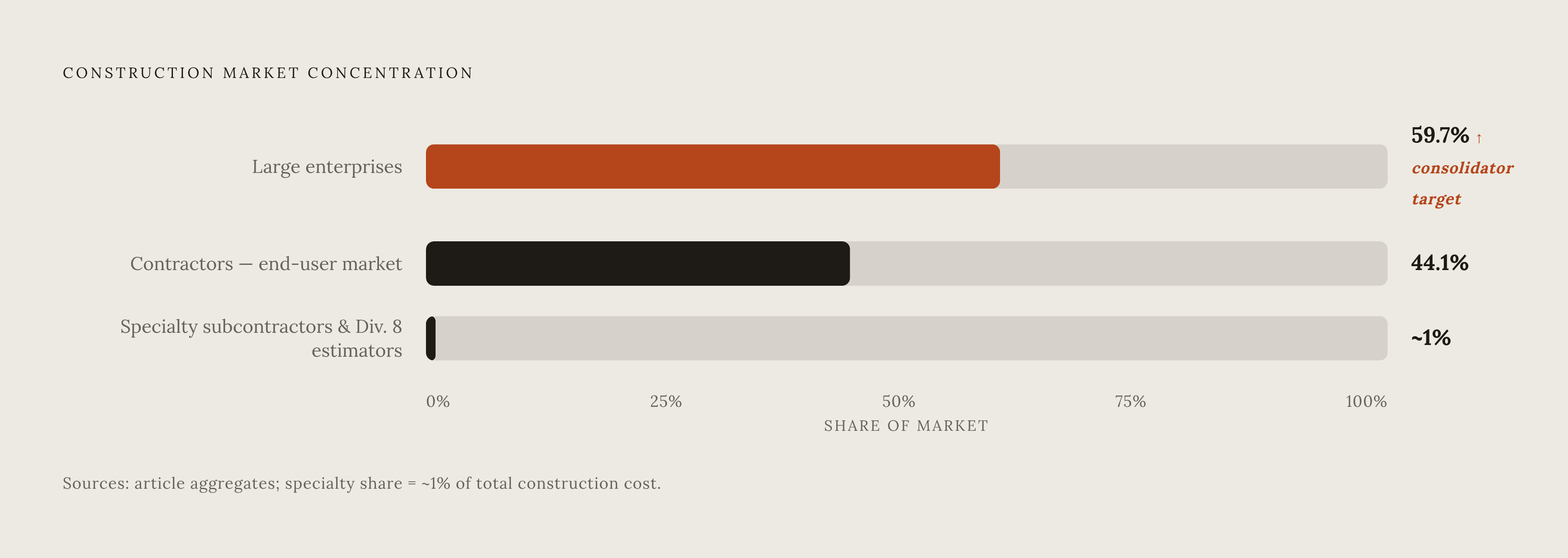
The math behind consolidation always points toward the biggest addressable market first. Contractors make up 44.1% of end users, large enterprises hold 59.7% of market share, and those two numbers alone are what shape a consolidator's product roadmap. Verdantix's read on the current thesis, that consolidation is now about strengthening the connective tissue between existing tools and data, only reinforces the point. That connective tissue is being built around GC workflows, BIM coordination, and cross-trade rollups. It is not being built around reconciling a hardware set against a floor plan and a spec at the same time.
On-premise deployment is projected to grow faster than any other deployment model, driven largely by institutional and government clients who care deeply about data security. That's precisely the segment where Division 8 work gets hardest: hospitals, universities, government buildings, where owner-standard hardware authoring is the rule rather than the exception. None of the acquisition activity so far has moved in that direction, and there's no sign it's about to.
The economics explain why. Building for the segment holding 59.7% of market share and 44.1% of end users is the rational move for any consolidator chasing scale. Building for a trade that represents roughly one percent of total construction cost, no matter how disproportionate its field risk, doesn't clear that bar. Until something changes that math, the platforms will keep getting sharper at the problems general contractors have, and the mismatch buried inside every door schedule, between what gets specified and what an opening actually needs, will keep getting solved the way it always has: by hand, one opening at a time, by someone who can't afford to get it wrong.