Natural Language Specification Parsing in Estimating AI
Machines need to grasp spec structure before they can accurately price hardware.
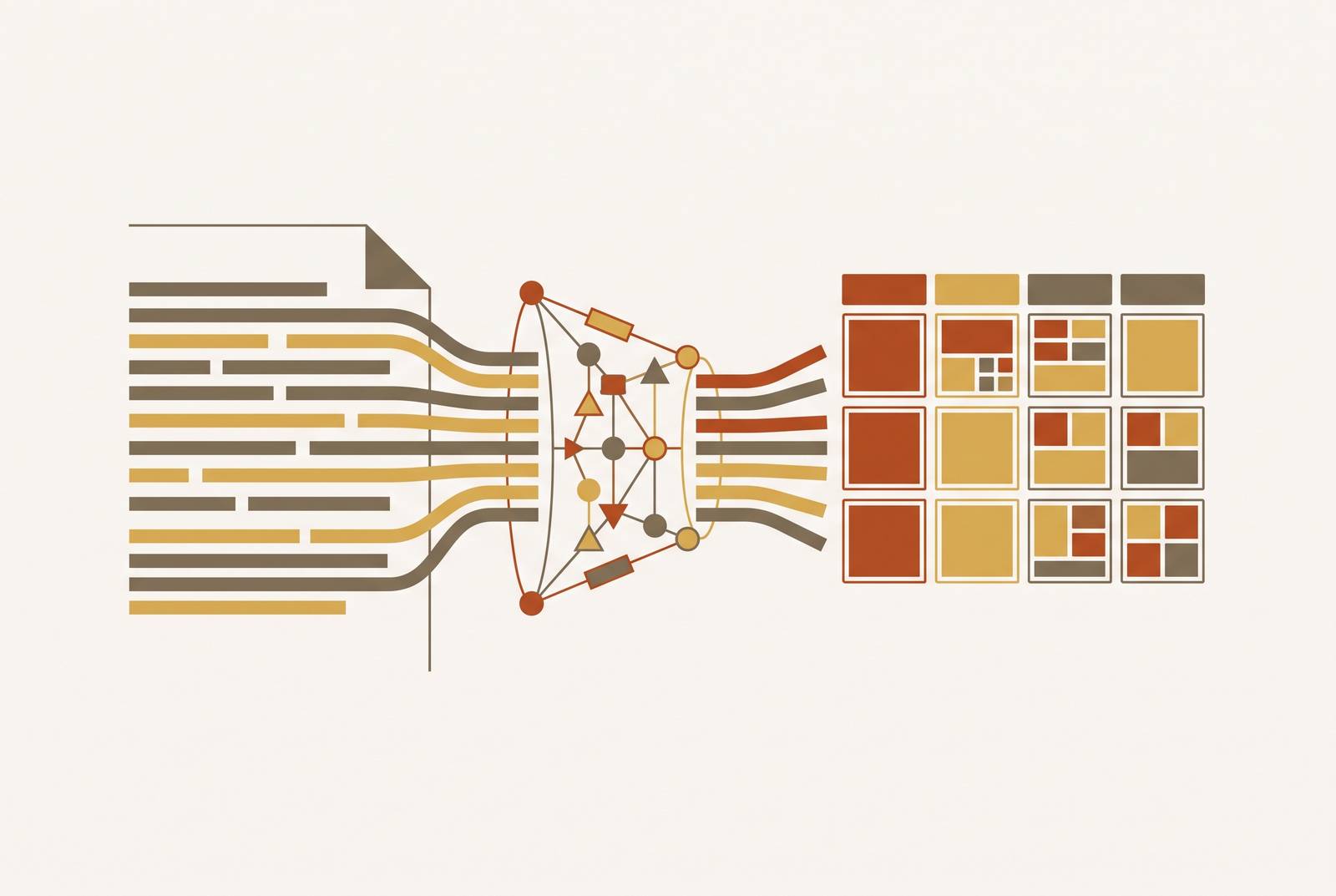
Natural language spec parsing in estimating AI means teaching a system to read a hardware section the way a Division 8 estimator reads it: not scanning for keywords, but working out what a set requires, who's supplying it, and what has to be flagged before pricing. That distinction, interpretation versus extraction, decides whether the output is a usable takeoff or a plausible-looking spreadsheet full of quiet mistakes.
Door hardware estimating sits at an odd intersection of formats. Specifications are written in prose and tables that were never meant to survive export. Drawings are visual. Door schedules are grids that live in a separate file, drafted by a separate discipline, on a separate revision schedule. None of these three documents share a structure, and none of them can be priced correctly in isolation. Section 087100, the hardware schedule embedded inside the spec, looks like a table, which leads most people to assume it's the easy one. It usually isn't one by the time an estimator opens it.
Structural and semantic obstacles that make the 087100 spec harder to parse than it looks
Open a Word-to-PDF export of a typical 087100 section and the hardware schedule will look tabular: rows of items, columns of quantities, finishes lined up in neat vertical bands. Export the document, though, and that alignment is often cosmetic. The column headers, if they existed as real table structure, frequently collapse into flat text during conversion. What's left is a sequence of lines that a human reads as a table because a human can infer structure from spacing and repetition. A parser has to earn that inference; nothing hands it over.
The City of Santa Fe Fire Station No. 2 spec, Section 087100, is public and shows exactly what this looks like on the ground. Set 1.0 covers door 109-1: a removable mullion, two exit devices, a mullion cylinder, surface closers with drop plates, threshold, gasketing, mullion gasketing, sweep, and six hinges. Reproduced as printed, the set runs five columns with no machine-readable headers. Every line in that set needs its finish decoded and its scope attributed before it means anything to an estimator.
Three kinds of line-level ambiguity appear constantly. Finish codes get abbreviated, EN for example, and repeated across dozens of lines in a section without ever being decoded in the hardware article itself. The decoder key often lives elsewhere in the document, sometimes pages away. Scope handoffs are worse: a line tagged for "other trades" has to be excluded from the estimator's number in writing, and missing that tag inflates scope in a way that's invisible until someone reconciles against the actual installed hardware. Then there are blank finishes, lines where no finish is stated. On the Santa Fe spec, a meaningful share of line items carried no finish, which forces a choice: flag it, or guess and hope.
Owner standards make this worse, not better. Three public specs sharing the same section number, Santa Fe, Cornell, and Michigan State, look almost nothing alike once you're inside them. Santa Fe publishes sets with doors assigned and finishes partially stated, but the document has embedded errors: four doors assigned to two sets simultaneously, and nine doors assigned to a set captioned "NOT IN USE." Cornell's format skips finishes, US codes, and BHMA numerics entirely; every hinge line just reads "As Required MK," proximity reader models require a phone call to identify, and power supply lines list neither amperage nor voltage. Michigan State abandons the set structure. Its section runs thirteen pages organized by component type across nine separate tables, which means an estimator has to match each opening's usage to the right row and repeat that match nine times per door.
No single parsing schema survives contact with all three of those conventions. A system has to identify which structural logic a given spec is using, complete sets, partial sets, or component tables, before it can extract a single reliable line. A dispute that predates any software drives this: whether a quantity listed against a hardware set applies per set or per item is contested within the trade itself. Get that backwards on a multi-set project and the resulting takeoff is internally consistent, fully reconciled against itself, and wrong from top to bottom.
How an experienced estimator reasons through a Division 8 spec as a process NLP can replicate
An estimator who's done this work doesn't start reading line one. The first move is figuring out the document's organizational logic: complete sets, partial sets, or a component table like Michigan State's. Only after that does the estimator go looking for the finish decoder and the scope attribution codes, because reading line items before locating those keys means reading them twice.
From there the sequence gets more deliberate. Hardware set headers get read together with door assignments, never in isolation, because a set means nothing detached from the opening it serves. Any door assigned to more than one set gets flagged. Any set marked inactive, like Santa Fe's "NOT IN USE" caption sitting on top of nine assigned doors, gets flagged. Set numbers in the spec get checked against set numbers in the door schedule, because those numbers drift across revisions more often than anyone would like. Every blank finish, every scope handoff, every placeholder model number gets logged as an open question, not priced as a guess.
None of that is data extraction. It's the construction of a picture: what's known, what's assumed, and what needs a phone call or a formal information request before bid day. A mid-size commercial project, three to five floors, can carry somewhere between 180 and 400-plus individual openings, each with its own fire rating, frame type, hardware set, and ADA requirement. A single opening's hardware set can run fifteen or more line items. Multiply that across a few hundred openings and the volume alone is where manual tracking starts to fail, because human attention degrades under repetition in ways that have nothing to do with skill.
This is the process NLP has to replicate, in sequence: identify the schema the spec is using, extract structured records against that schema, and flag the conditions that need a human decision instead of silently resolving them. The point is to get every judgment call in front of the estimator faster and more completely than a manual pass reliably does. It's to get every judgment call in front of the estimator faster and more completely than a manual pass reliably does.
The cross-document reconciliation problem that single-document parsing cannot solve
Specs and drawings come from different people, on different timelines, revised on their own schedules. A hardware set can get revised inside the spec during a late-stage cost review while the door schedule, sitting in a different file under a different discipline's control, never catches up. Reading either document alone, no matter how well, cannot catch that gap. Only reading both against each other can.
Conflicts cluster in predictable places: multi-discipline interfaces, assemblies referenced from more than one spec division, and anything revised late in design. Those are close to the definition of an edge case on a complex Division 8 job: a door schedule notation that reads "similar to Set 3" is a warning label, not a shortcut, because if the opening were identical to Set 3 it would just say Set 3. They're close to the definition of one. A door schedule notation that reads "similar to Set 3" is a warning label, not a shortcut, because if the opening were identical to Set 3 it would just say Set 3. The word "similar" exists specifically to signal a difference, and failing to find that difference is a pricing miss.
Hardware prep coordination failures follow the same pattern. A spec calling for a mortise lockset paired with a door prepped for cylindrical hardware is a conflict that's invisible unless someone reads the hardware spec and the door schedule at the same time, side by side. Read separately, both documents look correct. The mismatch becomes visible only at installation, which is the most expensive place for it to appear. Working from a superseded schedule carries the same risk in a different shape: hardware gets priced that's already been replaced, and the fix is always the same, confirm the current revision before a number goes anywhere near a bid.
Best practice here is to find the conflict, measure what it costs if it goes the wrong way, and log the assumption in writing. It's to find the conflict, measure what it costs if it goes the wrong way, and log the assumption in writing. A system that parses only the spec, or only the schedule, will still produce a takeoff that looks finished. It'll have row after row of clean data. It just won't tell anyone what it missed, because it never had both documents in view at once. Division 01 belongs in this conversation too: general requirements set submittal timelines, allowances, and testing obligations that hardware pricing has to reflect, and skimming that section is a common way estimators miss cost obligations that have nothing to do with the hardware schedule itself.
What Division 8-specific NLP training enables beyond general-purpose parsing
Division 8 runs on its own vocabulary: door marks, hardware set designations, finish codes, frame profile references, fire rating designations, ADA hardware descriptors. A model trained broadly on construction text, without exposure to this specific dialect, will misread these terms or miss them outright, because nothing in a generic training set teaches a system that "OT" next to a hardware line means exclude this from your number.
The conventions that carry real pricing consequences are exactly the ones a general parser has no basis for recognizing. "Similar to Set 3." An "OT" scope handoff. A set captioned inactive that still has doors assigned to it. A blank finish field. None of these are exotic; they're routine in Division 8 documents, but routine only means something to a system that's seen the pattern before and knows what it implies. There's also a physical layer to this: items like kick plates, thresholds, and astragals have to be sized against leaf and opening dimensions, which means a parsing system needs the hardware spec and the physical door dimensions in view simultaneously.
General-purpose tools can extract text from a spec. Extracting text and resolving Division 8 conventions are different tasks, and conflating them is where the trouble starts, because the output from a generic tool still looks structured. It has rows, columns, values. What it doesn't have is the judgment to flag a caption that contradicts a door assignment, and an estimator who trusts that clean-looking output without reverifying it manually has just recreated the workload the tool was supposed to remove. Reducing manual data entry only pays off if it also reduces overlooked specifications, since overlooked specs are what turn into change orders and rework on the other side of an award. The gain that matters is a number the estimator can defend. It's a number the estimator can defend.
The boundary of estimator judgment in NLP-based parsing
NLP surfaces judgment calls. It doesn't make them, and that boundary is the actual shape of what the technology does well versus what it can't do.
Some conditions have no algorithmic answer. A spec conflict where neither document is clearly authoritative needs a question asked before bid day. A hardware item that's clearly specified but discontinued or stuck on a long lead time is a spec that's correct and a market that's moved; a parser can flag the item, but it can't solve a sourcing problem that lives outside the document. An owner-standard spec with no finish listed, the kind that names a standard without spelling out the option chosen, puts the decision back on the estimator: carry an assumption, qualify it, or pick up the phone and ask. A door that shows up on a floor plan but never made it into the door schedule is best handled by counting it off the plan and logging the discrepancy, and while a system can surface that the door exists and the schedule is silent on it, deciding how to carry it in the bid is still a human call.
The assumption log is the artifact that survives all of this. Every judgment call needs to be written down, because the estimator, not the software, answers for what got counted and why when the number gets challenged. NLP parsing speeds up everything that happens before that decision. It doesn't touch who's accountable after it. There's a reasonable argument building across the industry that AI can automate a large share of the mechanical work in construction estimating, but the calls that actually win or lose a bid still belong to someone who's done this long enough to know which flags matter. The goal is getting the estimator to the judgment calls faster, with fewer of them missed along the way. It's getting the estimator to the judgment calls faster, with fewer of them missed along the way.
The effect of faster, more consistent spec parsing on bid volume and estimating capacity
Custom frames, specialty glazing, and electrified hardware routinely carry lead times of eight to fourteen weeks. A missed item caught after award isn't just a cost overrun at that point, it's a schedule problem, and schedule problems on a hardware package tend to cascade into the trades waiting on that door to close out. Speed of takeoff, in other words, is a competitive necessity. It's frequently the difference between a contractor being able to pursue a job within its bid window at all and having to pass.
Winning more bids, for most estimators, comes down to quoting more jobs, not working longer hours on the ones already in front of them. Compressing the time a spec review takes is the actual mechanism that makes higher bid volume possible without adding headcount, and it matters more now than it might have a decade ago. An AGC/NCCER workforce survey found that 92% of construction companies struggle to fill open positions, with estimating roles among the hardest to staff, cited by 77% of firms specifically looking to hire for them. When the labor market can't supply more estimators, throughput per estimator becomes the only lever left.
Smaller distributors and operators have historically lacked the estimating depth that large contracting firms could afford to build in-house. Parsing technology narrows that gap, because the leverage a well-trained system provides doesn't scale with firm size the way a large estimating department does. Padded contingencies built to cover a sloppy takeoff lose bids against tighter, better-documented numbers, and a parsing process that flags every conflict and logs every assumption is what makes a tight number defensible rather than reckless.
The compounding effect changes the total cost of bidding, affecting every downstream stage of the job. More bids submitted, fewer errors carried forward into the field, fewer change orders showing up after award, each of those reduces the cost of being wrong somewhere upstream. None of them, on their own, look dramatic. Together, over a season of bidding, they're the difference between an estimating team that's keeping pace and one that's quietly falling behind.