AI Accuracy in Division 8 Takeoffs vs General Estimating Tasks
Specialized Division 8 software catches matching errors that general AI tools miss.
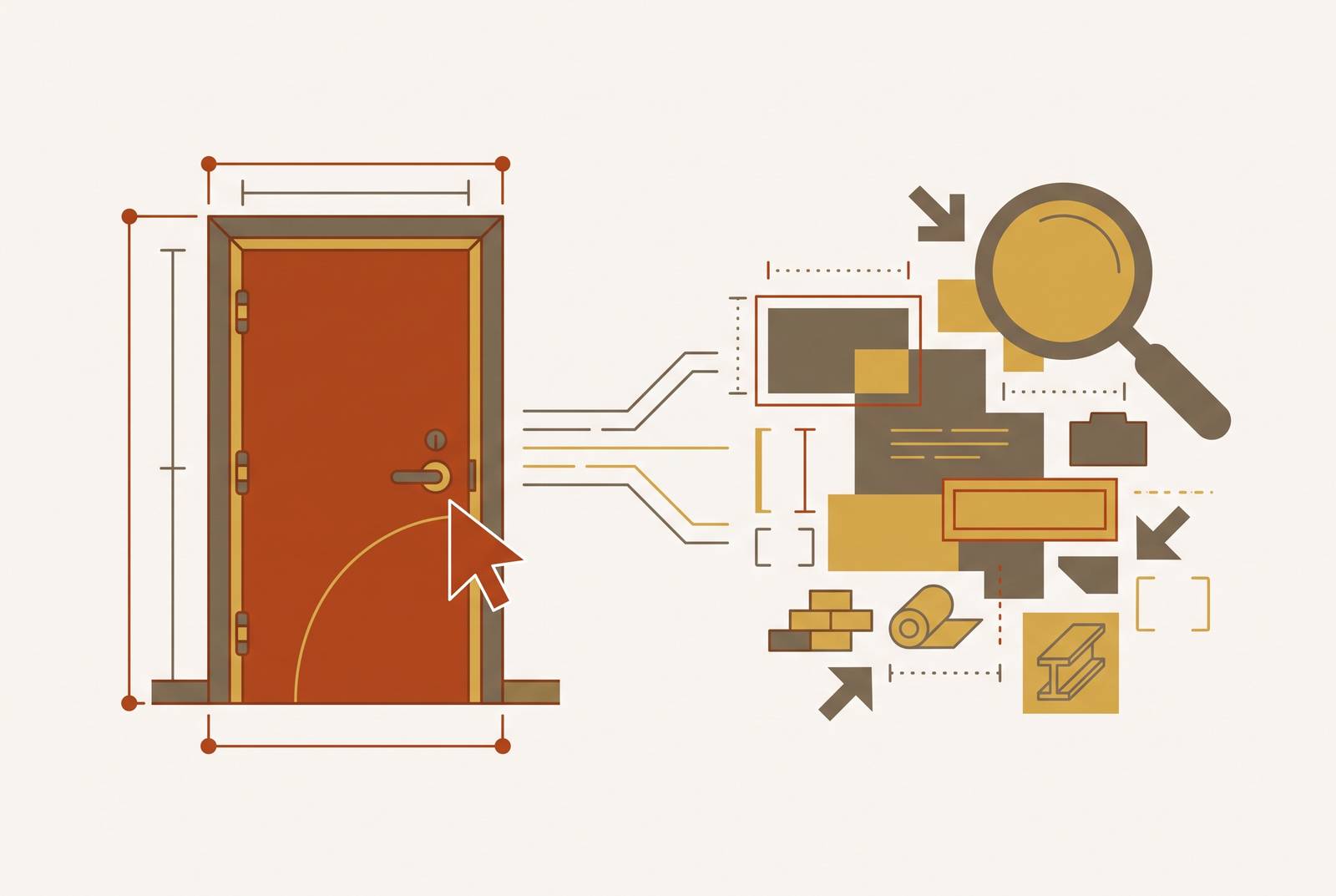
Division 8 estimating comes down to counting and matching, not measuring, and that distinction explains why general-purpose takeoff software struggles with it in a way it doesn't struggle with drywall or paint. A door opening is a bundle of interdependent decisions. It's a bundle of interdependent decisions, door type, frame type, fire rating, hardware set, handing, ADA status, and every one of those has to match across five separate documents before the number is even usable. AI built specifically for that matching logic produces fewer errors than general tools asked to do the same job, because the job itself is structurally different from what those tools were designed to solve.
How the takeoff works: five document types that must be read simultaneously
A Division 8 takeoff doesn't come from one document. It requires the floor plan, the door schedule, the window schedule, the hardware schedule, and the Division 8 spec section, all open at once, all cross-checked against each other. Schedules get outdated. Plans get revised after the schedule was printed. Trusting either source on its own is where most missed items start.
The math behind a clean opening count looks like this: plan count plus schedule-only units, minus duplicate counts, minus excluded units. It's a reconciliation, and it only works if someone actually compares the two sources rather than assuming one is right. It's a reconciliation, and it only works if someone actually compares the two sources rather than assuming one is right.
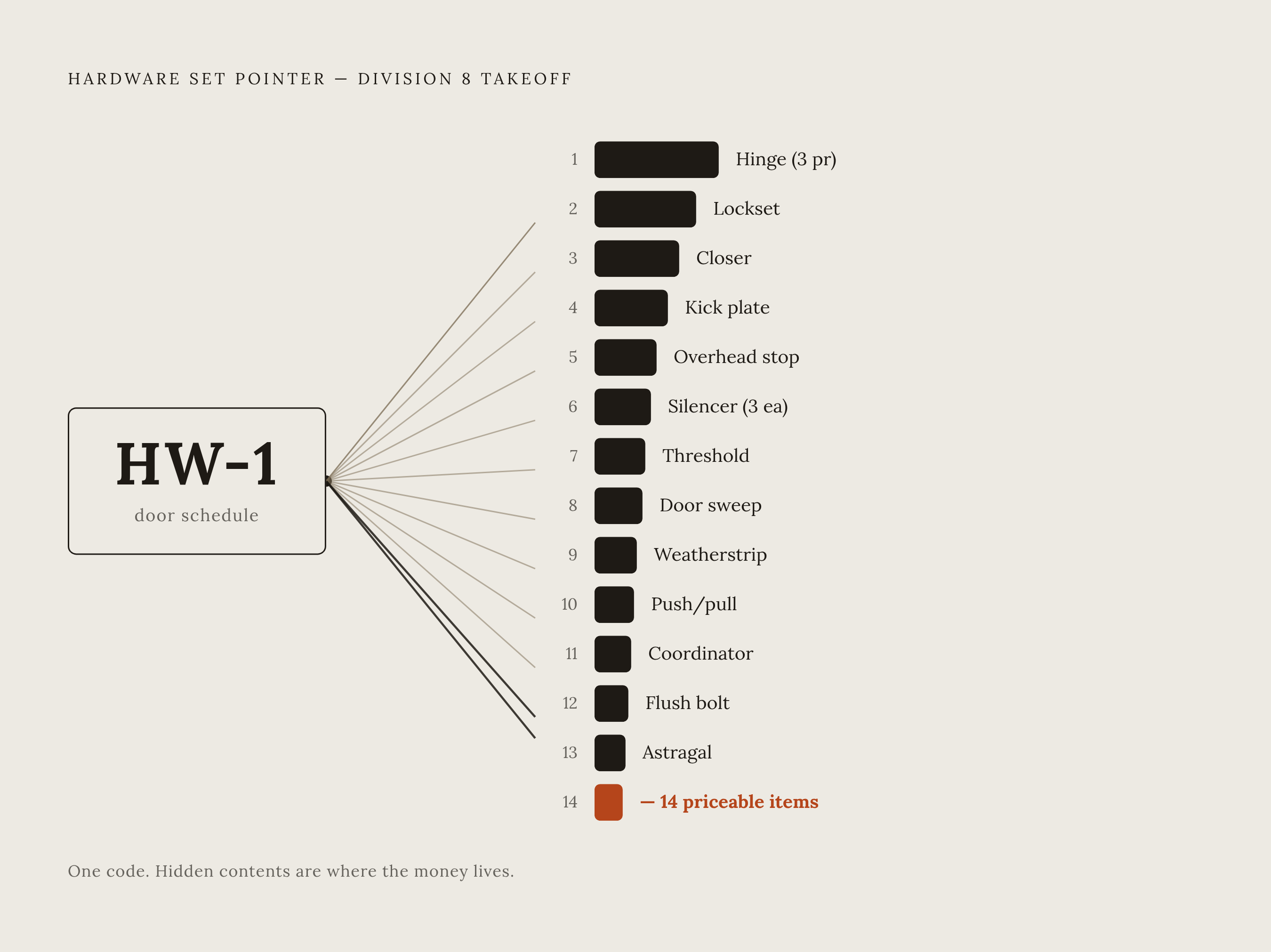
Hardware adds a second layer on top of that. Each door on the schedule carries a hardware set designation, HW-1, HW-2, and so on, and that single code points to a full set definition sitting somewhere else in the spec. One number on a schedule can stand in for as many as 14 line items once you go find where it's defined.
Division 8 doesn't stay inside its own lane, either. Frames sit in metal stud walls governed by Division 5. Electrified hardware ties into Division 26 electrical work. Access control touches Division 28. Coordination notes for all of that live outside the Division 8 document set entirely, which means an estimator working only within Section 08 is already missing context.
The usual QA step is a second reviewer checking counts against the schedule, if the schedule lists a door count, the takeoff better match it. But that check only catches errors in the count. It does nothing if the underlying reconciliation between plan and schedule was wrong to begin with. And the raw document set an estimator opens on day one can run hundreds of pages. Someone has to locate the relevant line, then retype it, cell by cell, and on a larger project that process eats days, sometimes weeks.
Where manual reconciliation breaks down: the specific failure modes
Set number mismatches are the most common failure. The hardware set referenced on the door schedule doesn't match the set defined in the hardware spec, and nothing about the mismatch is visible unless someone is actively cross-referencing both documents at once.
Missing a single line item is quieter and just as costly. Leaving the door closer off 60 doors means the estimator has left roughly five figures on the table, without a single bad unit price anywhere in the takeoff. Nothing about that error announces itself.
Then there's a dispute that surfaced publicly in 2025, when detailer Emilio Bendever flagged that at least one estimating platform was submitting total quantity across an entire hardware set rather than quantity per door, which makes the numbers nearly impossible for an architect to review against the schedule. Lori Greene, Manager of Codes and Resources at Allegion, confirmed the trade convention is quantity per opening. The Santa Fe Fire Station No. 2 specification backs that up directly: it states that quantities listed apply to each pair or single door. Yet the convention still sits unsettled between the field's certifying body, its most-cited code authority, and its most widely used software. Get it backwards on a project of any scale and every downstream number is wrong by a multiple. Nothing looks broken, because the figures stay internally consistent with each other, just consistently wrong.
Blank finish fields are their own quiet hazard. In that same Santa Fe hardware schedule, 233 lines long, 83 items carried no finish at all, every gasketing line, every threshold, every sweep, every silencer. Each of those blanks is a price the estimator has to invent on the spot, under deadline. It's a price the estimator has to invent on the spot, under deadline, and that invented number gets baked into the bid as though it were sourced.
Because most teams work one document at a time, a contradiction between a spec note and a schedule line can slide straight through pricing and land in the submittal package without anyone catching it. And late addenda make the whole thing worse: hardware sets can change two days before bid day, and any process that already locked in its counts has to tear back through the affected pages and start over.
What a real hardware specification contains and why it resists general-purpose parsing
The Door and Hardware Institute's Sequence and Format standard governs how hardware specs get written under Section 087100, and in most published specs the resulting layout carries no column headers. The document is reproduced exactly as printed, formatting quirks included.
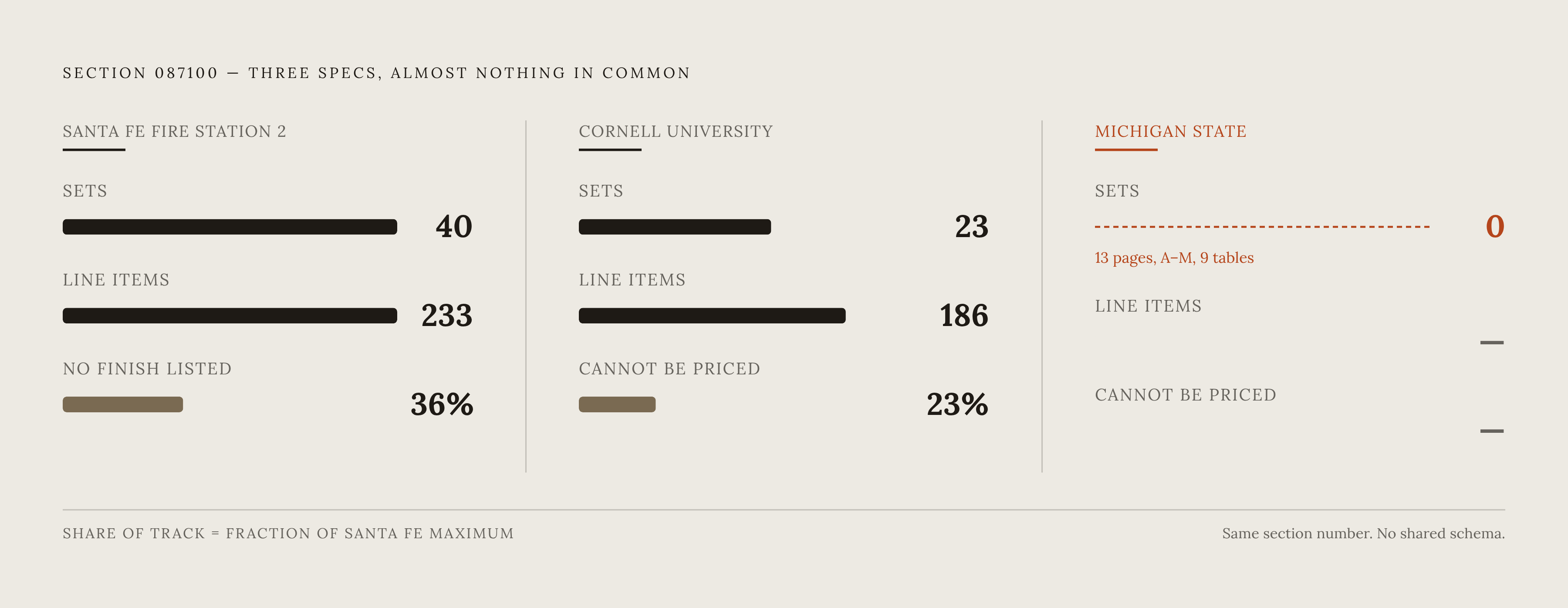
Santa Fe Fire Station No. 2's Section 087100 shows what that looks like at full complexity: 40 set headers, 34 of them live, 233 line items spread across those sets, and 76 doors assigned to them. A typical set runs 5.8 line items. Set 1.0, the most complex exterior opening, runs 11 items sourced from three separate manufacturers, McKinney, Sargent, Pemko, plus one line marked OT, which belongs to somebody else's scope. Only 64% of line items in that schedule carry a stated finish. The rest, 36%, carry none. Four doors are assigned to two sets at once in that schedule. Nine doors get assigned to Set 8.0, which is captioned "(NOT IN USE)." Read the caption and those nine openings carry nothing. Reading the door list as the authority instead means the estimator owes 63 line items for doors the spec says don't exist.
Cornell University's published spec runs a different way entirely: 23 sets, 186 line items, and not one finish stated anywhere, no US codes, no BHMA numerics. Every hinge line just reads "3 3 Hinge As Required MK." Six proximity reader lines instruct the estimator to call and get the model number by phone. Of the 186 line items, 43, about 23%, carry nothing that can actually be priced from the page.
Michigan State's spec abandons the set structure. There are no sets. It's a 13-page section organized A through M by component type, spread across nine tables, and an estimator has to match usage to the right row and repeat that process nine separate times per opening.
Three public specs, same section number, 087100, and almost nothing else in common structurally. A parser trained to expect a standardized schema has no stable shape to hold onto here, because there isn't one. And even the finish codes themselves aren't standardized: US32D is the traditional designation used in one national convention. designation for a finish, 630 is the BHMA numeric for that same finish family, and proprietary manufacturer codes often go undefined. EN shows up 19 times in the Santa Fe section, and Article 3.8.C decodes it as a manufacturer abbreviation, not a finish code.
The added complexity institutional jobs bring that general tools miss
Universities, health systems, and state agencies publish their own master specifications for Division 08, and those standards constrain product selection well beyond whatever the individual project spec says.
The University of Houston issues a master Section 087100 template that applies to every AE project on campus. The University of Kentucky runs a Section 087100 Access Control and Door Hardware Standard across both its main campus and its healthcare campus, and the standard is explicit that it won't appear in the contract documents themselves, the design team has to build it in manually, and any exception needs sign-off from the Capital Projects Project Manager and the UK Police Department. The University of North Texas keeps its own Design and Construction Standards with Division 08 71 00 as a named section. The University of Texas at Austin runs its own Design and Construction Standards covering multiple campuses and facilities. Some major academic medical centers maintain their own facilities management design guidelines with dedicated hardware specification guidance for renovation work. Some state facilities agencies name actual manufacturers, model series, and finish standards in their door hardware specs, prescribing specific products rather than leaving selection to the design team. Some health sciences campuses cite detailed testing standards for exit devices, specifying grade levels and cycle ratings from independent lab testing.
None of that lives in the project's Division 8 spec section. An estimator working an institutional job has to know the owner standard exists, find it, and author the takeoff against it, which is a fundamentally different task than extracting quantities from the drawings in hand. Institutional owners also weigh total cost of ownership, maintenance, energy use, life cycle cost, which makes substituting away from the standard nearly impossible and creates a separate quoting reality for hardware distributors working these jobs. A general-purpose AI tool has no way to pull in a standard that was never part of the document set it was fed.
What makes AI accurate at Division 8, and where general-purpose tools fall short
General takeoff software gets built for measurement trades. It digitizes a drawing and measures length, area, or volume. Division 8 was never a measurement problem, so a tool built for measurement is solving the wrong problem the moment it's pointed at a door schedule.
Applied to Division 8, a general tool typically works through one document at a time. It can count doors off a floor plan. It can pull line items from a schedule. What it can't do is hold both open simultaneously and flag the gap between them.
Getting Division 8 right requires ingesting the floor plan, door schedule, window schedule, hardware schedule, and Section 087100 spec all at once, and recognizing that a hardware set code on a door schedule is a pointer, not a value, that has to be joined to its full definition somewhere else in the document. It requires understanding the trade's own data structures: five-column sets with no column headers, finish codes that shift between naming conventions from one spec to the next, scope exclusions hidden inside a two-letter manufacturer abbreviation like OT. It requires catching internal contradictions on its own, four doors claimed by two sets, a set header marked "NOT IN USE" that still has doors assigned to it. And it requires treating a blank finish field as an unpriced risk rather than an empty cell to skip past.
The quantity-per-opening dispute is a good stress test for this. A general tool built for measurement has no grounding in trade-specific conventions like this, and no mechanism for flagging when its output departs from them.
Fire ratings compound the problem further. Five standard commercial ratings, 20, 45, 60, 90, and 180 minutes, each carry their own requirements for door construction, frame prep, hinge type, closing device, and seal package. A general tool can read the rating label off a schedule easily enough. It has no way to check whether the hardware set actually assembled for that opening satisfies what the rating demands.
Speed follows naturally from that structure, it isn't a separate feature bolted on top. When a system holds every document in one relational model instead of parsing them one at a time, it doesn't need a second manual pass to catch what the first pass missed. Accuracy and speed come out of the same design decision.
Material cost volatility in 2025-2026 and its effect on takeoff precision stakes
Aluminum mill shapes rose 30.5% over calendar 2025, and steel mill products rose 17% over the same stretch, both the steepest increases since 2022. The broader nonresidential input index climbed 3.3% across that same period. None of that is background noise for Division 8 specifically, but it raises what a missed item actually costs.
Section 232 duties now apply against full customs value rather than metal content alone, and they don't land evenly. On a single opening, a frame might carry one duty rate, a closer another, and a lockset none at all, and a general tool has no way to model an asymmetry like that.
Price books lag the market on top of it. Someone has to digitize, validate, and load manufacturer pricing on a quarterly release cycle, and pricing systems can lag the manufacturer's actual book by a meaningful margin. Items new to a database carry no purchase history at all, so a schedule with a meaningful share of unfamiliar items is one the estimator hasn't really priced before, whatever the software shows on screen.
Put together, a missed item costs more than it used to. A stale price costs more. A blank finish field left to the estimator's judgment turns into a larger invented number than it would have been two years ago. Margins have compressed enough that the contingency padding that used to absorb these errors doesn't stretch as far as it once did. Institutional work, which already carries the owner-standard burden described above, is exactly where cost overruns draw the most scrutiny.
Domain-specific AI takeoff in practice for a Division 8 estimator
The practical benchmark is straightforward: a full Division 8 takeoff that used to eat a full day, or several days on a large job, completing in a fraction of that time. That gap doesn't come from counting faster. It comes from removing the manual, document-by-document reconciliation step that ate most of the time.
Done right, the output isn't a set of separate lists pulled from separate documents, it's one joined record per opening, built from the door schedule, floor plan, spec section, and hardware sets all at once. Items like kick plates, thresholds, and astragals get sized against the actual opening record instead of copied off a template that may not fit. Openings can be located on the floor plan, tagged by configuration, and checked against the door schedule as part of the same process. And where an approved alternate exists, the system can draw on catalog data to support that comparison, which compresses the time value engineering would otherwise require it used to take when someone had to run that comparison by hand.