How AI Reads Construction Documents vs Human Estimators
AI excels at volume counting but humans must validate the judgment calls.
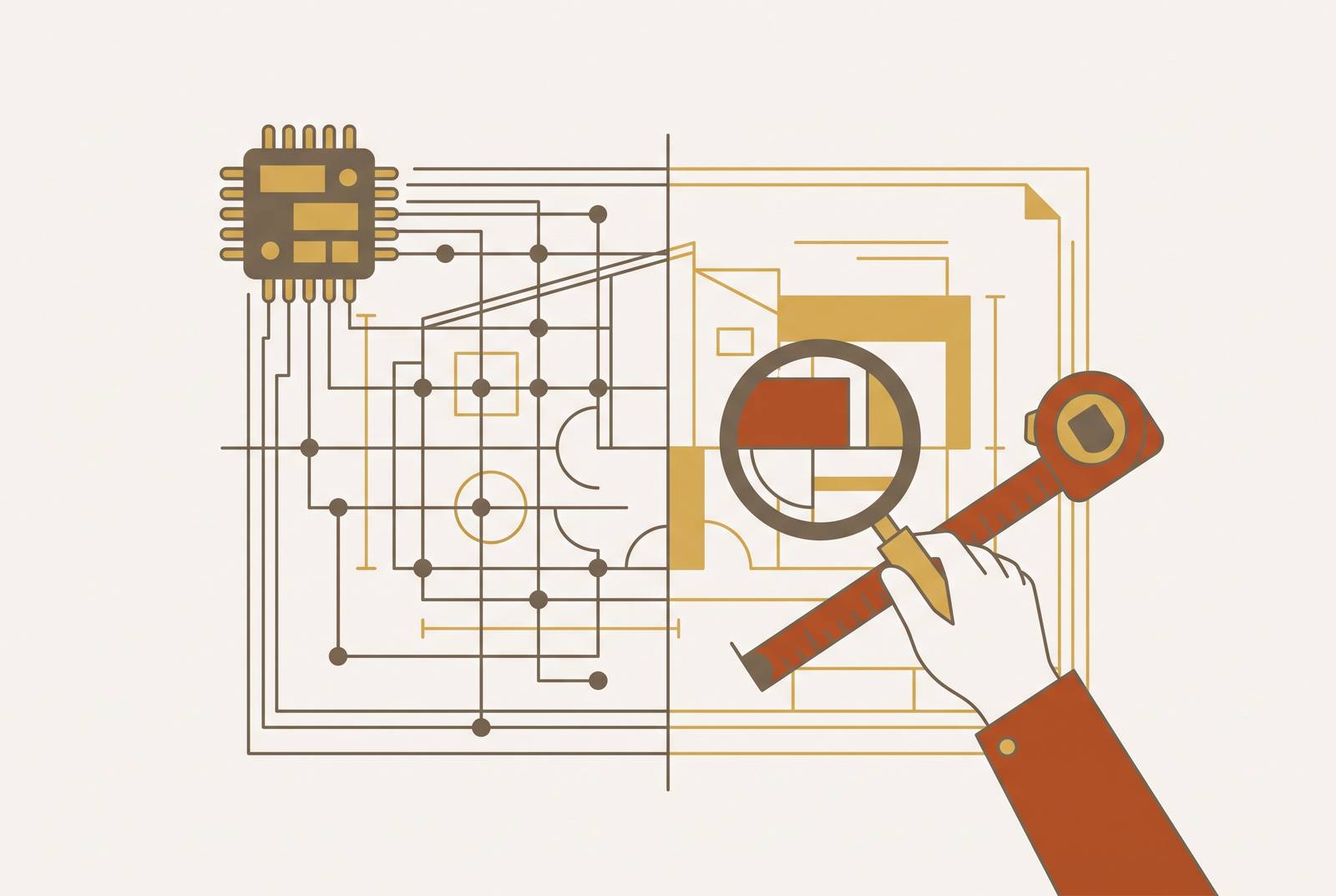
Division 8 covers doors, frames, hardware, glazing, storefronts, curtain walls, and every specialty opening assembly in between, and on a mid-size commercial job that means 180 to 400-plus individual openings, each one carrying its own fire rating, hardware set, and code requirement. AI and human estimators approach this same document pile in fundamentally different ways, with different strengths and different blind spots, and the gap between the two explains why AI can rip through Division 8 volume work while a person still has to sign off on the calls that actually decide whether the bid holds up.
How a trained human estimator reads a Division 8 document set
The workflow is sequential, and it has to be. An estimator reviews the full drawing set and specs, walks the floor plans level by level, sorts by type and material, counts hardware sets, applies fire ratings and code requirements, pulls pricing, and builds the bid summary before running a final QA pass against the schedule totals.
The step that generates most of the errors is matching each door to its hardware set. That means listing every hinge, closer, lockset, push-pull, and threshold for that opening, and doing it while holding three separate documents in mind at once: the floor plan tells you where the door sits and what's around it, the door schedule gives size, material, fire rating, and a hardware group number, and the 087100 hardware spec translates that group number into the actual products. When those three don't agree, that's where installation problems start on site.
A trained estimator brings real judgment to this. Recognizing that a corridor door labeled "standard" actually sits inside a smoke compartment and needs a different rating, filling in what the spec implies but never states outright, knowing that a certain hardware group number on a hospital job is almost certainly wrong for the door type shown on the plan. None of that comes from a training manual. It comes from having done the work long enough to spot when something looks off.
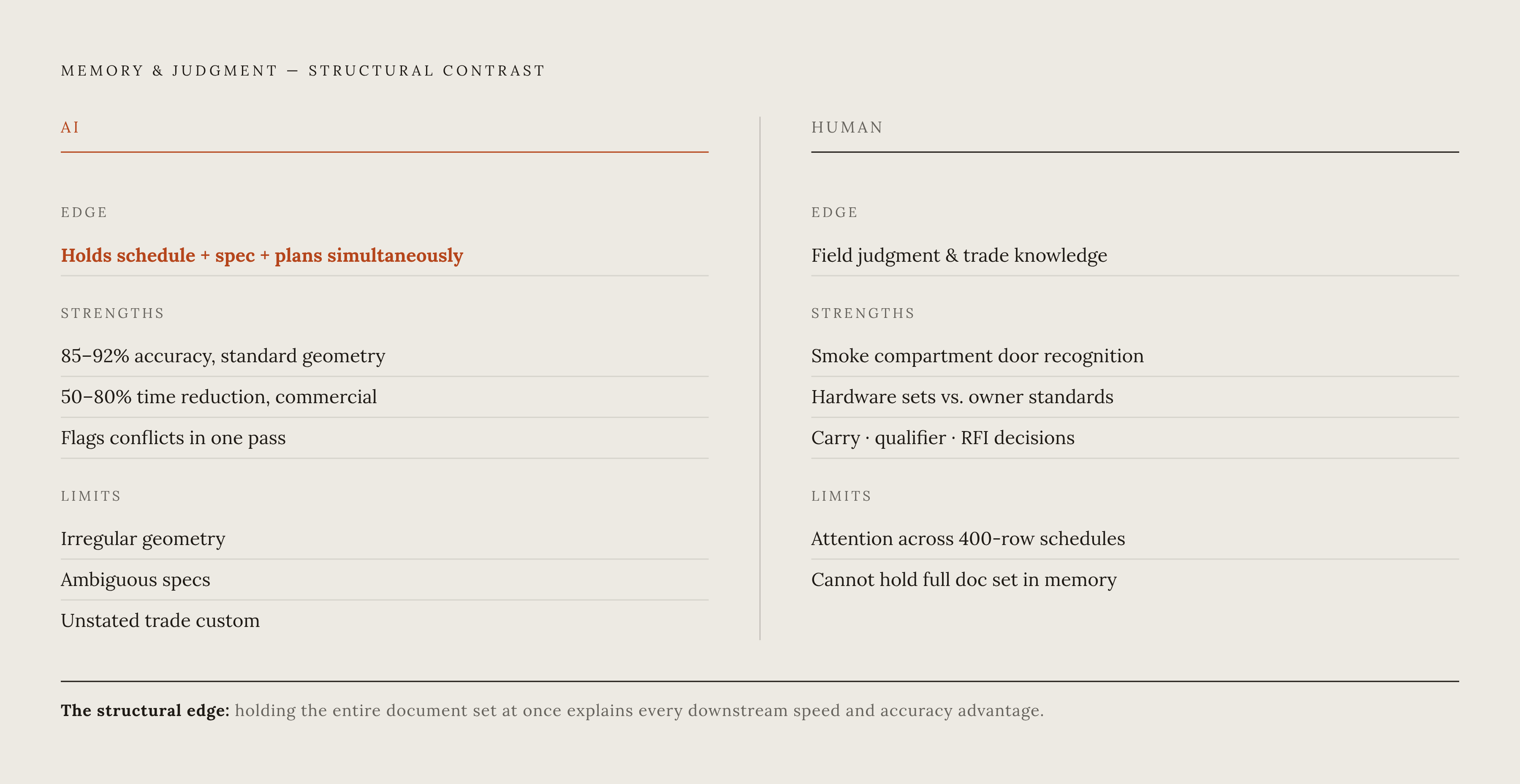
But the failure modes here aren't about individual skill, they're structural. Attention drifts across a door schedule with hundreds of nearly identical rows. Finish codes go missing: a hardware specification can carry no finish designation at all on a significant share of its line items, including gasketing, thresholds, sweeps, and silencers. Proprietary manufacturer codes can appear without definition anywhere in the document set. And because the process runs document by document, a conflict between the schedule and the spec only gets caught if the estimator happens to have both open at the same moment. No person can hold 400 door rows, 20 hardware sets, and a 200-page spec in working memory at once, and that's not a training problem. It's a limit built into how the process is structured.
What AI is doing when it processes the same documents
AI estimating tools aren't one technology, they're several stacked together, each doing a distinct job. Optical character recognition reads and extracts text and symbols off scanned drawings and PDFs. Computer vision identifies geometry, room boundaries, wall runs, opening counts, and it handles rotated or buried dimensions across multi-sheet sets without losing track. Natural language processing reads the spec text itself and maps that language to cost items. Machine learning recognizes repeating symbols, door tags, hardware group markers, fire-rating flags, across hundreds of sheets in a single pass.
The structural difference that matters most: when a document set fits inside the model's context window, the schedule, the spec, and the plans get held together at once. A conflict between them doesn't require the reader to remember a page buried early in the document while looking at one much further along, it surfaces automatically as a flag. Dimensional interpretation across drawings is applied consistently, a step that a tired human estimator can get wrong under deadline pressure. Schedule verification against floor plans, catching missing tags and fire-rating mismatches, can occur within the same read rather than as a separate QA pass tacked on afterward.
None of this is flawless. Reported accuracy on straightforward building geometry runs 85 to 92%, dropping on complex multi-level layouts. On clearly written specifications, Claude has shown 80 to 90% accuracy on construction documents. And AI doesn't infer local trade custom or jurisdiction-specific rules unless they're written into the documents themselves, what's unstated simply isn't supplied. What it does provide, consistently, is traceability: every quantity in the output links back to its source drawing, schedule line, or note, something manual takeoff never produces on its own.
Where AI outperforms humans on Division 8 volume work
The tasks where AI has a real structural edge happen to be the tasks that dominate Division 8 work. Counting repetitive items, doors, hardware tags, fire-rating symbols, across hundreds of sheets without attention drift. Reconciling every door schedule row against its hardware spec entry at once instead of one door at a time. Flagging missing tags and finish gaps as a standard part of the output rather than a function of how sharp the estimator's eyes still are by page 47.
On straightforward floor plans with typical materials, AI estimates have landed within 5% of human-generated numbers in tested scenarios, so the speed isn't coming at the cost of accuracy. Firms using AI takeoff tools have reported time reductions of 50 to 80% on complex commercial projects. The finish code example makes the case well: on that 233-line spec with 83 items missing a finish designation, a simultaneous read across the full document flags every unresolved line in one pass, while a human working row by row may never make it that far with full attention intact.
Hardware sets average 5.8 line items apiece, ranging from just 2 on a roof hatch to 14 on a card-access exterior door, and AI holds that variance steady across every single set on the job. Human focus, understandably, compresses as the count climbs into the hundreds. That speed gain isn't just a convenience either, it changes what's possible on the bidding side: an estimator who can process more document sets in a given week can quote more jobs, and that's a real path to winning more work without adding more hours. The traceability piece lets outputs reference their own source sections, which makes internal QA and any post-bid review faster and easier to defend.
Why AI cannot substitute for humans who still own the process
Accuracy drops off fast on exactly the conditions that matter most in Division 8. Irregular geometry, borrowed lights, sidelights, non-rectangular openings, complex multi-level schemes. Specs written ambiguously, a line that just says "finish 4.0" can read as metric or imperial, and the material cost swing between those two readings is real money. Proprietary manufacturer codes with no definition anywhere in the document. Trade custom and local code requirements that never made it onto the page, AI has no way to infer a standard it was never shown.
The judgment calls in this work stay firmly human. Deciding whether to carry, qualify, or send an RFI when the schedule and spec contradict each other. Recognizing a hardware group assignment that just looks wrong for the door type in front of you, a read that comes from field experience, not from parsing text. On institutional jobs, authoring hardware sets against an owner's internal standard rather than just extracting what the project spec says, that's an interpretive act, not extraction. And risk sits with a person too: what an exclusion actually means, what a scope gap does to bid exposure, whether an addendum quietly changes the whole basis of the takeoff.
AI surfaces the conflicts faster, and that's the real value, not eliminating the judgment call but making sure it never gets missed in the first place. Every AI-generated output still needs a human review pass before anyone bids off it, measurement rules, inclusions, exclusions, edge cases all need confirming. A reviewed AI takeoff is safer than one nobody checked, but an unreviewed one still isn't a finished takeoff. Final bid validation, pricing decisions, project interpretation, all of that stays with the estimator. AI hands over a cleaned and flagged starting point. It doesn't hand over a signed estimate.
Why general-purpose AI tools fall short on Division 8 specifically
A general-purpose AI tool counts openings. It doesn't understand the relationship between a door schedule row, a hardware group number, and the 087100 spec section that defines what that group actually contains, and that relationship is the entire job. Counting doors on a floor plan is a small subset of what Division 8 demands, the hardware reconciliation, the finish resolution, the fire-rating cross-check, the ADA flag, and that is the work that actually determines whether the bid is accurate.
General tools tend to struggle with the document types Division 8 throws at them constantly: hardware schedules with no column headers and finish codes mixed across systems (US32D next to 630 next to a manufacturer's proprietary code), partition schedules and elevation drawings carrying opening information that never appears in the door schedule at all, and owner standards documents on institutional jobs, a document type general tools have no real framework for handling.
Broad testing of general large language models on construction documents has shown 65 to 75% accuracy on architectural PDFs for ChatGPT's paid tier, and 80 to 90% on clearly written specs for Claude, but Division 8 specs are often neither clean nor consistently formatted. A model trained mostly on broad construction data has simply seen far more concrete and MEP takeoffs than hardware sets, and what a model has seen most shapes what it recognizes reliably. A 2025 survey of more than 2,200 construction professionals by RICS found just under 12% used AI regularly in any specific process, which suggests the firms getting real value are the ones applying it to the document type it actually fits, not spreading it thin across every estimating task. The accuracy gap between a general tool and something built specifically for Division 8 is widest exactly where the documents are most specialized: hardware specs, finish schedules, owner standards. A platform built to understand the difference between a project spec and an owner standard, to read hardware sets as structured data instead of loose text, and to cross-reference schedule, plan, and spec at the same time is doing fundamentally different work than a tool that just counts symbols on a page.
What the human-AI division of labor looks like in a working Division 8 takeoff
In practice, the estimator uploads the door schedule, floor plans by level, the 087100 spec, partition schedules, and any owner standards documents. The AI reads everything together: every door row gets matched to its hardware group, every group gets expanded into its full line-item list, and conflicts, missing finishes, and rating mismatches all come back flagged in the output. What lands on the estimator's desk is a structured takeoff with problems already marked, not a blank schedule waiting to be filled in from scratch.
From there, the estimator reviews the flagged conflicts and decides what to carry, qualify, or turn into an RFI. Trade knowledge gets applied to the edge cases AI couldn't resolve on its own, a hardware group that doesn't fit the door type, an owner standard that overrides what the spec says. Pricing gets checked against current vendor numbers, and the bid summary gets built with assumptions and exclusions stated in clear terms.
QA changes shape too. Instead of a second estimator re-checking the whole document set for anything missed, the reviewer works through a prioritized list of flagged discrepancies, a narrower and faster review. Every quantity still traces back to its source page, so the estimate holds up if a scope question comes up after the job's awarded.
A takeoff that once consumed many hours can be completed significantly faster once AI handles extraction and cross-referencing, and the estimator's time shifts almost entirely toward the judgment calls that decide whether the bid is both accurate and competitive. That opens up bid volume too, faster cycle times mean a solo estimator or a smaller distributor can quote more jobs in the same stretch of time, closing a gap that used to favor only the larger firms with bigger estimating teams. Guard against treating the AI output as a finished product instead of a reviewed starting point. The human sign-off on flagged conflicts is mandatory. It's the step that turns the speed gain into something reliable instead of something risky.