AI Confidence Scores in Construction Takeoff Output
High-confidence AI detections still miss what specs don't show on drawings.

A confidence score in a construction takeoff tool answers one question: which line items in an AI-generated quantity list can an estimator trust, and which ones need a human to check them by hand. That distinction matters more in Division 8 than almost anywhere else in a bid set, because a door and hardware schedule hides most of its risk in places a plan sheet never shows. Vendors quote accuracy figures in the high 90s, and independent testing has confirmed some of those claims while leaving others unverified. The confidence score, not the marketing sheet, is what an estimator should actually be reading.
What a confidence score is and what it represents in a takeoff
A confidence score is a probability estimate, generated per item, reflecting how sure the model is that it found what it was trained to look for. A 92% score on a detected door opening means the model is fairly certain it identified a door on the sheet, and that's the whole claim it makes. That's the whole claim it makes. It does not confirm that the hardware set assigned to that door is correct, that the fire rating matches the schedule, or that the frame type got captured correctly.
That gap matters more in Division 8 work than in most trades, because a drawing shows geometry, an opening, a swing direction, a rough leaf size. Hardware specifications, including group assignments, grade requirements, finish codes, and keying instructions, are documented separately, typically in a dedicated spec section. The score measures certainty about what the model saw on the page. It says nothing about whether the takeoff data attached to that item is complete.
Each detected symbol or schedule line carries its own score. There's no single number for the whole job, and a tool that reports one is flattening information an estimator needs to do the work. An old-school estimator would recognize the shape of it: a red flag stuck on a manual takeoff sheet, telling the checker which items to look at first. It doesn't say which items are wrong.
How the three confidence tiers translate to estimator workflow
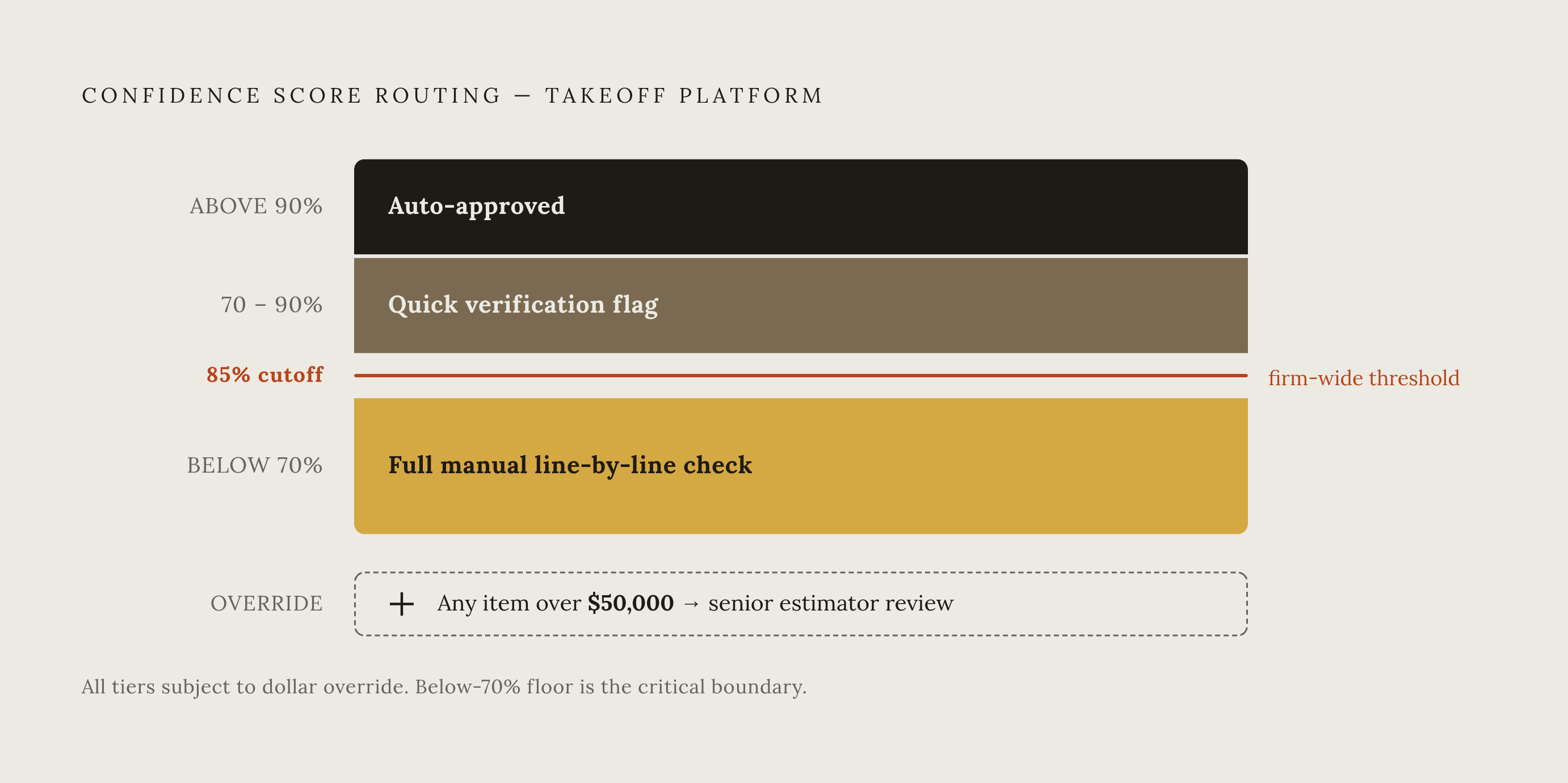
Most credible takeoff platforms sort detections into three bands. Above 90%, an item gets auto-approved. Between 70% and 90%, it gets flagged for a quick look. Below 70%, it needs the same line-by-line manual check an estimator would have run before AI entered the picture.
Done right, this cuts full manual review down to roughly 5% to 10% of the takeoff. The software absorbs the volume, and the estimator supplies judgment where judgment is actually needed. Firms that use this well don't leave the threshold to individual preference: expert guidance recommends setting 85% as the manual-check cutoff, so quality doesn't depend on who's running the job that week.
A dollar-value rule needs to run alongside the confidence threshold, because a score alone can't carry this weight by itself. Anything over $50,000 gets senior estimator review no matter what the AI scored it. A high-confidence detection on an expensive assembly is still worth a second set of eyes, given what's riding on it.
None of it works without an audit trail. The software has to show which symbols on which sheets fed a given count, or "verification" just becomes a recount, and the entire point of tiering confidence scores collapses back into doing the job twice. The most reliable way to calibrate any of this to a real workflow is a parallel run: three to five projects worked manually and through the tool side by side, on the same bid set, watching for where the scores hold up and where they quietly don't.
Where confidence scores reliably fall in Division 8 document sets
On clean, vector-based PDF plans, the leading platforms perform well. Independent testing found InEight Estimate landing within 1.8% of ground-truth quantities, a strong result by any measure. What gets left out of that pitch: an 8% to 12% error rate on dense, heavily annotated commercial sets is still common, and a Division 8 set qualifies as dense almost by definition.
Confidence scores fall apart fast under conditions that show up constantly in door and hardware work. Scanned sheets with poor resolution, door symbols that don't follow a standard convention, structural annotations sitting directly on top of a door tag, irregular opening geometry, revision clouds from a drawing set that hasn't been fully reconciled: all of it degrades the read. On a clean digital plan, a model runs somewhere in the 80% to 95% range on its own. On a scanned, marked-up, annotation-heavy set, that range drops hard, and Division 8 sets tend to be exactly that kind of set.
Scale turns that error rate from an academic concern into an expensive one. A mid-size commercial project spanning three to five floors can carry 180 to 400 or more individual door openings, each tied to its own fire rating, frame type, hardware set, and ADA requirement. A modest miss rate compounds across that many line items fast, and it compounds silently.
A confidence score only exists for what the model actually attempted to read. If a door symbol was non-standard enough that the model skipped it outright, there's no low-confidence flag waiting to be noticed. There's just nothing, an absence that looks identical to a clean, fully-verified takeoff. Treating a report with no red flags as a complete one is where most missed openings originate, and it's the single most dangerous habit an estimator can pick up from a tool that otherwise performs well.
The spec-blindness gap that no confidence score covers
Hardware specifications, manufacturer designations, ANSI/BHMA grade requirements, finish codes, keying instructions, electrified hardware sequencing: all of it lives in the 08 71 00 spec section, and none of it appears on the drawing face. A model built to read plan geometry can find the opening. It has no way of knowing what hardware set the spec assigns to that opening, and it cannot confirm that set meets the required grade or that the finish code stays consistent across the run of doors it belongs to.
Because a confidence score only gets generated for content a tool actually attempts to read, there's no score at all for the spec layer on a geometry-only system. That's an absence, not a low number, and an absence carries a different kind of risk: nothing in the report tells you to go looking for it.
Standard practice on Division 8 work reads the plans, the door schedule, the hardware schedule, and the spec section together in the same pass, cross-checking finishes, ratings, and notes against each other as the review moves. Working through those documents one at a time is where most hardware estimating mistakes get introduced. A hardware set that looks fine against the plan can be flatly wrong against the spec, and nobody catches it until submittal review, well past the point where it's cheap to fix.
This is the structural reason a general-purpose takeoff tool hits a ceiling on Division 8 work specifically. It can post a strong score on the geometry, the opening count, the leaf sizes, the swing directions, while the part of the job that actually drives cost, hardware set reconciliation against the spec, goes entirely unscored. Institutional projects raise the bar further still, since owner standards often call for authoring hardware sets to a facility's own requirements rather than just extracting whatever the project spec happens to say. A model trained to read geometry has no framework for that kind of interpretation. The score is necessary information, but the risk sits exactly in the gap it doesn't cover.
Reading a confidence report on a Division 8 takeoff in practice
Start at the bottom, not the top. Items under 70% require the same line-by-line manual check an estimator would have run before AI, and prioritizing them early reduces the risk of bid-day errors. The 70% to 90% band warrants quick verification, confirming whether the detected opening matches the scheduled door type, leaf size, and swing direction, or whether there is a mismatch the model glossed over.
High-confidence items still deserve a spot check against the plan. But most of the review time belongs somewhere the score can't reach at all, the hardware set assignments pulled from the spec. Layer the dollar-value rule on top as a second filter, so anything over $50,000 gets a senior estimator's eyes regardless of what the software reported.
Use the audit trail to trace every count back to a specific symbol on a specific sheet. A number that can't be traced that way hasn't actually been verified, no matter how high the attached score looks. A walk through the floor plans, level by level and zone by zone, catches openings sitting in odd locations that the model may have missed silently, without ever generating a flag to mark the gap.
Every judgment call made during that review belongs in an assumption log, a written record of what got decided and why. That log is what makes a bid defensible after the fact, and what makes the review repeatable for whoever runs it next. The parallel-run period, projects worked manually and through the tool side by side, is where a team actually learns which of its scores can be trusted and which ones consistently run short.
The "set and forget" failure mode and what the human-in-the-loop model requires
A serious operational risk is a good tool used carelessly. It's a good tool used carelessly, treated as a rubber stamp because the overall confidence report looks clean on the surface.
General-purpose AI models scored somewhere in the 65% to 75% range reading construction drawings in independent 2025 testing, with hallucination rates running roughly 15% to 18.7% on complex professional tasks. Worse, those general models don't produce a confidence score. An estimator using one has no signal telling them where the output might be fabricated versus where it's solid. Purpose-built takeoff software with item-level scoring is a real step up from that baseline, but only when the score gets treated as a review directive instead of an approval stamp.
The right division of labor puts the AI on repetitive detection, counting, and schedule parsing, while the senior estimator owns final risk analysis and verification on anything complex or expensive. That structure holds regardless of how good the tool gets, because it's the correct shape of the job, not a workaround for a tool's limitations.
Addenda raise the stakes further. A takeoff is rarely a single event: three or four rounds of addenda before bid day is routine on a commercial job, and each round changes something. A tool that surfaces what changed between issues lets the estimator re-examine confidence flags on the modified areas specifically, rather than skimming whatever looks new. Full implementation of a new takeoff tool, including assembly customization, pricing database alignment, and training the team on what the scores mean for their document types, runs one to two weeks of part-time effort. Skipping that step leads a team to misread what its own confidence scores are telling it. The estimator's job has shifted from counting quantities to reviewing them strategically. The machine covers ground; the judgment calls that decide whether a bid wins or loses still belong to a person.
What to look for in a Division 8 AI takeoff tool's confidence scoring implementation
Item-level scoring is non-negotiable. A tool that returns one confidence figure for an entire takeoff is hiding exactly the information an estimator needs, since a single number can't say which of four hundred doors deserves a second look.
The tool needs to read the spec section, not just plan geometry. A system that only detects openings will always look clean on its own scorecard while the costliest part of the job, hardware set reconciliation, sits entirely outside its scope. Schedule cross-referencing matters just as much: panel schedules, door schedules, and hardware schedules should get parsed and checked against the floor plan detections, with confidence scored at the point where those sources agree or conflict, not just on the plan in isolation.
Every scored item needs a path back to the exact symbol on the exact sheet it came from. Without that audit trail, verification turns into a recount, and the entire time-saving premise behind confidence tiering falls apart. Addenda handling deserves the same scrutiny: a tool should compare a new issue against the last one and flag what changed, added openings, removed openings, revised hardware groups, with fresh scores on whatever got touched.
Trade specificity matters, and it shouldn't get assumed. A Division 8 estimator needs a system trained on door schedules, hardware sets, and 08 71 00 spec language specifically, since a general model treats a door tag the same way it treats a diffuser symbol. Trade-specific tools tend to outperform general-purpose ones on dense, specialized sets, though the gap isn't absolute: some frontier general-purpose models have matched or beaten specialized tools on certain evaluations. Bringing a vendor conversation to the accuracy figure they're advertising misses the point. Nearly all of them say 95% to 99%, and none of those numbers have been checked independently. What actually matters is what the tool scores on documents that look like the ones sitting on an estimator's desk, and whether the confidence output gives that estimator something to act on, rather than a number they're simply asked to believe.