AI Estimating Tools Tested Against Real Commercial Bids
AI tools excel at counting doors but still need humans to catch spec contradictions that cost jobs.

Division 8 estimating has a benchmarking problem, and the numbers everyone cites don't quite mean what the vendor decks imply. AI-assisted takeoff tools post real, peer-reviewed accuracy gains against generic construction quantity work: counting doors, measuring linear feet of wall, flagging rooms on a floor plan. Applied to actual commercial Division 8 bids, where door schedules, frame elevations, hardware sets, and the 08 71 00 spec all have to agree with each other before a number gets written down, those same benchmarks tell a narrower story than the marketing suggests.
A peer-reviewed study published through Wiley found AI-assisted estimating raised accuracy by 20.4% and cut completion time by 51.3% against traditional manual methods. Computer vision tools tested on well-drawn commercial sets report accuracy in the 80 to 98% range, with one benchmark covered by Robotics & Automation News clocking a full architectural takeoff at 12 minutes on real plans. These are legitimate results, not inflated claims. But nearly all of them measure quantity takeoff in isolation: area, linear feet, a count of openings on a plan. Counting doors is the easy part of a Division 8 bid. The other 80% is knowing which hardware set governs which opening, checking that the frame in the schedule matches the wall it's supposed to sit in, and catching cases where the spec quietly contradicts the schedule note sitting three tabs away. That's a different problem, and it's the one this piece takes seriously.
What a Division 8 takeoff requires before a number can be bid
CSI MasterFormat groups doors, frames, hardware, and glazing under Division 8, "Openings," and hardware alone can add a meaningful chunk to the installed cost of a single door. The complication is that hardware schedules almost never live on the drawings. They live in the specs, in a different document, written by a different person, on a different schedule than the architect's plan set.
The standard workflow starts simply enough: count openings off the floor plan and door schedule, sort them by type, then build a per-opening assembly, door slab, frame, hardware, sealant and trim, install labor, before rolling the whole thing into a Schedule of Values. Where it gets slow is the reconciliation step in the middle, because the information an estimator needs sits in four separate places that all have to be read at once. The door schedule is the master reference, listing every opening. Its frame type column points to a detail drawing somewhere else in the set for profile, material, gauge, and how the frame attaches to the wall. Its hardware group column, something like "HW-3," points into the 08 71 00 spec for the actual manufacturer, catalog number, and finish of every piece in that set. The floor plan gives location and tag. And the spec itself governs everything, in one of two formats: a book spec, which carries a lot of the governing detail in Part 1 (General) and Part 3 (Execution), or a leaner sheet spec, which carries less and leaves more gaps for the estimator to fill in by inference. Neither format is wrong. They just demand different levels of attention, and a tool or an estimator that doesn't know the difference will misread one for the other.
Why manual-process errors are structural, not personal
Document sets on commercial jobs routinely run into the hundreds of pages, and there's rarely any cross-organization tying the plans to the specs to the schedules. Manual hunting through every page, one at a time, is still the default method most estimators work with today. Once the right numbers are found, they have to be retyped by hand into ERP software, cell by cell. On a large project that retyping alone can eat days, sometimes weeks, and it pulls the estimator off every other task on their desk while it happens.
The errors that come out of this are structural, built into a process that asks one person to hold four documents in their head at once. They're structural, built into a process that asks one person to hold four documents in their head at once. Get the documentation wrong upfront and the mistake cascades: an inaccurate hardware spec turns into miscommunication between architect, spec writer, contractor, and installer, and nobody notices until the wrong part arrives on site.
A few failure patterns recur repeatedly in the field. Working off a superseded hardware schedule revision is a common one, since a schedule with a hundred openings on it might have three or four quietly revised without every downstream reader catching the change. "Similar to Set 3" is another trap. The note exists precisely because the set is not identical to Set 3, and treating it as shorthand for "same as" is how the wrong closer ends up on the wrong door. Prep mismatches, a mortise lockset called out in the spec against a door that's actually prepped for cylindrical hardware, stay invisible on paper and only become real when the hardware lands on site and doesn't fit.
What AI can and cannot automate in a Division 8 workflow
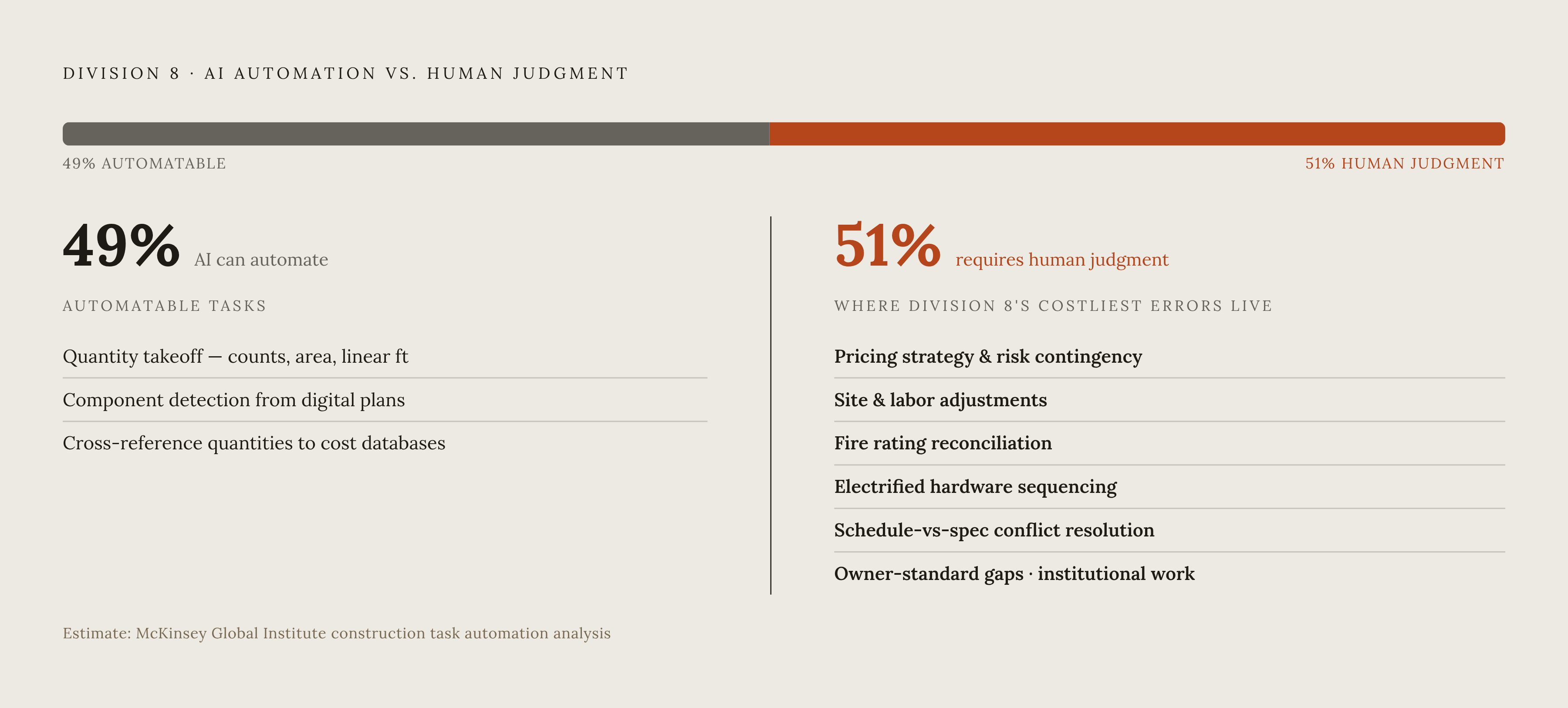
AI handles the countable part of estimating well. Quantity takeoff from blueprints, area, linear measurement, and opening counts. Component detection: doors, windows, walls, rooms, pulled straight off a digital plan set. Cross-referencing those quantities against a cost database or a contractor's own historical job data. Repetitive measurement across a stack of similar floor plans is tedious for a human and trivial for a model.
None of that touches the harder job of pricing, which still needs a person with judgment. Estimates that AI could automate up to 49% of construction tasks put a rough number on this split, but the remaining 51%, which actually wins or loses a bid, still needs a person with judgment. Pricing strategy and how a bid gets positioned against competitors. Adjustments for site access and local labor availability. Risk assessment, contingency, and the negotiating calls that happen once a client pushes back on scope. None of that appears in a takeoff benchmark, because none of it can be measured off a drawing.
Division 8 has its own version of this judgment layer, and it's specific enough that a tool built for general construction won't reliably catch it. A schedule note that contradicts the hardware spec needs to get flagged for a human to resolve, not silently overwritten by whichever value the model trusts more. Institutional jobs often run owner standards alongside the project spec, and a tool that only reads what the project spec says will miss requirements that exist only in the owner's document; this gap becomes especially costly on hospital and school work. Fire rating has to reconcile between the opening schedule and the life safety plan. Closer arm swing and clearance need a human eye, and continuous hinges get specified for high-cycle doors for reasons a takeoff tool has no way to infer from geometry alone. Electrified hardware is maybe the sharpest example: it has to get flagged before conduit gets run, not after the walls close, and that's a sequencing call, not a counting one.
None of this works if the input documents are bad to begin with. AI project failures in construction trace to poor data quality 85% of the time, not to weak models. That number holds for Division 8 specifically: a poorly drawn schedule or an inconsistent spec degrades AI output exactly the way it degrades a manual takeoff, because the tool is only ever as good as what it's reading.
Comparing available tools against Division 8 conditions
Judged against Division 8 conditions rather than generic benchmarks, the tools on the market split fairly cleanly by how much of reconciling documents against each other they're built to solve. Does the tool read multiple document types at once, does it cross-reference hardware sets against schedules, can it export into an ERP without manual retyping, does it understand Division 8's own conventions and shorthand, and when it hits a conflict, does it surface that conflict to the estimator or quietly resolve it on its own.
One category of tool is trained specifically on Division 8 work rather than adapted from a general construction model. A contractor uploads the files received from the GC, the model extracts the takeoff information, and it exports a file that opens directly inside the contractor's ERP, eliminating the need for someone to retype the data by hand afterward. Training on Division 8's own language, diagrams, and schedule conventions, not generic drawing recognition, is what separates this kind of tool from a general-purpose model pointed at a door schedule.
A second approach reads door schedules, hardware schedules, and floor plans together out of a full bid set and turns that into a reviewed takeoff and a priced quote rather than a bare quantity list. Door tags on the plan sheets get matched back against the schedule automatically, which is the single cross-reference that matters most in this trade, and openings that appear on a plan but never made it into the schedule get flagged rather than silently dropped. A human still has the option to drag a box around anything the detector missed, keeping review in the loop instead of trusting the model blind. Output lands as a CSV ready to hand off downstream. Built around the full document set at once, schedules, floor plans, and the 08 71 00 spec, this kind of tool treats conflicts between documents as something that appears in the estimator's review for a decision, not something to resolve silently, and it can surface gaps between the project spec and owner requirements on institutional work rather than only reading what the project spec says.
A third type of tool automates door, frame, and hardware takeoff, estimating, and scheduling straight from digital plans, accepting PDFs, CAD files, and BIM models as input. Hardware detection with grouping logic auto-populates schedules from whatever's imported, and the tool produces bid documents and reports at the end. It's positioned as specialized estimating software for door work specifically.
What separates all three from a generic AI takeoff tool is the same thing: none of them treat a door count as the finish line. They treat it as the first step toward a reconciled, priced opening.
The ROI case for Division 8 contractors specifically, not the industry average
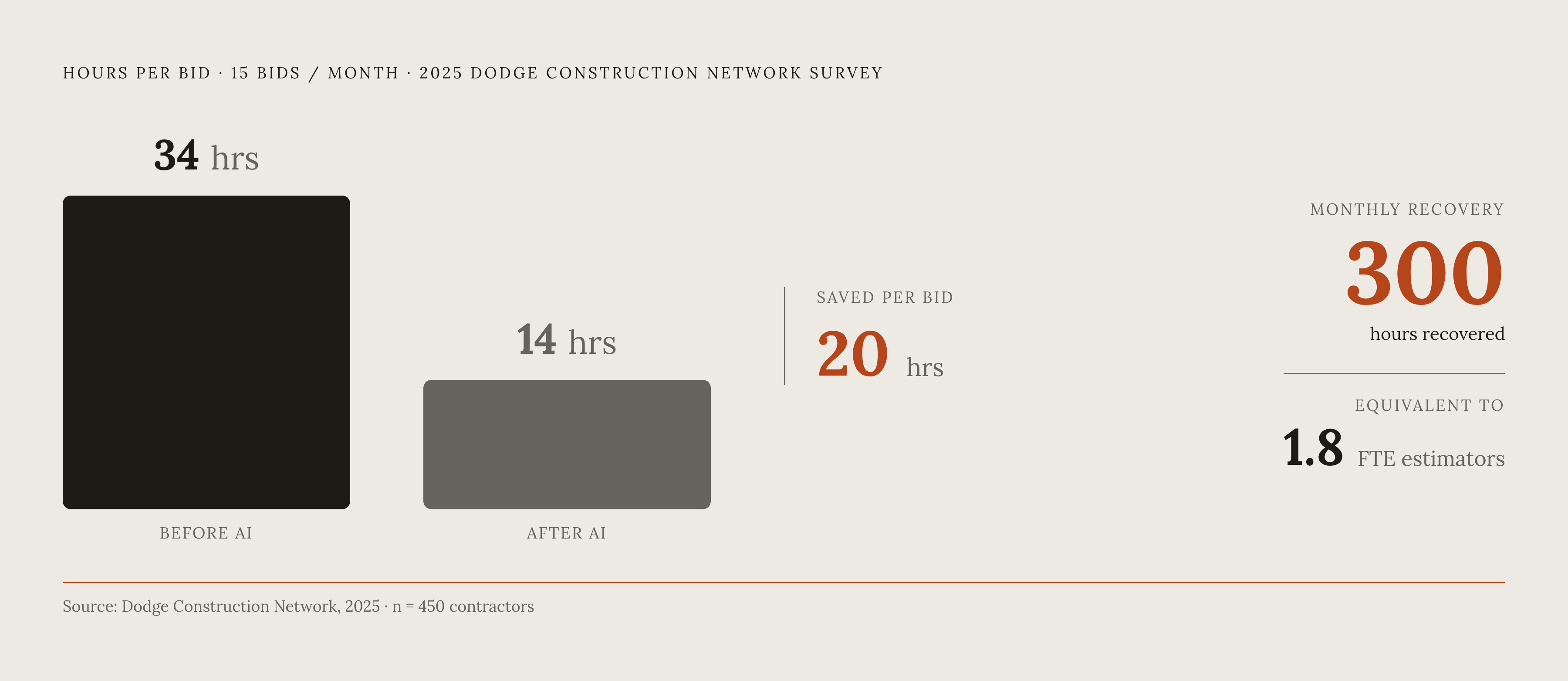
Industry-wide, the numbers already look strong. A 2025 survey by the Dodge Construction Network, covering 450 contractors, found average bid preparation time drop from 34 hours down to 14 hours with AI-assisted estimating in place. For a contractor pushing out 15 bids a month, that gap works out to roughly 300 recovered hours, which is close to adding 1.8 full-time estimators without actually hiring anyone. Accuracy moved too: the Associated General Contractors of America reported that contractors using AI-powered estimating saw 22% fewer change orders tied back to estimating errors.
Those are industry averages, and they undersell what's happening in Division 8 specifically. For a door contractor or a hardware distributor, the bottleneck was never the arithmetic of a bid. It's the hours spent reconciling a schedule against a spec against a set of floor plans before there's even a number to run math on. Compress that reconciliation from a full day down to under an hour, and the win isn't just time saved on one bid. It changes how many bids the same estimator can turn around in a month, which is the real lever behind winning more work: not longer hours from the same person, but more jobs quoted by the same person in the same week.
The accuracy side of the ledger matters just as much as the speed side, and arguably more, since a fast bid built on a missed hardware conflict just moves the cost of that error downstream to the job site, where it's far more expensive to fix.