How Venture Funding Is Reshaping Construction Estimating Software
Venture money backs broad platforms, but Division 8's complexity demands specialists.

Venture capital is pouring into construction estimating software, and the money is chasing a specific bet: that AI can compress the pre-construction workflow enough to change how contractors bid. The more interesting story is what that funding is actually buying. Most of it is building horizontal platforms that try to cover every CSI division at once, and that strategy runs directly into trades like Division 8 doors, frames, and hardware, where the estimating problem is a document reconciliation task, not a quantity takeoff, and where a tool built for breadth cannot hold the compliance detail the trade demands. Tools purpose-built for Division 8, like Fresco, exist because that gap doesn't close on its own.
Why venture capital is flooding into construction estimating software
Construction checks every box that makes a vertical software market attractive to investors: an end market fragmented across thousands of small and mid-size contractors, a trade that has historically adopted new technology late, and a workflow complex enough that even modest gains in speed or accuracy translate into real money. Pre-construction work in particular, takeoffs, scope checks, document search, bid risk assessment, has stayed stubbornly manual, and the people who do it for a living describe it as genuinely painful, measured in hours spent cross-referencing documents by hand.
The funding pattern bears this out. XBuild, one of the firms attracting capital in this space, describes itself as an "AI-native" estimating platform with planned coverage across concrete, landscaping, painting, windows and doors, glass and glazing, insulation, HVAC, and plumbing, though it is currently live only for residential roofing. That spread of ambition, seven or more trades named as destinations even while only one is operational, tells you what investors are underwriting: not a single-trade tool, but a platform meant to eventually touch nearly every line item on a construction budget.
The logic behind the capital is straightforward. If AI can meaningfully shrink the time between a bid invitation and a submitted number, the economics of estimating change. A contractor or distributor who can turn a quote in an hour instead of a day can pursue more bids without hiring more estimators, and that kind of leverage is what venture investors look for when they fund software in a labor-constrained trade. The promise being sold, in effect, is speed at scale, across trades, without adding headcount. Whether that promise holds up once it meets the actual document complexity of a given trade is a separate question, and it's the one the rest of this piece takes up.
What the funded platforms are selling
Nearly every well-funded estimating platform competes on the same axis: horizontal breadth, serving as many CSI divisions as possible through one interface. FlowManual, for instance, targets "general and MEP construction contractors," a scope that is explicitly cross-trade from the outset. XBuild's stated plan is to build what it calls a "vibe coding" estimating platform spanning concrete, landscaping, painting, windows and doors, glass and glazing, insulation, HVAC, and plumbing, an ambition defined by breadth rather than depth in any one of those areas. Alloovium takes a related but distinct approach, positioning itself as a document intelligence layer that reads "every document and piece of data on a project," contracts, specs, drawings, compliance records, conversations, aiming to be a universal layer that sits under construction rather than a specialist in any single trade's output.
The investment logic behind this horizontal framing is easy to follow. A platform that works across every trade has, on paper, a larger total addressable market than one built for a single CSI division, and it can in theory land any contractor regardless of what that contractor actually builds. Breadth gets presented as comprehensiveness, a single tool capable of serving the whole jobsite.
Construction is not one discipline wearing different clothes; it is dozens of specialized trades, each with its own document types, its own terminology, its own compliance frameworks, and its own bid workflow. A platform calibrated to perform adequately across all of them is, by definition, calibrated to be excellent at none of them.
Why Division 8 estimating breaks general-purpose tools
Division 8, the CSI division covering doors, frames, and hardware, answers that question clearly, because its estimating workflow is structurally unlike most other trades. The core task is reconciling at least five distinct document types that all have to be read together, not in sequence.
The scope itself is already intricate: hollow metal doors and frames, commercial wood doors, architectural hardware covering hinges, locksets, closers, and panic hardware, and specialty doors including fire-rated assemblies and lead-lined doors. Every opening in a building carries its own interlocking set of fire rating, access control, and compliance requirements, and no two openings in a large project are guaranteed to be identical.
The door schedule is the document that bridges the architectural drawings and the hardware specification, and on a large institutional or commercial project, it can list hundreds or even thousands of doors. CDF Distributors, in its published Division 8 guide, states that "errors or inconsistencies between the door schedule and the hardware specification are common sources of project delays and change orders.
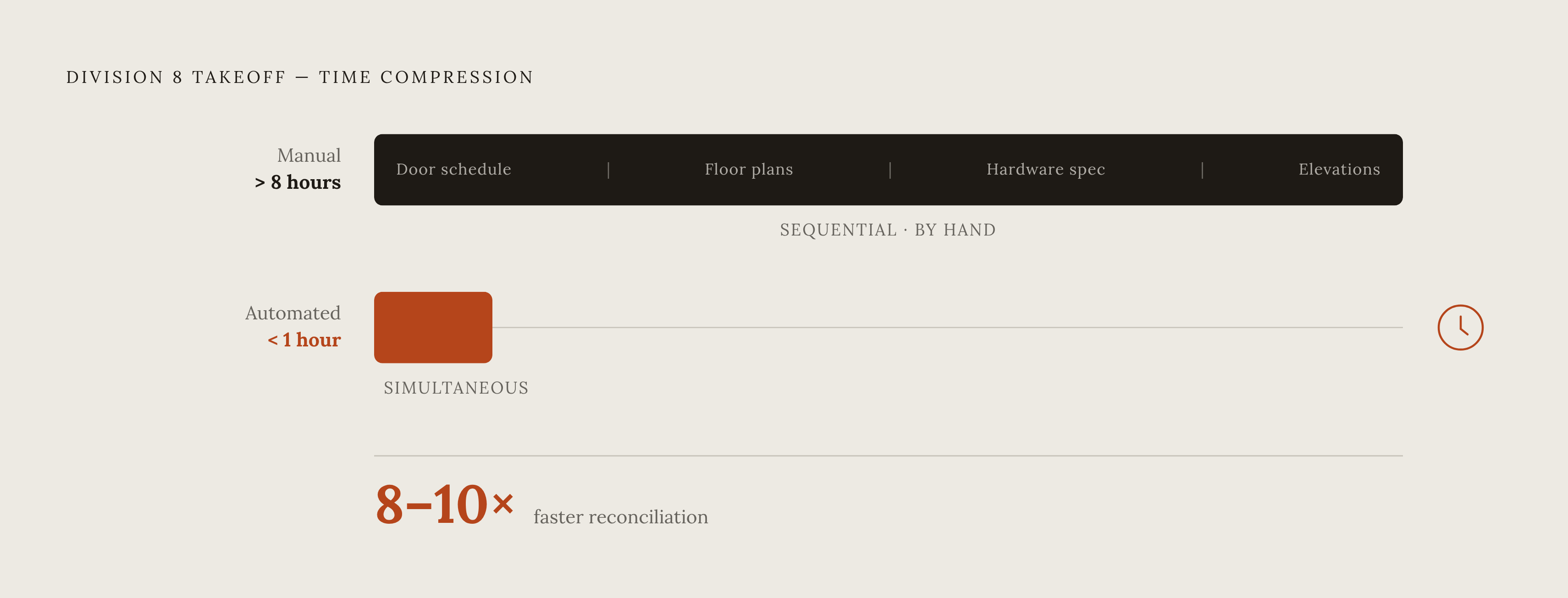
Catching those inconsistencies requires reading the door schedule, the floor plans, the hardware specification, and the elevations simultaneously, cross-referencing one against another as a single act rather than four separate reviews. Fresco's published workflow documents describe exactly this: its models read those four document types at once and flag where they disagree. Bid-day scope gaps make the stakes even clearer. Electrical drawings might show power supplies for an electrified door opening without showing the raceways that carry the wiring, or they might indicate wiring without clearly assigning who supplies the device. A general-purpose tool has no way to catch a gap like that, since it has no model of what Division 8 expects to find.
Hardware groups add a further layer of precision, and a general tool simply cannot encode it. A hardware consultant assigns each group based on a door's function, its location, its fire rating, accessibility requirements, security level, and expected traffic volume, and each group functions as a self-contained specification telling the distributor what to supply for that opening. Misread one group, and the error doesn't stay contained. It cascades across every door assigned to that group across the project. A tool trained to read concrete takeoffs or MEP drawings has no concept of what a hardware group even is, let alone what it means when the schedule and the 087100 hardware spec contradict each other, or what a missed door type costs when it surfaces at submittal review instead of at bid time.
Division 8's document reconciliation problem is exactly where general-purpose tools fail, because they were never built with a model of how door schedules, hardware specs, elevations, and floor plans interrelate. Platforms built exclusively for Division 8, like Fresco, encode that structure directly into the AI itself, so the system understands not just what a hardware group is but what it means when two documents disagree about it.
Institutional jobs expose the deepest gap in general-purpose tools
Institutional work, universities, hospitals, government agencies, pushes this problem further still. On these jobs, estimating Division 8 isn't just a matter of extracting what the project spec says. It becomes an act of authorship: the hardware set has to be written against the owner's standing design standards, which sit above and alongside the project-specific spec and carry their own binding force.
Missouri State University's published design standard makes the expectation explicit. Owner standards apply across all projects on campus, and the standard states that "any deviations should be discussed with the Project Manager and will be reviewed for conformance." The standard is a standing requirement that every hardware set submitted for a campus project has to be checked against, regardless of what the project's own spec happens to say.
Layered on top of owner standards is a compliance regime that institutional work treats as non-negotiable: ANSI/BHMA certification. Testing is conducted by independent, BHMA-accredited laboratories, not self-reported by manufacturers, and every certification grade carries specific cycle counts, impact resistance benchmarks, and weight tests that hardware has to pass before it can be specified on institutional work. If a hardware set matches the project spec but falls short of the certified grade an owner requires, that is a submittal rejection waiting to happen.
A general-purpose estimating tool has no mechanism for holding an owner's design standards in memory, cross-referencing them against the active project spec, and flagging where a submitted hardware set deviates from what that owner requires. Building that capability takes a tool designed around institutional Division 8 workflows specifically, because the knowledge in question is specific to how institutional owners govern their own buildings over time, not generic to construction. If you produce a fast quote without that institutional knowledge in hand, it won't survive submittal review, no matter how quickly you made it. Speed without that knowledge isn't an advantage on institutional work; it is a liability that appears later, at the worst possible point in the schedule.
Where AI takeoff accuracy breaks down for trade-specific tools
None of this means AI takeoff tools have no real limits, and the honest case for specialization has to account for those limits, not wave past them. Hand-drawn sketches, low-resolution scans, non-standard symbology, and plans with heavy overlap between symbols all degrade AI takeoff accuracy, and that degradation affects any AI tool, regardless of how it was trained or which trade it targets. Drawing quality is a shared constraint, not a problem specialization alone solves.
The harder limit is judgment: knowing what to flag and when. Judgment gaps become most acute around early supplier involvement. Projects that bring a supplier in only after the contract is awarded, with material already needed in the field on a compressed timeline, carry the highest risk of schedule pressure colliding with specification mismatches, and recognizing that risk pattern in the moment is still a human judgment call, not something current AI fully replicates.
The working model this reality points toward is a human-AI hybrid rather than AI replacing the estimator. AI's role is handling the mechanical reconciliation, the line-by-line cross-referencing of schedule against spec against elevation, so the estimator's attention goes to the judgment calls that actually require experience: which supplier relationship carries risk, which deviation from an owner standard needs a phone call rather than a note in the margin.
This is where domain training earns its keep. When a tool is trained on Division 8 document structures, terminology, and how those documents typically conflict, it will surface the right flags to the human reviewer standing in front of a submittal deadline. A general-purpose tool, lacking that training, surfaces noise instead, misses the conflicts specific to Division 8, and leaves the estimator doing the reconciliation work the tool was supposed to handle. That gap is the strongest answer to the usual objection to specialization, that narrow tools serve a smaller market and therefore cap venture scale. The objection assumes accuracy is fungible across trades. Division 8's document structure shows that it is not.
How specialization resolves the bidding volume tension
Venture-funded platforms are, at bottom, selling capacity: the ability to bid more jobs with the same team. But if Division 8 contractors and distributors bid more without a matching gain in accuracy, they don't win more work. It just produces more expensive errors spread across more jobs.
Funding accelerates a "bid more" pitch, while good practice in specialty contracting increasingly rewards selectivity, choosing the right jobs and pricing them correctly the first time rather than chasing volume indiscriminately. Resolving that tension doesn't require choosing between the two. It requires eliminating the manual reconciliation step that forces the tradeoff. Fresco's platform, for instance, describes a Division 8 takeoff that once took more than a day being completed in under an hour once schedules, plans, and specs are reconciled automatically instead of by hand, sequentially, one document at a time.
The venture thesis, that AI can compress pre-construction cycle times and let contractors bid more work without adding headcount, holds most convincingly in trades like Division 8, where the manual baseline is at its most painful. Turning a full day of document reconciliation into under an hour doesn't just save time on a single bid. It changes how many bids a single estimator can realistically carry at once, which is the actual mechanism by which capacity and accuracy stop competing with each other.
That matters acutely for distributors, who face disincentive pressure from online configurators and direct manufacturer channels. If a detailed hardware quote costs too much estimator time, smaller jobs go unquoted and larger ones get delayed, and either way the business goes to a competitor who can turn a quote faster. A horizontal tool covering every trade can offer the Division 8 estimator speed on paper, but not the accuracy that makes that speed worth anything on a real bid. A specialized tool offers both at once, and that combination is the advantage most of the VC-funded market still hasn't delivered for this trade. The estimator who can quote accurately at volume is the one who actually wins the business the venture capital is chasing.
What specialized tools must prove against well-funded horizontal platforms
Venture pressure on horizontal platforms doesn't make trade-specific tools obsolete. It raises the bar those tools have to clear with estimators who now have more options to choose from than they did even a few years ago. That pressure is already visible even among incumbents who didn't start out AI-native: Buildxact has introduced an "AI crew member" concept called Blu, covering assembly assistance, estimate review, and takeoff support, a sign that established players are taking the AI-native wedge seriously rather than dismissing it.
In that environment, a specialized tool has to demonstrate accuracy on the document types that actually define its trade. For Division 8, that means reading the door schedule, the hardware spec, the elevations, the partition schedule, and the floor plans as one interconnected set. It has to encode the compliance layer that general tools were never built to hold: ANSI/BHMA certification requirements, owner design standards, architectural hardware consultant qualification requirements. And it has to fit the actual workflow of the people using it, from a solo owner wearing every hat in a small shop, to a senior estimator managing a multi-million-dollar commercial bid, to a distributor's sales rep turning quotes between customer calls.
Venture funding is accelerating the category as a whole, that much is clear from how much capital is moving into estimating software right now. But the contractors and distributors who come out ahead won't be the ones who adopted whichever platform raised the largest round. They'll be the ones who adopted the platform that actually understood their trade, down to the level of a hardware group, a door schedule conflict, and an owner standard that doesn't bend for anyone's bid deadline.