Outsourcing Division 8 Estimating vs Buying Software
Understanding when to outsource versus automate Division 8 estimating work.

Division 8 estimating, the takeoff and pricing of doors, frames, and hardware, is a document-reconciliation and specification-interpretation exercise unlike most trade takeoff work. It is a document-reconciliation and specification-interpretation problem, and that distinction is why generic solutions consistently fall short and why the choice between outsourcing the work and buying software to do it carries more weight than it would for almost any other division.
Structural differences in Division 8 estimating
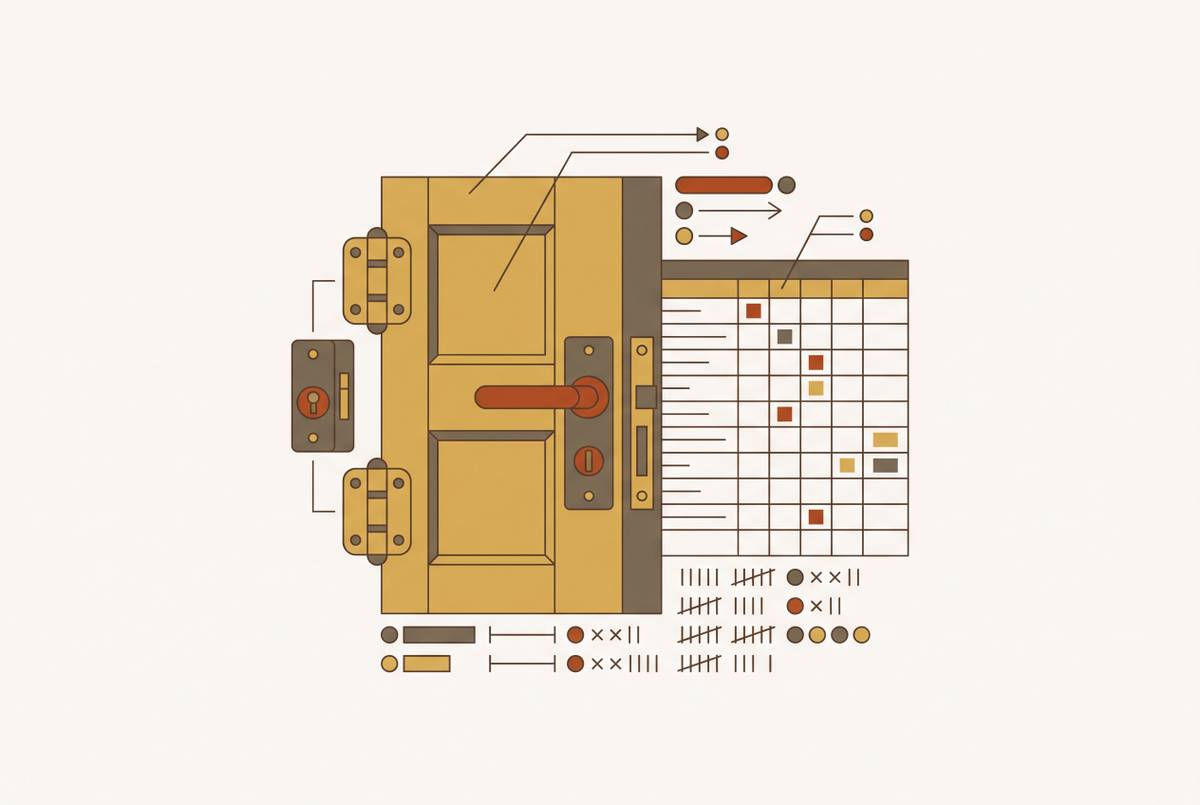
Three separate documents have to be read together on any commercial opening: the door schedule pulled from the drawings, the hardware specification found in section 08 71 00 (whether written as a book spec or a sheet spec), and the keying schedule. None of these duplicates what the others say. Each one references information that lives somewhere else in the set, so an estimator cannot simply extract quantities from one document and move on.
The door schedule functions as the bridge between the architectural drawings and the hardware spec. An architect will assign a door a hardware set designation, something like HW-3, and the estimator has to locate that designation inside the spec and interpret the full set definition before a single line item can be priced. That interpretation requires judgment. An 8-foot door needs four hinges instead of the standard three, and that has to be caught and flagged rather than assumed. A fire-rated opening may require an intumescent seal that the spec implies through code reference rather than lists outright. Kick plates have to be sized to the actual width of the door in question. These are judgment calls built on code knowledge and hardware familiarity, not fields to be copied from one document into another.
Institutional work adds a further layer that has nothing to do with the document set itself. Owner-standard specifications from universities, hospitals, and government agencies bring credential requirements, commonly an AHC or CDC designation, into the bidding process. They also require the hardware schedule to follow a specific format, DHI's "Sequence and Format for the Hardware Schedule," and they require coordination with security consultants on keying. That complexity is not visible as a line on a drawing. It sits entirely outside the document set, and an estimator who has not worked institutional jobs before will miss it.
The manual process creates the bottleneck outsourcing and software both address
What limits how many bids a Division 8 shop can pursue in a given month is the manual, document-by-document nature of the process itself. A skilled estimator reading a set correctly still has to flip through the pages one at a time, cross-reference each hardware set by hand, and build the opening schedule before pricing can even begin.
Finishing the takeoff leaves a further step still to do. This is a distinct manual step that happens after the reconciliation work, not a byproduct of it, and it consumes hours that could otherwise go toward the next bid.
That second cost compounds because commercial projects revise constantly. Specification changes are routine on larger jobs, sometimes daily, which turns reconciliation into an ongoing workflow rather than something an estimator finishes once and moves past. Every revision means re-checking whether a hardware set changed, whether a door schedule update shifted a fire rating, whether a keying decision downstream needs to be revisited. Time spent reconciling one bid set is time not spent opening the next one, and for smaller shops in particular, bid volume is directly tied to revenue opportunity. The bottleneck is structural, and it is exactly the problem that both outsourcing and purpose-built software exist to solve, from different directions.
Outsourcing Division 8 estimating in practice
Outsourcing Division 8 estimating means contracting out for domain expertise and for capacity at the same time, though how much control and responsiveness a contractor keeps depends heavily on the engagement model chosen. What actually gets handed off is the reconciliation work itself: reading the document set, building the opening schedule, cross-referencing hardware sets against the spec. The bid decision stays with the contractor, who still reviews the output, adjusts it, and submits it under their own name.
The case for outsourcing rests on a real talent shortage. Job postings for Division 8 estimators routinely ask for DHI industry exposure, commercial openings experience, and familiarity with electrified hardware and code compliance, a combination that is genuinely difficult to find in a local labor market. Institutional work sharpens this further: some owner-standard jobs require an AHC-credentialed person available during business hours, a bar that an outsourced service staffed with AHC holders can clear when an in-house hire cannot.
Engagement models vary considerably. A project-based arrangement means sending a document set and receiving a completed takeoff back. Staff augmentation puts an outsourced estimator inside the contractor's own process, working their software and their habits day to day. The difference matters because it determines how much institutional knowledge the vendor accumulates about a given business and its owner standards over time, rather than starting fresh on every job.
Two limitations sit inside this arrangement. Turnaround time depends entirely on the vendor's queue, and a bid with a 48-hour window is not a reliable fit for a service that needs to be scheduled in advance. And proprietary bid packages, once handed to an outside party, carry real information security exposure: owner-standard specs, pricing strategy, and client relationships are all embedded in the document set being shared. Outsourcing solves the expertise and capacity problem for a given bid, but it does so by trading internal estimator hours for dependence on someone else's schedule.
Purpose-built Division 8 software versus general-purpose takeoff tools
General-purpose AI takeoff tools can detect a door on a floor plan. They cannot interpret a hardware set from a specification, and that gap is the whole problem.
Computer vision tools can detect building elements across an entire architectural takeoff and report real speed gains doing it, but the output is drawing-derived geometry, not hardware-ready pricing data. STACK's AI detects doors, windows, rooms, and walls from blueprints and integrates with ERP and accounting systems on the back end, but its Division 8 output still requires the estimator to separately read the spec and cross-reference hardware sets by hand. Neither tool is built to fail here. They were built to solve a different problem, geometric detection across a whole building, and Division 8 asks for something else: the simultaneous reading of a door schedule, a hardware spec, and a floor plan together, a reconciliation task that computer vision applied to drawings alone was never designed to complete.
A separate category of software has been built specifically around that reconciliation task. Others, like Plank, pull door schedules, hardware schedules, and floor plans out of a bid set into one reviewable takeoff and output a priced quote and CSVs. DHWin, built by Kelleher Corporation, is a longer-established entrant that automates takeoffs, generates door schedules and bills of materials, and integrates with CAD tools. Elsewhere in the market, service-oriented platforms combine automated processing with optional expert human review, delivering a finished estimate rather than raw takeoff data, a model that sits closer to outsourcing than to self-service software.
What distinguishes the Division 8-specific category operationally is the ERP integration point. These tools produce hardware-ready output that flows directly into the shop's own quoting platform, collapsing what used to be two separate workflows, the takeoff and the hardware entry, into one continuous process. That is a structural difference from general-purpose takeoff software, not an incremental improvement on it.
Vendor accuracy claims deserve scrutiny
The strongest objection to adopting Division 8 software deserves to be stated rather than dismissed: Division 8 is a judgment problem as much as it is a data problem, and most of the accuracy claims circulating about it come from the vendors selling the software. Every door on a commercial project has to satisfy fire rating requirements, accessibility rules, sound or sight separation, and code compliance, decisions that often require input from more than one person on a project team and cannot be settled by reading the document set in isolation.
The edge cases are where mistakes hide, and they are precisely the cases described earlier: a door height that changes a hinge count, a fire rating that implies a seal the spec never states outright, a kick plate width tied to an actual door dimension rather than a default. These require rules-based interpretation, and interpretation is harder to verify from the outside than simple extraction. Vendor accuracy figures in this space are company-reported, and independent third-party verification of those figures has not been widely published.
That objection is fair, but it has to be weighed against the actual alternative, not against a perfect one. Industry benchmarks put manual takeoff error rates in a range that makes the real comparison software against a process already known to produce errors, not software against flawless human judgment. Manual reconciliation done by a fatigued estimator working a hundredth line item at midnight before a bid deadline is not a reliable baseline either.
The submittal review process remains the most effective quality control step available, regardless of whether the original takeoff came from a person, a vendor, or software. That is where spec-to-submittal conflicts get caught, hardware set errors get corrected, and fire rating coordination gets verified, and no software vendor's tool eliminates the need for it. What a contractor evaluating a platform should actually test is narrower and more concrete than an abstract accuracy percentage: whether the tool handles the specific document formats the shop works with, book spec or sheet spec, flat-list or table hardware schedules; whether it flags conflicts for a human to resolve rather than resolving them silently on its own; and whether the output is reviewable before it becomes a submitted order rather than arriving as a black box.
Bid volume capacity by shop size and structure
A solo owner or a small shop bidding a handful of projects a month faces a different equation than a distributor quoting hundreds of openings a week, and the right answer between outsourcing and software depends on which situation actually describes the operation in question.
For the solo owner, outsourcing can close the estimating gap without requiring a software investment, as long as the vendor's turnaround time fits the bid schedule and volume stays low enough that dependence on someone else's queue does not become the limiting factor. For a shop pursuing higher bid volume as a deliberate growth strategy, quoting more jobs in order to win more work rather than simply working longer hours, outsourcing tends to create a ceiling. The vendor's own capacity and turnaround become the binding constraint. Software behaves differently at that scale: the marginal cost of each additional takeoff drops as volume rises, and the platform's capacity scales with the shop rather than requiring proportional increases in headcount or vendor hours.
Distributors and hardware reps face a related but distinct version of the same problem. Major manufacturers such as ASSA ABLOY maintain specification writers who use Openings Studio, a BIM software platform also used by architects, contractors, security consultants, and distributors, and that platform can export data directly to distributor partners. A distributor who can consume and act on that exported data quickly holds a real quoting advantage over one who still processes it manually, and that advantage compounds with every bid cycle.
Institutional contractors carry their own wrinkle. Owner-standard jobs require the person building the hardware sets to understand the owner's particular standard, not just the project specification in front of them, and that kind of institutional knowledge accumulates inside a business over years. It is harder to transfer to an external estimating service working project by project than it is to retain in software trained on the contractor's own standards over time.
The talent scarcity argument for outsourcing deserves one more look here, because it cuts both directions. Experienced Division 8 estimators are genuinely hard to hire, which is the whole premise behind outsourcing in the first place, but they are equally hard for outsourcing vendors to retain. Turnover in outsourced technical services is a documented failure mode, and a vendor's expertise is only as reliable as the stability of the specific people doing the work behind it.
What to weigh when deciding for your operation
The decision between outsourcing and software comes down to four variables: bid volume targets, tolerance for turnaround risk, institutional knowledge requirements, and where the cost of an estimating error ultimately lands.
Bid volume is the first test. A shop aiming to quote substantially more work than its current capacity allows will find that software's scaling economics favor it over outsourcing, since marginal cost per takeoff falls as volume rises rather than climbing with added vendor hours. A shop with stable, modest volume may find the lower upfront commitment of outsourcing a better fit, at least for now.
Turnaround tolerance is the second. Outsourcing introduces a queue and a handoff between two parties. Software keeps the process internal and on the contractor's own schedule. For shops working tight or irregular bid windows, control over turnaround carries real dollar value that is easy to underweight until a 48-hour deadline arrives and the vendor's queue is full.
Institutional knowledge is the third. Owner-standard jobs demand that hardware sets be interpreted against an owner's established standard, not just the project spec in front of the estimator, and that is knowledge that accumulates inside a business over repeated jobs. Outsourcing it project by project means rebuilding context every time a new bid comes in, while software trained against a contractor's own historical standards can retain that context instead.
Where the error cost lands is the fourth and often the most consequential. A missed opening or a misread hardware set, whether it came from a manual takeoff or an outsourced one, produces a change order somewhere downstream. Outsourcing contracts rarely include error indemnification anywhere near the level of margin risk that a Division 8 mistake can represent, leaving the question of who carries that cost unresolved.
None of this has to be decided once and locked in permanently. A shop that starts by outsourcing to close an immediate capacity gap can move to software as volume grows, and a shop that has already invested in software can still bring in outsourced AHC expertise for the specific institutional jobs where credentialing is a bid requirement rather than an optional nicety. The venture capital moving into Division 8-specific platforms, including a seed round led by Khosla Ventures in July 2025 for one such platform, signals that the industry increasingly believes the specification-interpretation problem is solvable at scale, and contractors should weigh the long-term risk profile of software against the long-term risk profile of outsourcing on that basis. The operation's own bid volume, turnaround needs, institutional relationships, and appetite for error risk are what determine which path fits, and that determination belongs to the contractor making it, not to either side of the comparison.