Estimating Software Requirements for Door Hardware Distributors
Door distributors need software that reconciles specs, schedules, and plans simultaneously.
Estimating Software Requirements for Door Hardware Distributors is the subject at hand.
Door hardware distributors' distinct estimating problem
Door hardware distributors sit at the intersection of the spec, the door schedule, and the GC or sub's bid timeline, absorbing complexity from all directions simultaneously, a structural difference rather than a matter of degree. That's a structural difference in kind.
The deliverable itself makes the job harder than it looks from outside. A distributor isn't handing over a count of openings the way a glazing sub might count storefront units. The output has to be a priced hardware package organized by hardware group, cross-referenced to every single opening, and defensible line by line against the 08 71 00 specification. Section 08 71 00 tends to be the most detailed and complicated section anywhere in Division 8, because it has to coordinate hardware across every door type, every function, every fire rating, every accessibility requirement, and every security level in the building, all at once. There's no shortcut around that coordination. It has to happen before a number gets typed into a bid form.
The workflow compounds the exposure. A distributor receives the project spec and door schedule, prices the hardware package, and submits the bid to the GC or door sub. If the bid is awarded, the real accountability starts: a detailed submittal has to list every hardware item for every door, organized by hardware group, naming manufacturer, model, finish, function, and any deviation from spec. That submittal then lands on the desk of the architect or hardware consultant for approval. Any error made at takeoff doesn't stay buried. It resurfaces at submittal, on the record, with the project schedule sitting on top of it. A misread hardware set discovered during bid review costs a distributor a bad number. The same error caught at submittal costs time on a live project, and time on a live project is the one thing nobody in Division 8 has spare.
The difficulty of pricing the hardware set document accurately
A hardware set, sometimes called a hardware group, is a numbered list of every component required to make one door type function, including hinges, the lockset or latchset, the closer, the stop, seals, the threshold, silencers, and whatever specialty hardware the opening calls for. Sets get numbered sequentially, HW-1, HW-2, and so on, and the door schedule references those numbers so that every door assigned to a given group receives identical hardware. In theory this is a clean system. In practice, three real specs sharing the same section number can look almost nothing alike.
Take finish codes. One spec carries three distinct finish codes, and one of them, EN, shows up on many lines but is only decodable indirectly, through the manufacturer table buried elsewhere in the spec rather than through any dedicated finish table. Then there's scope bleed: one line item in that same document belongs to another trade entirely, and ten of the 34 live sets hand off at least one line this way. Across the full Santa Fe schedule referenced in this material, 64% of lines carry a stated finish, leaving more than a third of the schedule with a blank finish that the estimator has to invent a price for. That's a substantial share of the schedule left to guesswork. That's more than a third of a schedule where the estimator is guessing.
Michigan State's spec does something different again: it publishes no hardware sets at all. The section is organized by component type across tables, so the estimator has to match usage to a row and repeat that matching process for every single opening. So the reader is left with three specs sharing a section number and almost nothing else. Each door on the schedule carries a hardware set reference that maps to the full set definition in Section 08 71 00, but only if the numbering is consistent between the two documents.
Quantity is its own trap. Lori Greene, Manager of Codes and Resources at Allegion, has confirmed that a hardware set should show quantity per opening. Santa Fe's spec agrees, stating quantities per pair or per single door. Yet at least one widely used estimating platform submits total quantity across all openings instead. Get that backwards on a project with multiple sets and every downstream number is wrong by a multiple, and there's no visible flag telling the estimator anything went wrong. The output looks clean. It just isn't correct.
The document reconciliation problem that precedes any pricing
Before any of this can be priced, it has to be reconciled, and reconciliation is where most of the actual labor in a hardware takeoff lives. The door schedule and the hardware schedule are meant to be read in parallel: the schedule describes the physical opening, and the spec describes what operates it. Each door carries a hardware set reference that maps back to the full set definition in Section 08 71 00, but that mapping only holds if the numbering stays consistent between the two documents. When it doesn't, or when a distributor is working from a revision of the hardware schedule that's already been superseded, the pricing that follows is pricing for hardware nobody is going to install.
Some of the traps are almost designed to be missed. A door schedule notation reading "similar to Set 3" means, by definition, that differences exist somewhere, or the door would simply be labeled Set 3. Finding those differences means going back to the plan sheet, a step that's easy to skip under bid deadline pressure. The Santa Fe spec examined here has four doors assigned to two hardware sets at the same time, and nine doors assigned to a set explicitly captioned "(NOT IN USE)". Reading that caption literally leaves nine openings with nothing. Reading the door list as the authoritative source instead gives those same nine openings dozens of line items. Both readings are defensible on paper. Only one of them is right, and the document itself won't tell you which.
Prep coordination adds a second axis to the same problem. The hardware set defines what mounts on the door. The door schedule defines what preps the frame has to be ordered with. Those are two separate pieces of information, held in two separate documents, and they have to align exactly or the frame arrives from the factory without the cutouts the hardware needs. Electrified hardware tends to be the item most often under-carried in a fast bid, because it touches both the door schedule and a security or access-control spec section that many hardware estimators aren't reading closely under time pressure.
None of this is optional cleanup work. Discrepancies and missing items are supposed to go to the architect before bidding, not after. But catching them at all requires having already reconciled schedule, spec, plan, and owner standard simultaneously, which is precisely the step that a rushed takeoff skips. Without precise detail upfront, the hardware specification itself ends up inaccurate, and that inaccuracy propagates through architect, specification writer, contractor, and installer before anyone notices. A tool that reads the door schedule alone, or the spec alone, or processes the two in sequence rather than at the same time, cannot surface these conflicts before they turn into errors in the submitted bid.
The added layer institutional and owner-standard specs bring that the project spec does not contain
Institutional owners frequently maintain their own hardware standards, and those standards sit above the project spec rather than inside it. Cornell University's owner-standard under Section 087100 states that the hardware sets noted are typical applications at Cornell, and that project-specific hardware still has to be reviewed and approved by the Cornell University Lock Shop. The distributor, in other words, answers to a standard that never appears in the bid documents.
Transit authorities push this further. IndyGo's invitation for bid requires keying systems to be factory-keyed and field-verified against the owner's existing system, and it names the accepted lockset series outright: Sargent Manufacturing's 8200 Series and Schlage's L9000 Series, both required to be Grade 1, CPD-listed, built with a corrosion-resistant steel case, and field-reversible for handing. That's a performance spec only the named product or its true equivalent can satisfy, not something a distributor can substitute with an equivalent product. It's a named-manufacturer requirement, and pricing it wrong means pricing the wrong product.
Qualification requirements for the distributor itself appear in these specs too, not just requirements on the hardware. Himmelman Construction's Section 087100 requires the supplier to have maintained an office and furnished hardware in the project vicinity for at least two years, with office and warehouse facilities sized to the project. The same spec requires the supplier to employ at least one Architectural Hardware Consultant available during business hours for consultation with owner, architect, and contractor. Himmelman's spec also requires the supplier to be an authorized factory distributor of every product specified.
Substitution windows close early on these jobs. Requests have to go in before bidding, inside Division 1 timelines, and approval sits entirely at the discretion of the architect and hardware consultant. There's no negotiating that after the fact. Put together, institutional work requires a distributor to author hardware sets against a separate owner standard held alongside the project documents, not derived from them. Software that only parses what's written in the project's 08 71 00 section has no way to represent that second layer, and on institutional work, that second layer often carries more weight than the section it's attached to. Per New York State OGS spec, the AHC credential designates a Door and Hardware Institute-certified expert in complex architectural openings requiring advanced knowledge of model building codes, safety standards, ADA requirements, access control, and installation.
Pricing staleness distributors underaccount for
Hardware price books start life as manufacturer catalogs, and those catalogs have to be digitized, checked, and loaded into whatever system a distributor prices from before a single number is trustworthy. Two pressures compound that lag beyond the catalog cycle itself. Items new to a distributor's own database carry no purchase history, so a schedule where a meaningful share of the line items are unfamiliar hasn't really been priced with any confidence, no matter how clean the output looks. And every line with no stated finish is, again, a price the estimator has to invent. On the Santa Fe schedule that meant 36% of lines carried no confirmed finish code at all.
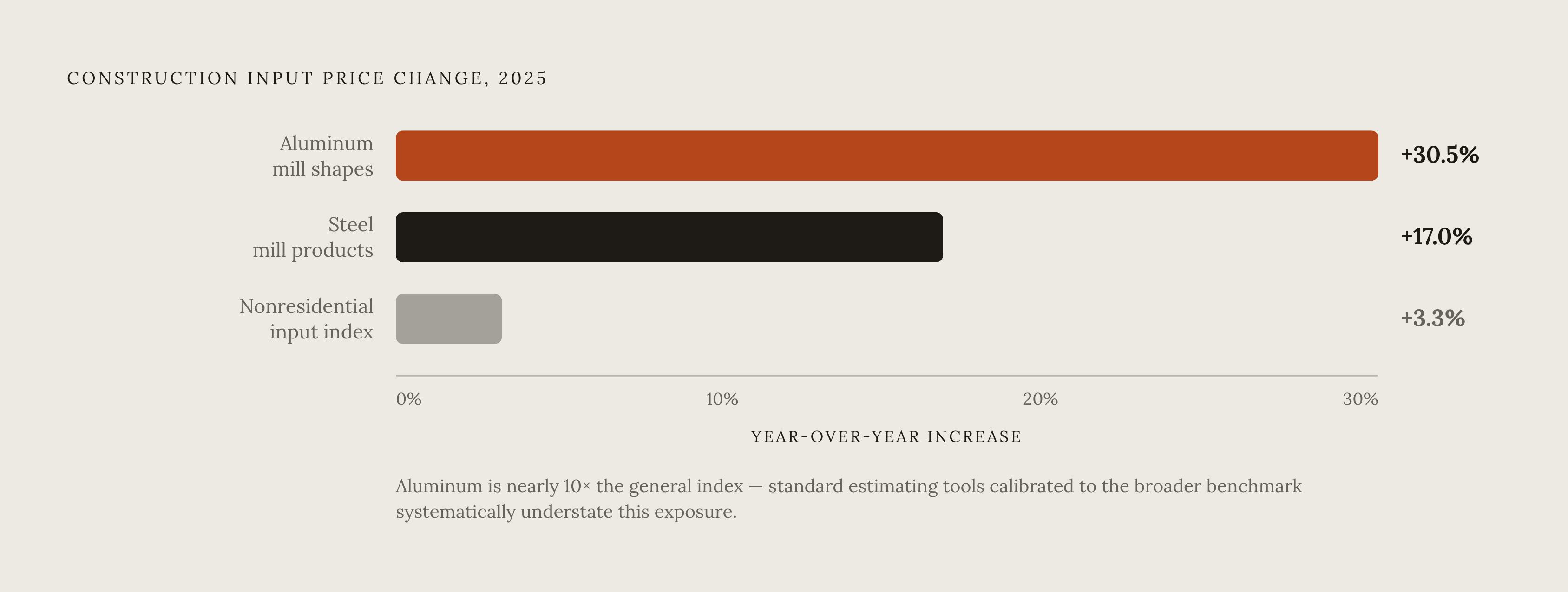
Material costs are the deeper cause here, and they are producing uneven price movement, visible in how aluminum mill shapes and steel diverge from the broader construction input index. Aluminum mill shapes rose 30.5% and steel mill products rose 17% over calendar 2025, while the broader nonresidential construction input index rose only 3.3% over that same stretch Fresco. Hardware components, in other words, are moving several multiples faster than the general construction inputs most estimating tools are calibrated against. Section 232 duties add a further wrinkle, since they apply to the full customs value of an item rather than to its metal content, and they apply unevenly across a single opening, so a frame, a closer, and a lockset on the same door can each carry a different tariff exposure. A bid priced in spring and awarded by summer has already absorbed weeks of that movement, and the original estimate never captured it. What this points to is a pricing layer that flags stale figures instead of presenting them as current, and that treats a line with no stated finish as unpriced rather than quietly filling it with a zero.
The quoting volume problem: why distributors need to bid more jobs, not spend more time per job
Winning more work, for a distributor, mostly comes down to bidding on more jobs in the same stretch of time. An estimator who burns a full day reconciling one hardware set against one door schedule is structurally capped in how many bids that distributor can chase, regardless of how skilled the estimator is. The reconciliation work described above, the schedule, the spec, the plan, and the owner standard, all cross-referenced at once, is where that day goes. It's a process problem created by document volume and cross-reference count, not a competence problem.
Smaller distributors and independent hardware reps feel this most acutely, since many don't have a dedicated estimating department at all, and the owner of the business is often the one doing the takeoff between everything else on the calendar. Meanwhile the market these smaller shops are competing in keeps expanding. Allegion alone reported multibillion-dollar revenue in 2025, and the non-residential segment is projected to keep growing. The pipeline of biddable work is getting larger while estimating headcount at most distributors stays flat. Speed and accuracy aren't in tension here, whatever intuition might suggest. A faster takeoff that also catches more of the conflicts a manual read misses is simply better on both counts. What distributors need is the ability to turn a complete 08 71 00 spec and door schedule into a priced, opening-level hardware package in a fraction of manual time, without giving up the cross-document checking that catches the errors in the first place.
Where the current software landscape stops short for distributors
One side builds fenestration fabrication systems, oriented around frame configurators, cut lists, and glass engineering. The other builds commercial takeoff systems, oriented around counting openings off plans and bundling door, frame, hardware, and labor per opening. Neither category was built from the ground up around the reconciliation and owner-standard problems described above, though several tools cover meaningful pieces of the work.
An established desktop takeoff system (On-Screen Takeoff + Quick Bid) supports door, frame, and hardware set assemblies with per-opening organization, and its Takeoff Boost AI feature returns a first pass of area, linear, and count takeoff in as little as 30 seconds. A web-based platform built specifically for commercial door and window subcontractors handles PDF plan takeoff with per-opening assemblies and produces schedule-of-values output for GC submission, priced at $100 per person per month, though by its own account it has no automated hardware-set scheduling logic and no live supplier price feeds ScopeTakeoff. A separate cloud-based estimating platform supports Division 8 takeoffs through pre-built templates and an up-to-date cost database, aimed at rolling up cost across a full estimate rather than hardware specifically. And one AI-powered platform is described as automating door, frame, and hardware takeoff, estimating, and scheduling directly from digital plans, with AI-driven hardware detection.
On the fabrication side, one platform offers deep frame configurators, cut lists, and mulling logic, priced from roughly $495 a month per user, but it's built for manufacturers rather than hardware distributors. Another offers configuration, quoting, design, optimization, and manufacturing software with schedule-driven quoting and hardware estimating for window and door manufacturers. Further down the market, a handful of residential-oriented tools appear in ranked comparisons: one is a strong pick for residential door teams that want repeatable takeoff-to-schedule output with controlled revisions, mapping door and hardware attributes through those revisions; another combines CRM and estimating with door and material assembly pricing for smaller shops; a digital takeoff tool supports door counts and framing for smaller operations; and one platform focuses on door and millwork takeoff across both commercial and residential contractors.
Taken together, these tools cover a lot of ground: counting openings, bundling assemblies, pulling cost data, even detecting doors from a blueprint automatically. None of them is described as reconciling a door schedule against a hardware schedule against an institutional owner-standard, at the same time, catching the kind of conflicts detailed earlier, a door assigned two sets, a set captioned "not in use" that still carries dozens of line items, a quantity field that silently totals across openings instead of reporting per opening. That's the gap: it's a shortfall in what the problem actually requires, not in ambition or engineering effort. It isn't a gap in ambition or engineering effort. It's a gap in what the problem actually requires, and it's the first thing a distributor evaluating software should be checking for before anything else on the feature list. General commercial takeoff platforms have been confirmed in multiple 2026 sources. STACK is a cloud-based, broad multi-trade platform whose Floor Plan AI (AI Takeoff) features detect doors and windows from uploaded blueprints, offers a pre-built material cost database and assembly libraries, integrates with Procore, QuickBooks, and Sage, prices on a plan basis, and may offer depth exceeding what a focused Division 08 distributor needs for fast hardware-only bids.