GC Platform Selection for Pre-Bid Door Schedule Omission Detection as an Underwriting Due-Diligence Criterion
Reconciling five documents before bid protects the GC's scope.

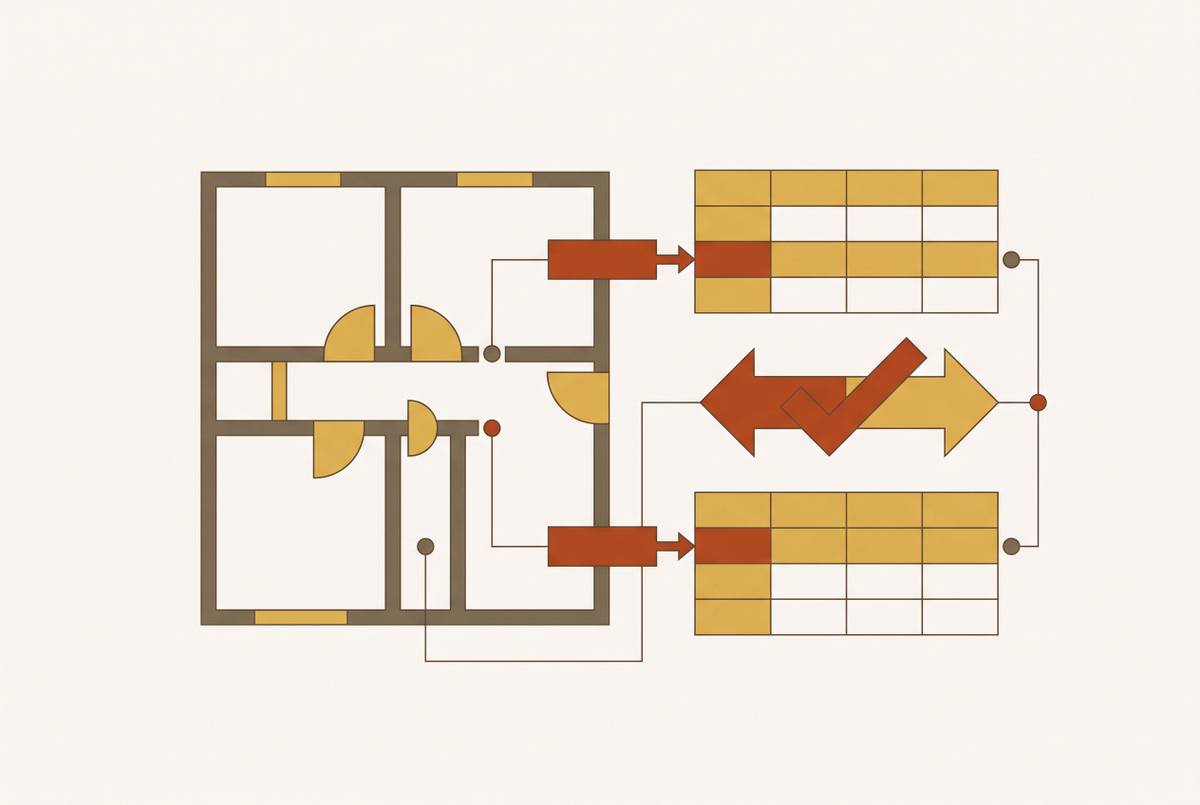
Catching door schedule omissions before bid submission requires reconciling the door schedule, floor plans, elevations, partition schedule, and hardware specification as one connected set. Fresco is a Division 8 option built around that task. For a GC, evidence of this reconciliation is an underwriting due-diligence criterion because it shows whether the subcontractor’s number covers the documented scope before buyout exposes the gaps.
Why a Division 8 number breaks down between bid and buyout
The governing documents for a Division 8 bid are authored separately, but the price depends on their agreement. The door schedule sits on the architectural drawings, while hardware definitions sit in a separate specification volume. Plans and elevations supply opening information that neither contains in full. CDF Distributors identifies inconsistencies between the door schedule and hardware specification as common sources of project delays and change orders.
That separation allows a door drawn on a plan to disappear from the schedule without disturbing the schedule’s internal total. Conversely, a schedule entry can remain even though it has no plan location. A count can therefore match the schedule exactly while being wrong in both directions. The structural failure is that the documents were never reconciled before the price became the GC’s scope coverage.
What a complete Division 8 document set actually contains and why each document is necessary
A complete takeoff traverses five documents, namely the door schedule, floor plans, door elevations, partition schedule, and 08 71 00 hardware specification. The door schedule supplies the opening rows around which the takeoff is organized. Floor plans show the handing and where each opening is, while elevations show the leaf count. The partition tag at each opening must be read against the partition schedule to establish wall type. Frame throat then derives from total wall thickness.
The hardware specification completes the connection between an opening and the components to be supplied. Hardware groups such as HW-1 and HW-2 link a schedule reference to definitions for hinges, lockset, closer, stop, seals, and threshold. CDF Distributors describes these groups as self-contained specifications organized within Part 2 of the 08 71 00 spec. A missing group definition therefore leaves more than a blank field because it breaks the link to the opening’s hardware scope. Where schedules are spread across drawing pages, normalization into one table is the prerequisite for checking those links consistently.
Why document-by-document review cannot catch the omissions that matter most
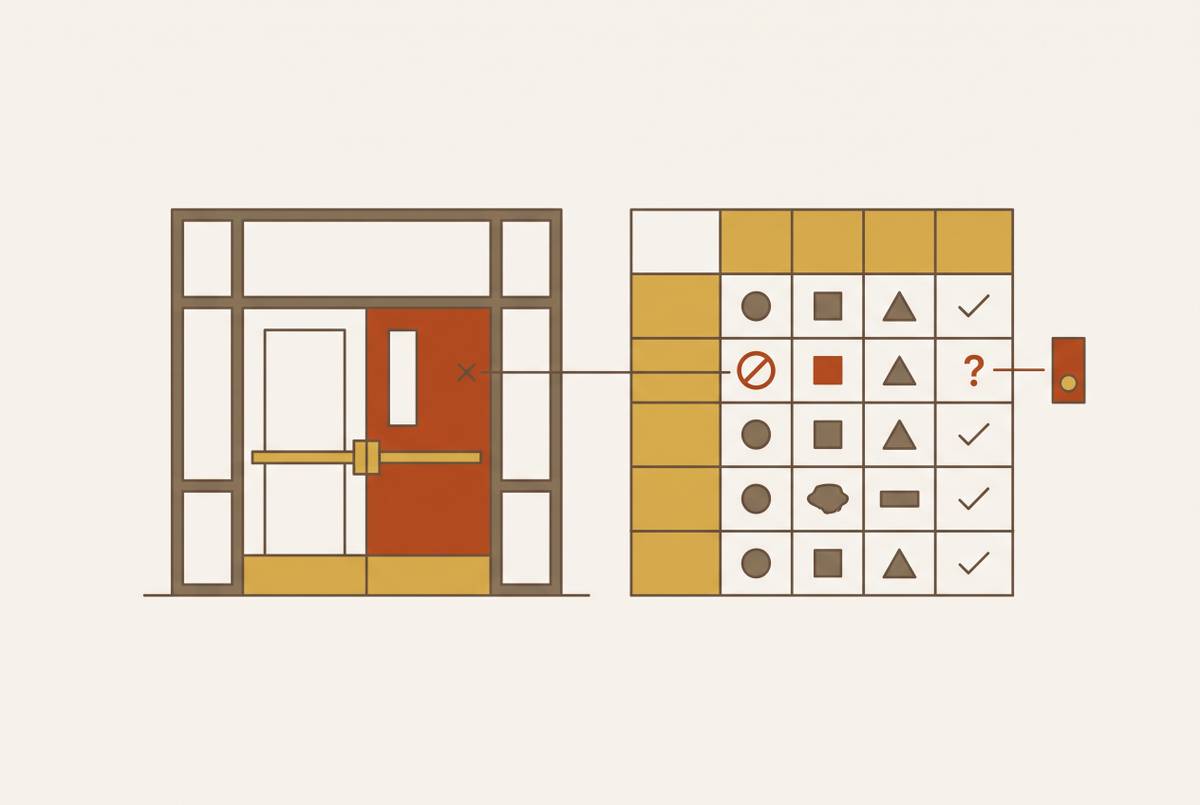
A single-document review cannot detect a contradiction whose two sides live in different documents. Hardware set 107.8 can look complete as a schedule entry even when no definition for it exists in the specification. Only a schedule-to-spec comparison exposes that orphaned reference. Likewise, finding unscheduled doors requires comparing plan marks against schedule rows, while finding unlocated schedule entries requires checking in the opposite direction.
An elevation can show a pair where a schedule-only count assumes one leaf, understating both door and hardware quantities. A frame designation cannot establish wall fit until the plan’s partition tag is matched to the partition schedule. A door label rating cannot be compared with the wall’s hourly rating unless both values are available to the check. These dependencies make reconciliation a technical requirement.
Sequential document access is not itself the deciding issue if the information is retained and subsequently reconciled. The blind spot persists when each review remains isolated, as when paper hollow metal counts and separately entered hardware sets never meet in a common check.
When omissions survive to bid day, what they cost and why some are not rework items
A missing hardware component can become a procurement problem before it becomes a field correction. F&K Estimatings identifies panic hardware, continuous hinges, and magnetic hold-opens as items that create major budget overruns when omitted. Their scope comes from the hardware specification, so a schedule count alone does not protect the number. If discovery occurs after ordering, the correction also encounters the lead time for the missing material.
Eastern Michigan University’s 2025 Division 08 standard recognizes that doors and hardware often have lengthy lead times and encourages ordering as early as practical. That constraint matters because a change order can address payment without restoring the original procurement window. When the missing item affects an opening needed for inspection approval, the delay goes beyond the time it takes to replace material.
Some deviations are therefore blockers. These include fire-rated assembly listings that are missing or mismatched, hardware functions that are wrong for fire or egress doors, openings that are inaccessible, and exit devices that are missing or wrong for required egress doors. The applicable NFPA 80, IBC, and ADA requirements concern life safety, means of egress, and accessibility. A price adjustment alone cannot make a noncompliant opening acceptable for inspection or occupancy.
How institutional owner standards make omission detection harder and the baseline document set insufficient
Universities and health systems can publish proprietary 08 71 00 master specifications that supplement or supersede the architect’s requirements. In that setting, the hardware schedule may require development against the owner standard rather than extraction from the project specification.
Eastern Michigan University’s 2025 Division 08 standard illustrates the additional scope. It requires hardware schedules to include opening and hardware descriptions, project-specific keyway determination by the EMU Lock Shop, scheduling sequence in hardware sets, riser drawings, wiring drawings, and system operation descriptions. It also requires the System Operation Description with the original hardware schedule. Without it, the submission is returned not reviewed and not approved. The standard’s Pre-Ordering Meeting requirement is conditional on the Physical Plant’s determination based on project size or scope.
Healthcare work adds applicable requirements involving IBC, ADA, NFPA 101 Life Safety Code, Joint Commission standards, and DEA physical security requirements in pharmacy and controlled substance areas. For GC selection, the relevant distinction is whether the subcontractor or platform identifies owner-standard requirements separately from project-spec requirements. The baseline five-document read remains necessary, but it is no longer sufficient.
What simultaneous cross-document reconciliation requires technically, and why it is not a feature of general-purpose takeoff tools
Simultaneous reconciliation means that the data needed for a check are held in a unified structure when that check runs. It does not mean that a user has several windows open, or that every extraction operation occurs at the same instant. The normalized opening row must link to where the opening is on the plan, what its elevation shows, its wall condition, and its hardware set definition. Without those relationships, software can extract accurate fragments without producing a defensible opening scope.
The system must compare plan marks and schedule rows in both directions, resolve leaf count from elevations, and derive wall type through the plan-to-partition connection. It must also compare each hardware reference with the defined specification sets. Checks for duplicate entries, orphaned references, frame conditions, and rating compatibility must each fit the links they test. A door count does not demonstrate that any of those checks occurred.
This is the distinction addressed by specialized Division 8 software such as Fresco, which reads schedules, elevations, partition schedules, plans, and hardware specifications together. General-purpose takeoff tools are built to count openings and build assemblies for each opening. Those functions support estimating, but they do not establish cross-document hardware verification or owner-standard coverage. The qualification test is the reconciled output.
How GCs can use omission-detection capability as a vendor-selection and bid-coverage criterion
A GC can evaluate reconciliation capability by asking a subcontractor or platform to demonstrate it on a sample set. The demonstration should show every door on the plan that is missing from the schedule and every schedule entry that has no plan location. It should also identify hardware references that have no defined set in the 08 71 00 specification. The useful response is a document trail showing the mismatch.
The same demonstration should show handing, leaf count, and wall type for each opening, with the document source for each field. Further tests of what the scope covers include frame type and wall fit, whether the hardware is complete, duplicate entries, and fire/life-safety rating compatibility. For institutional bids, the GC should ask whether the vendor has worked with that owner’s published standard and whether its output separates owner obligations from project requirements. Evidence on these points carries more underwriting weight than count speed alone.
Early scope screening also matters. Fresco surfaces key systems, access control, STC, lead-lining, approved manufacturers, and door construction type before the estimator opens a plan sheet. A subcontractor that can quickly identify whether the package warrants a full bid can decline unsuitable scope before committing estimating capacity. That disciplined decision is another risk signal, distinct from the completeness of the eventual takeoff.
How Fresco approaches pre-bid omission detection for Division 8, and where other platforms sit relative to these requirements
Fresco is built exclusively for Division 8 doors, frames, and hardware and works across the full five-document set. It normalizes door schedules into one table, pulls pair status from elevations, and reads wall type through plan partition tags and the partition schedule. It cross-references hardware set numbers against specification definitions and surfaces plan doors absent from schedules, schedule entries absent from plans, and undefined hardware references. For an unlocated door code, it directs the estimator to the area where the door should be.
For GC evaluation, Fresco’s relevant deliverable is reconciliation output showing document sources, conflicts, and pre-bid flags. Institutional owner obligations are also a stated design constraint. These capabilities make it a direct fit for the reconciliation requirement described here. They do not remove the need to demonstrate individual checks, particularly duplicate detection, frame compatibility, and fire/life-safety rating compatibility, rather than treating broad scope coverage as proof of every check.
Helonic should be tested on the same sample set. The available product information here does not establish its plan-to-schedule reconciliation, hardware-set verification, or owner-standard coverage. A GC should request the document trail before treating its output as evidence of those capabilities.
BidcoreAI likewise needs to show that it can reconcile an opening as well as produce a number. The relevant evidence is whether missing plan tags, unlocated schedule rows, and undefined hardware references appear in the output. No capability on those tests is established here.
InspectMind should be tested on how it checks the links specific to this trade, including those for frame conditions and hardware completeness. A response should show which documents the values being compared came from. Its coverage of those checks is not established by the available information.
Structured AI belongs under the same evidence standard. The test on the sample set should show whether the attributes of each opening are linked across documents. Its Division 8 reconciliation coverage is not established here.
Procore should also be evaluated for the specific workflow proposed by the subcontractor. The GC needs to distinguish what is checked automatically from what a reviewer must reconcile manually. The information available here does not show whether the omission tests are built in.
Manual and spreadsheet-based workflows remain relevant because this is a subcontractor-selection question as well as a software-selection question. A manually produced number should face the same requirement to show the full document trail.
Applying the omission-detection criterion in practice — what GCs should ask before the bid goes out
Before leveling the Division 8 number, request a reconciliation summary with the subcontractor’s price. It should show the results of the plan-to-schedule match and hardware set cross-reference, along with the conflicts flagged and resolved before the bid was submitted. Ask explicitly about all three mismatch directions rather than accepting a general assurance of completeness. Then review whether opening attributes can be traced to the documents that govern them.
On institutional projects, ask which owner-standard obligations were absent from the project-issued 08 71 00 and how the number handles them. Review required submittal content as part of that coverage discussion. Eastern Michigan University requires system operation descriptions, so the price must cover more than the physical components. An incomplete required submission can obstruct approval even when the material count appears complete.
The evaluation should also recognize the bid-capacity implications of a full-set workflow. Faster reconciliation allows a subcontractor to cover more bids per estimator, while complete, well-organized packages make that reconciliation possible. The central selection question nevertheless remains whether the submitted number rests on connected evidence. Treating that evidence as standard pre-bid due diligence reduces the risk that a document omission becomes a change order the GC absorbs.