Division 8 Specific Estimating Software Vendors Compared
Hardware-aware platforms catch spec mismatches that opening-count tools miss.
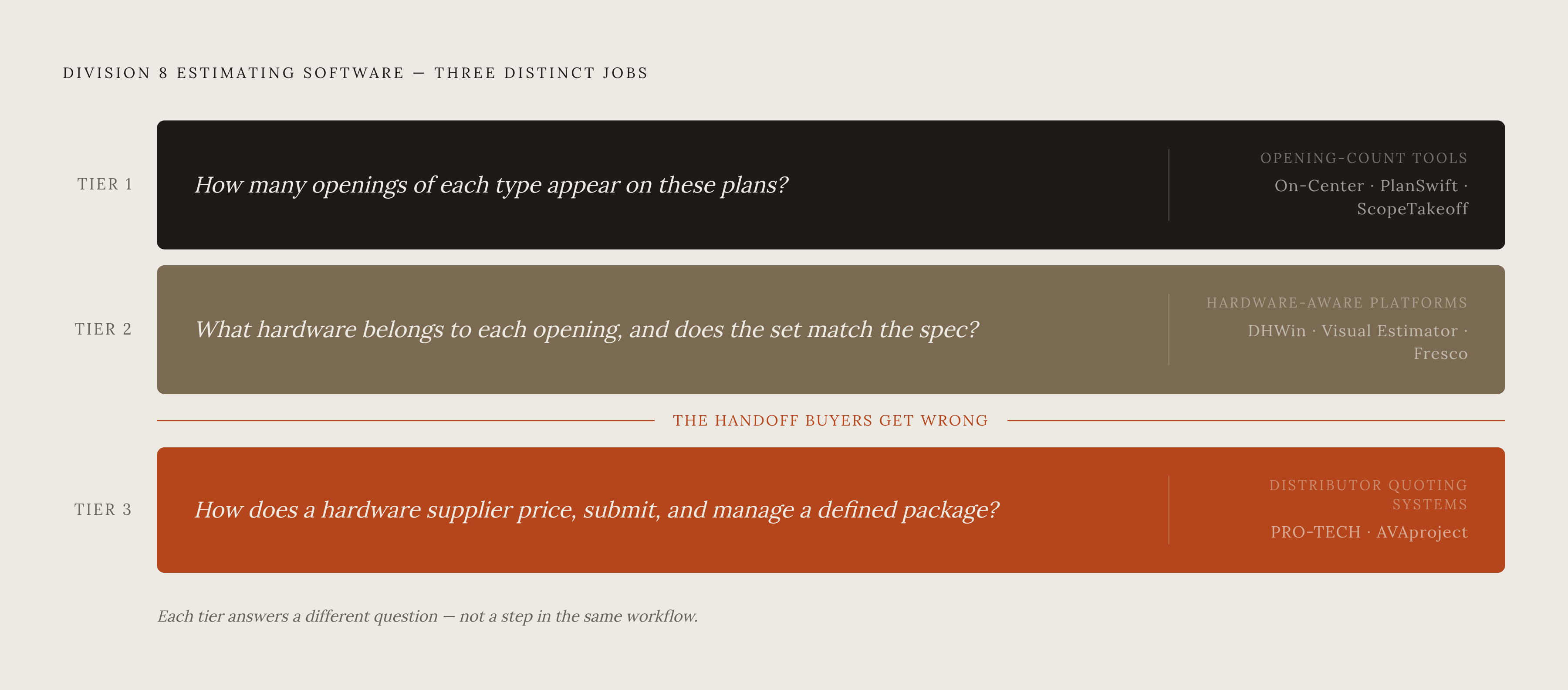
Division 8 estimating software is not one product category with ten competing brands. It breaks into at least three separate categories of tool, each built to answer a different question, so which vendor you pick depends on which question you need answered. A tool built for counting openings off a plan can't tell you whether the hardware assigned to a given door matches the spec, and a tool built for hardware reconciliation can't do a distributor's submittal and pricing workflow. Software purpose-built for Division 8, meaning doors, frames, and hardware specifically, breaks into opening-count tools, hardware-aware estimating platforms, and distributor-side quoting systems, and this piece compares named vendors in each tier against what the work actually demands.
Why Division 8 estimating software is not one category
Most buyers shop for estimating software the way they'd shop for anything else: compare price, read reviews, pick the one with the cleanest interface or the biggest name. That approach fails here, because the real differences between these tools are not cosmetic. Opening-count tools answer one question: how many openings of each type appear on these plans. Hardware-aware platforms answer a harder question: what hardware belongs to each opening, and does the set actually match what the spec calls for. Distributor and rep quoting systems answer a third question entirely: how does a hardware supplier price, submit, and manage that package once it's been defined. Each tier is a different job rather than a different level of the same tool.
The cost of picking the wrong tier is not a visibly broken number. An opening-count tool will produce a door count that is accurate and a hardware total that looks complete, because the software never knew to ask whether the hardware matches the opening it's attached to. Hardware takeoff is fundamentally a relationship problem: a hardware set only matters because it belongs to a specific opening with a size, a fire rating, a frame type, a function, a handing, and a use case. If you copy that set wrong, or let it contradict the spec, the error doesn't announce itself. It survives, quietly, until pricing or submittals, where the cost of fixing it is much higher than the cost of catching it at takeoff.
What the documents demand before any software touches them
A complete Division 8 takeoff requires reading several documents at once: the door schedule, the hardware specification, the elevations, the partition schedule, the floor plans, and Section 087100, which is the written hardware spec itself. Reading them one at a time, in sequence, is the most common reason items get missed. The structural mismatch between how the documents are organized and how the work actually needs to be checked, not the estimator's attention, is what causes items to get missed.
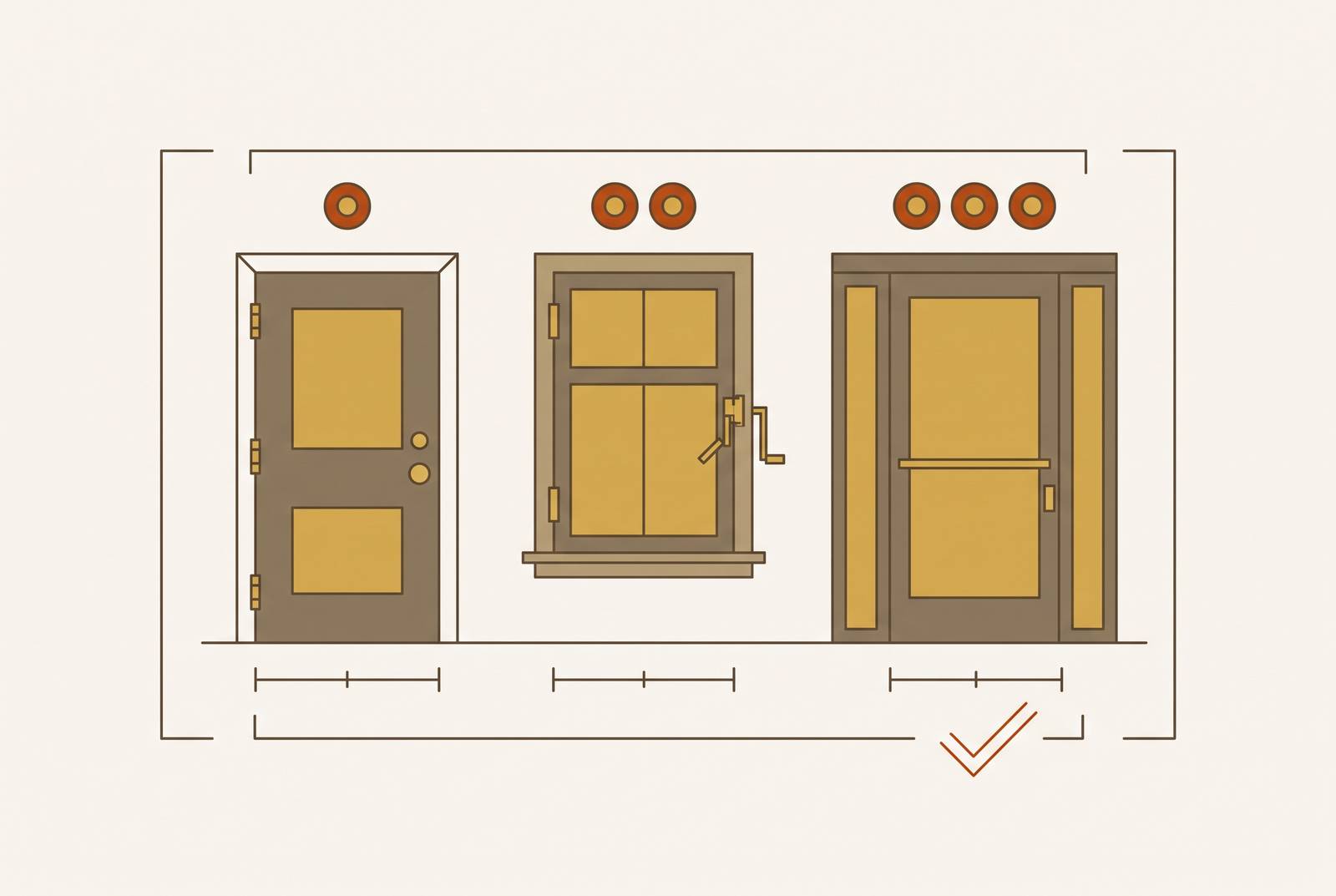
The door schedule is the bridge between the architectural drawings and the hardware spec. Each row on it represents a single opening, carrying the door number, size, material, frame material, fire rating, glazing requirements, and the hardware group number assigned to it. A hardware group, or hardware set, is a numbered list of every component a given door type requires: hinges, the lockset or latchset, closer, stop, seals, threshold, silencer, and any specialty items like kickplates or coordinators. Every door assigned to the same group gets identical hardware, and the hardware consultant assigns those groups based on function, location, fire rating, accessibility, security level, and how much traffic the opening sees. Door schedules routinely contain inconsistencies between what they list and what the written spec says, and those mismatches are a common source of delays and change orders later in the job.
The City of Santa Fe's Fire Station No. 2 specification, Section 087100, shows what that complexity looks like in practice. Set 1.0 in that document, the most complex exterior opening in the spec, carries hinges, a removable mullion, two exit devices, a mullion cylinder, a closer with drop plate, a threshold, gasketing, mullion gasketing, and sweeps across eleven lines. Several of those lines use a finish code, EN, that isn't decoded anywhere near the line itself, it's defined elsewhere in the section. One line is marked OT, meaning that item is out of scope and someone else is buying it, and that designation appears on most of the live sets in the document. Other lines carry no finish. Each one of those gaps is a price the estimator has to invent rather than read.
Owner standards add another layer on top of project specs. Cornell publishes hardware sets with no finishes stated and every hinge line simply reading "As Required." Michigan State doesn't publish numbered sets at all; it gives you only a 13-page Part 1 General section organized by component type, so the estimator has to match each door's usage to the right row and repeat that match for every opening on the job. A tool that reads only the door schedule, without the spec alongside it, has no way to catch set numbers that differ between the two documents, doors assigned to sets marked "(NOT IN USE)," or electrified hardware that's easy to under-carry on a fast bid. That's precisely why a platform like Fresco is built to read the door schedule, the spec, the elevations, and the floor plans at the same time, rather than leaving the cross-referencing to the estimator.
The quantity-per-item question every tool answers differently
The single most expensive ambiguity in Division 8 takeoff has nothing to do with document complexity and everything to do with a convention the trade has never fully settled: whether hardware quantities should be counted per opening or totaled per item across a set. A tool that doesn't surface this question to the estimator will still produce a number, just not a correct one. That number will look right, but it won't be.
The disagreement is not theoretical. Emilio Bendever, a working detailer, raised the issue publicly in 2025 after his estimating platform returned a total quantity across all the openings in a set rather than a quantity per door. He found that hard to accept, noting that every other program he'd ever used showed the quantities per door, which meant an architect reviewing the submittal would have to do math just to verify what should have been shown directly. Lori Greene, Manager of Codes and Resources at Allegion, answered from the code side of the argument: "Unless something has changed, the hardware set should show the quantity per opening." The Santa Fe spec itself backs that reading, stating that the quantities listed apply to each pair of doors or each single door.
So the convention sits unresolved between the trade's working detailers, its most-cited code authority, and its most widely used software, and no single body enforces one answer. Get the basis backward on a 40-set project and every downstream number is wrong by a multiple, not an error margin, and nothing about the output looks broken because the figures stay internally consistent with each other even while being wrong against the spec. This is the single most useful diagnostic question an estimator can bring into any vendor demo: does the tool ask which basis you're working on, or does it just decide for you and show you a number without telling you which convention it used to get there?
Tier 1: Opening-count tools
Opening-count platforms are genuinely useful for what they're built to do: counting and measuring openings off a set of plans quickly and accurately. Where they stop being useful for Division 8 work specifically is the hardware layer, which they either skip or treat as generic line items rather than sets tied to a spec.
On-Center has long been a standard in click-and-drag takeoff, through its On-Screen Takeoff and Quick Bid combination. It counts doors, swings, frames, handles, locks, stops, and hinges across a project, and its AI-assisted Takeoff Boost feature returns a first-pass count in seconds. Those quantities then flow into Quick Bid, which prices doors, frames, and hardware sets along with labor. It's a desktop application built for Windows, priced through a quote rather than a public price list, and it remains one of the most established tools for counting commercial doors, frames, and hardware, even though its hardware handling stays at the pricing level rather than the reconciliation level.
PlanSwift, now under Trimble, offers on-screen takeoff and estimating with precise digital measurement from PDFs, CAD files, and scanned plans. For door work, it counts doors, frames, hardware, and openings through assemblies the user builds and customizes, and it generates cost estimates and door schedules with Excel integration. Because the assembly structure is fully customizable, how well it covers hardware depends entirely on how carefully the user has built and maintained that assembly database. It isn't a workflow designed around Division 8 conventions from the ground up, it's a general takeoff tool that can be configured toward them.
ScopeTakeoff targets commercial door and window subcontractors directly: estimators count openings off plans, build per-opening assemblies combining door or window, frame, hardware, and install labor, and submit a Schedule of Values to a general contractor. It runs as a web-based tool across Mac, PC, tablet, and mobile, priced by subscription per person per month with no annual contract required. It supports PDF plan takeoff with openings grouped by type and repeated across the schedule, and it produces Schedule of Values output directly, with material and labor tracked on separate rails. It has no automated hardware-set scheduling logic, no live supplier price feeds, and no fabrication features like cut lists or a frame configurator. Hardware on this platform is a set of line items the estimator controls directly rather than a set of sets reconciled against the 087100 spec. If you're a commercial Division 8 install subcontractor, it's a strong, affordable fit, even if it carries less name recognition than On-Center.
Across all three, hardware coverage is at the line-item level: hardware gets priced, not checked against the spec. None of these tools reads the hardware specification alongside the door schedule to catch conflicts, confirm set assignments, or flag items marked out of scope. That step stays manual, which is the exact gap the next tier of software is built to close.
Tier 2 (Hardware-aware estimating platforms built for the Division 8 trade)
Dedicated Division 8 estimating platforms build hardware sets directly into the estimate rather than treating hardware as a list of priced parts. Their accuracy, though, still depends on two things: how well-maintained the estimator's hardware database is, and whether the tool actually reads the spec or just the door schedule.
DHWin, from Kelleher Corporation, is built specifically for doors, frames, hardware, and accessories. It automates takeoffs and generates door schedules, bills of materials, and cost estimates, and it supports complex project configurations, custom specifications, and integration with CAD and project management tools. Pricing is quote-based. How deep its hardware-set logic goes, and whether it reconciles the door schedule against the written spec, isn't documented publicly in much detail. Estimators evaluating it should ask directly in a demo how the tool handles discrepancies between a set number on the schedule and what the 087100 spec actually defines for that set.
Visual Estimator, from DEW Software, is a Windows-based tool built around visual takeoff from digital plans, letting users measure openings and generate bids with labor, material costs, and assemblies built in. It carries extensive customizable databases for doors, hardware, and accessories. Because the tool runs on a maintained pricing database rather than live feeds, it carries the same stale-pricing risk the trade has reported elsewhere: published accounts put a typical database price somewhere between a month and a quarter behind the manufacturer's current book price, and any item new to the database has no purchase history behind it to check against.
Fresco is an AI-powered takeoff platform built exclusively for Division 8, and it covers doors, frames, and hardware only. It reads the door schedule, the hardware spec, the elevations, and the floor plans at the same time rather than forcing the estimator to cross-reference them by hand, and one Division 8 subcontractor described a takeoff that used to take more than a day being completed in under an hour on the platform. It treats hardware as part of each opening's record rather than a disconnected list, which gives the estimator a review surface that reflects the actual relationship between a door and its hardware set rather than two separate lists that happen to share a project. It's built to handle institutional work where hardware sets have to be authored against an owner's own standards, such as Cornell's or Michigan State's, rather than simply lifted from a standard project spec. The platform is SOC 2 Type 2 certified and is used by commercial door contractors, Division 8 subcontractors, door hardware distributors, and estimators, currently through an early access model. Users quoted on the platform have called it "a game changer" and said it's "going to help me maximize and get more work done," with one noting, "I'm one person and I can't do everything." Fresco and other AI-based entrants in this space are early-stage, with thin public track records, so the time-savings and accuracy figures circulating about them are each company's own claims, not independently audited numbers. Estimators evaluating any of them should ask for a live takeoff run against a job they already know the answer to.
Even at this tier, the hardest gap to close is electrified hardware, which stays easy to under-carry on a fast bid regardless of which platform is doing the counting. Pairs, fire-rated openings, and special conditions all need a closer human look no matter how capable the software is.
Tier 3 (Distributor and hardware rep quoting systems)
Distributor and hardware rep quoting platforms serve a different job entirely: pricing, submitting, and managing a hardware package once it's already been defined, for the supplier selling into the job rather than the contractor estimating it. Treating these as substitutes for a Tier 1 or Tier 2 takeoff tool produces a mismatch, just a different one, because these systems assume the takeoff work is already done.
PRO-TECH, from ASSA ABLOY, is built specifically for contract hardware distributors, and it can manage door openings on projects of any size. You can run it as on-premises software, as a cloud-based deployment through PRO-TECH V8, or exclusively through the cloud as PRO-TECH TITAN.
People have called AVAware, through its AVAproject and AVAproject Fusion products, the leading Windows-based software built specifically for the architectural door and hardware industries, and it's used worldwide and supported by major manufacturers. AVAproject Fusion is described as the only solution in the architectural openings industry built to integrate with virtually any accounting or ERP system, which positions it squarely as back-office infrastructure for a distributor's business rather than a counting tool for a contractor's bid.
These systems sit at the opposite end of the workflow from opening-count tools. Tier 1 and Tier 2 software exist to give you an accurate quantity and an accurate hardware set before a bid goes out, but Tier 3 tools take that already-defined package and move it through pricing, submittal, and project management on the supplier's side. Knowing where that handoff happens is what keeps a contractor from buying a distributor's ERP system expecting it to do takeoff, or a distributor from buying a takeoff tool expecting it to manage submittals.