Bid-Stage Completeness Engines and the Multi-Document Gap They Were Built to Close

Catching door schedule omissions before bid submission requires reconciling the schedule with elevations, partition schedules, floor plans, and the 087100 hardware specification at each opening. A bid-stage completeness engine checks those documents against each other to find missing fields, pair-door miscounts, and hardware-set conflicts that a correct opening total cannot show. Its value is both a more defensible bid and more bids completed within the same estimating capacity.
Why Division 8 errors live between documents, not inside them
A door list records what the schedule says. A defensible bid accounts for what the other documents say about the same openings. That distinction matters because a complete Division 8 document set spans at least five sources, including the door schedule, door and frame elevations, partition schedule, floor plans, and 087100 hardware specification. Each is authored by a different hand, at a different time. No automatic mechanism forces those sources to agree. An accurate transcription of one can therefore preserve a contradiction with another.
Even when a schedule is read correctly and its quantities are added correctly, the bid can leave out requirements shown in other documents. Those requirements do not become visible through another calculation on the same list. Comparing the documents at the opening level makes those requirements visible. The relevant measure of completeness is therefore not whether every schedule row has been counted, but whether each opening has been reconciled across its sources.
The three cross-document failure modes that dominate Division 8 bids
Missing schedule columns are the first pattern. Architects routinely omit fields such as handing, leaf count, wall type, and existing frame, leaving information that the schedule cannot supply from within itself. Wall type illustrates the dependency clearly. The partition tag on the floor plan must be cross-checked against the partition schedule to establish the wall type associated with the opening. Treating the absent field as a schedule-only problem leaves the estimator without the document relationship needed to fill it.
Pair-door miscounts are the second pattern. A pair is one opening with two leaves, and a takeoff needs both quantities. The schedule may not identify pair status, while the elevation shows the two leaves drawn. That information must be carried back to the corresponding opening. Separate opening and leaf-count columns preserve the distinction that an opening total alone conceals.
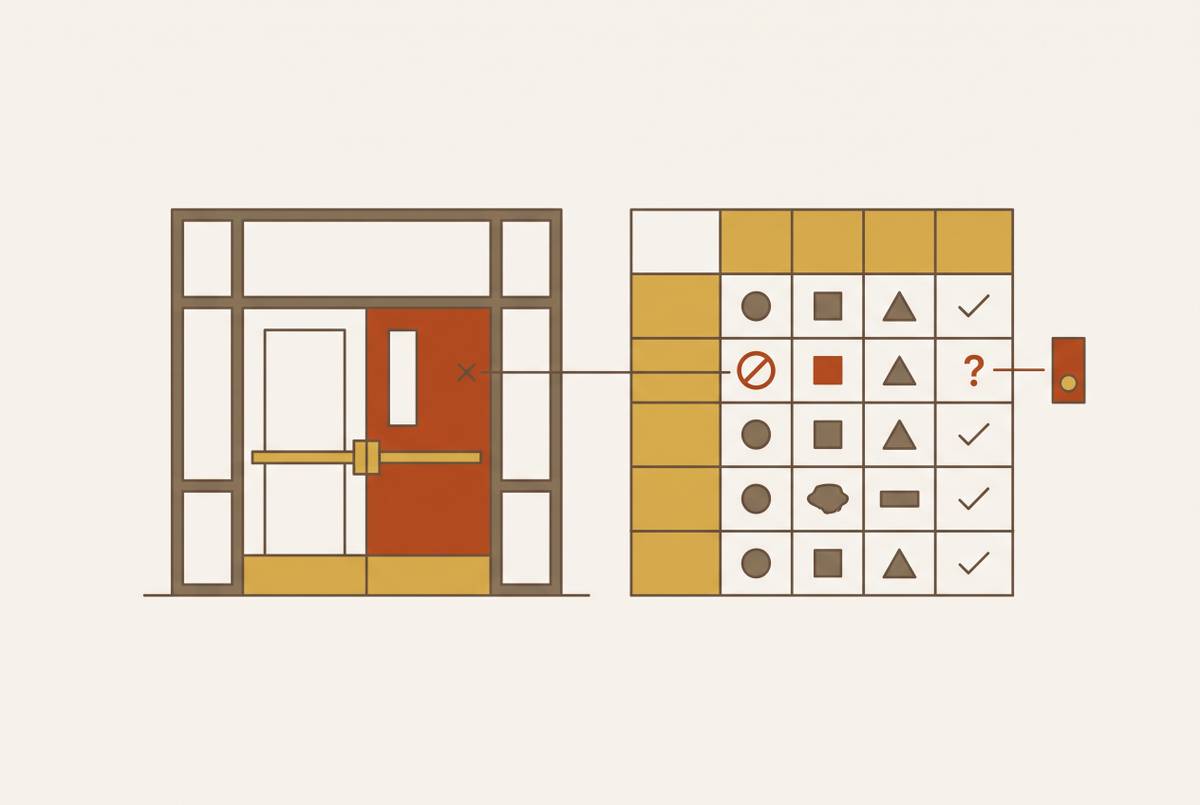
Hardware set conflicts are the third pattern, and the most counterintuitive because the count is right while the bid is wrong. A door may reference a hardware set that does not appear anywhere in the 087100 spec. Every opening can still be counted, but the hardware behind that assignment is missing entirely. A related conflict occurs when the schedule and specification assign different sets to the same door. Neither changes the opening total, so only a comparison of the set assignments and specification content exposes the problem.
Why manual workflows cannot close a gap that is structural
The multi-document gap is structural. Even an experienced estimator works within the cognitive and physical limits of a document-by-document process. Reading one source, moving to another, and later returning to an earlier assumption requires information to survive each handoff. Holding several documents open can expose an individual conflict, but it does not keep the full construction set in active comparison at scale. Greater diligence does not remove that constraint.
SMA Estimating describes a sound manual sequence that begins with schedules, counts one type at a time, marks matchlines, reconciles against the schedule, and logs assumptions. Those steps organize the work and give the estimator a method for reviewing it. They still depend on sequential reading and repeated human comparison, however. The process can catch specific omissions without eliminating the conditions that allow others to survive. This is why the solution requires a different architecture rather than simply faster counting or another review of totals.
What a bid-stage completeness engine actually is and how it is architected
A bid-stage completeness engine is a system that reads the Division 8 document set together and reconciles its contents at each opening. Its defining property is the ability to hold the five document types in a shared comparison. Simultaneous reading is therefore the engineering requirement that follows from the location of the errors. A system that processes each document in isolation and checks totals at the end has not addressed that requirement.
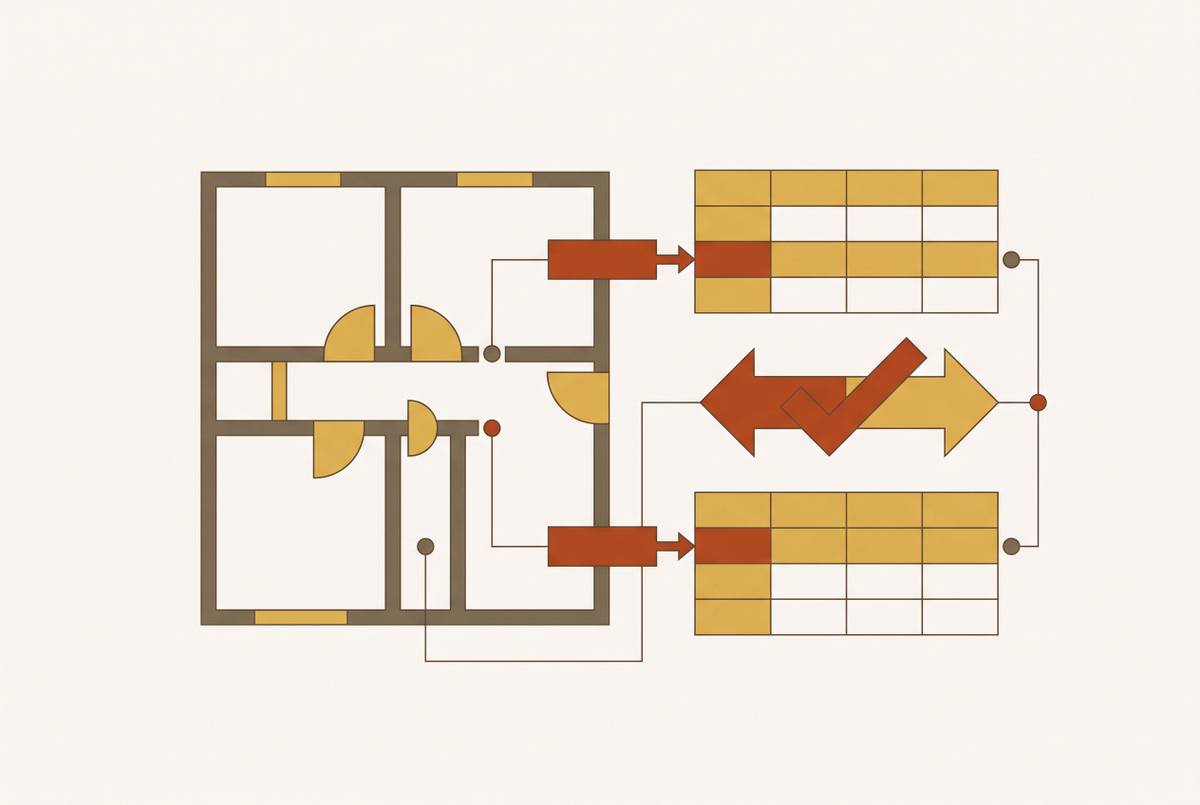
In practice, simultaneous means that the document readings feed a shared opening-level table where their relationships can be tested. Schedule normalization, elevation normalization, floor plan mark-off, and hardware specification cross-reference all feed the record for the same opening. The engine compares the schedule’s hardware assignment with the sets present in the 087100 spec, the scheduled leaf count with the elevation, and the opening with its presence on the floor plan. The common record is what turns separate readings into reconciliation.
This architecture also distinguishes a missing field from a decision that the documents cannot settle. Information present in another source can fill a schedule gap, but contradictory hardware assignments still require a judgment about which document governs. A completeness engine presents both conflicting values to the estimator. When an opening is missing, it returns a location on the plan.
How Fresco and other purpose-built tools implement the completeness engine model
Purpose-built openings tools can read a PDF, but their scope determines which parts of this workflow they address. Fresco is built exclusively for Division 8, and its foundational engineering principle is to treat the five-document set as one reconciliation problem. Its published architecture describes four to five passes feeding a shared opening-level table. Hardware-set cross-referencing and pair detection are explicit outputs of that design.
Fresco’s published takeoff methodology describes how it fills missing schedule columns from elevations and plans, reconciles pair-door counts, and checks hardware assignments against the specification. These operations expose the three patterns together rather than leaving each for a separate manual review. Fresco describes a takeoff that once required about a week being completed in under an hour, with blank schedule fields filled from the other documents. That time comparison concerns only the takeoff workflow described.
Upbuild targets Division 8 commercial door and hardware distributors and carries jobs from takeoff through estimating, submittals, conversions, purchase orders, and delivery. It can read architectural drawings, door schedules, hardware specifications, and construction documents that are in PDF format. That scope addresses a broader distributor workflow, but the ability to analyze those documents is not by itself evidence of simultaneous opening-level reconciliation. CDF Distributors approaches completeness from the quoting side through ProBuilder. The user selects door type, fire rating, function, and hardware preferences, and the tool generates a compatible assembly rather than reconciling the project’s five-document set.
ScopeTakeoff supports PDF plan takeoff to count openings by type and build assemblies for each opening that include the door or window, frame, hardware, and install labor. It also provides SOV output for GC submission. Those functions help assemble and price scope, but assembly building is a different task from detecting a conflict between an assembly and the specification. The same distinction applies to general-purpose takeoff platforms whose hardware logic operates at the line-item level. Reading documents, configuring compatible components, and reconciling conflicting sources are separate capabilities, even when they contribute to the same eventual quote.
The institutional case — when the completeness engine must author hardware sets, not just extract them
Universities and hospital systems have owner standards that may narrow or override what the architect’s project specification allows. The contractor or distributor is therefore pricing against two sets of requirements at once. Even a hardware set read correctly from the project spec may fail to meet the owner’s requirements. In this case, completeness depends on constructing the required set.
The University of Iowa Health Care Architectural and Engineering Design Standards makes that layer concrete under Section 08 71 00. It mandates finish US 26D satin chrome for interior doors and specifies hinges as full mortised, square cornered, five-knuckled, ball bearing, template, polished, and plated. Its approved manufacturers include Hager, McKinney, and Stanley. These are component and finish constraints that affect what belongs in the hardware set.
Other owner documents show that the layer extends beyond a fixed product preference. Cooper University Hospital’s Construction Project Design Standards, Revision 4, January 2025, added a specification for emergency release hardware under Section 1/Division 08/Door Hardware (087100). The University of Michigan AEC master specification log records a September 2017 update to Section 087100 Door Hardware revising part numbers on office locksets for classroom use. The Michigan DTMB Door Hardware Specification, updated April 30, 2025, requires all required materials to come from a factory-authorized dealer within a set radius of the project. That supplier constraint is not visible in the project documents themselves.
A completeness engine for institutional work must therefore hold the owner standard as a parallel specification layer. It must flag or resolve conflicts between that layer and the project requirements. For institutional jobs, Fresco distinguishes this work as authoring hardware sets against owner standards. On a standard commercial job, the engine confirms the set found in the specification. On an institutional job, it constructs the set from the owner requirements and then compares it with the project spec.
What simultaneous reconciliation changes for bid volume and distributor quoting
The business consequence of reconciliation is a change in how many pursuits can reach bid-ready completeness. A full manual Division 8 takeoff, including cross-document reconciliation, consumes a full working day or more per pursuit. That ties the number of competitive bids closely to estimating headcount. Automating the comparison reduces the time required for each bid and shifts the capacity constraint toward bid board management. The estimator’s judgment about which work to pursue becomes more important than the hours needed to carry information between documents.
Hardware distributors face the same constraint through quote attempts. A distributor receives the specification and door schedule, prices the hardware package, and submits a bid, often within a limited quote window shaped by material cost volatility. The distributor bears the quoting cost whether the job is won or lost. Reading the specification and schedule together cuts the routine work needed for each attempt.
A misread hardware conflict can be applied consistently across every affected opening. The engine must expose the conflict and preserve the estimator’s decision about which source governs. Completeness depends on that decision boundary as much as on the breadth of document reading.
More of the working week can go toward completing bids instead of repeating the same cross-document comparisons. Closing the multi-document gap makes more bids per estimator, per distributor, per week possible without adding headcount.