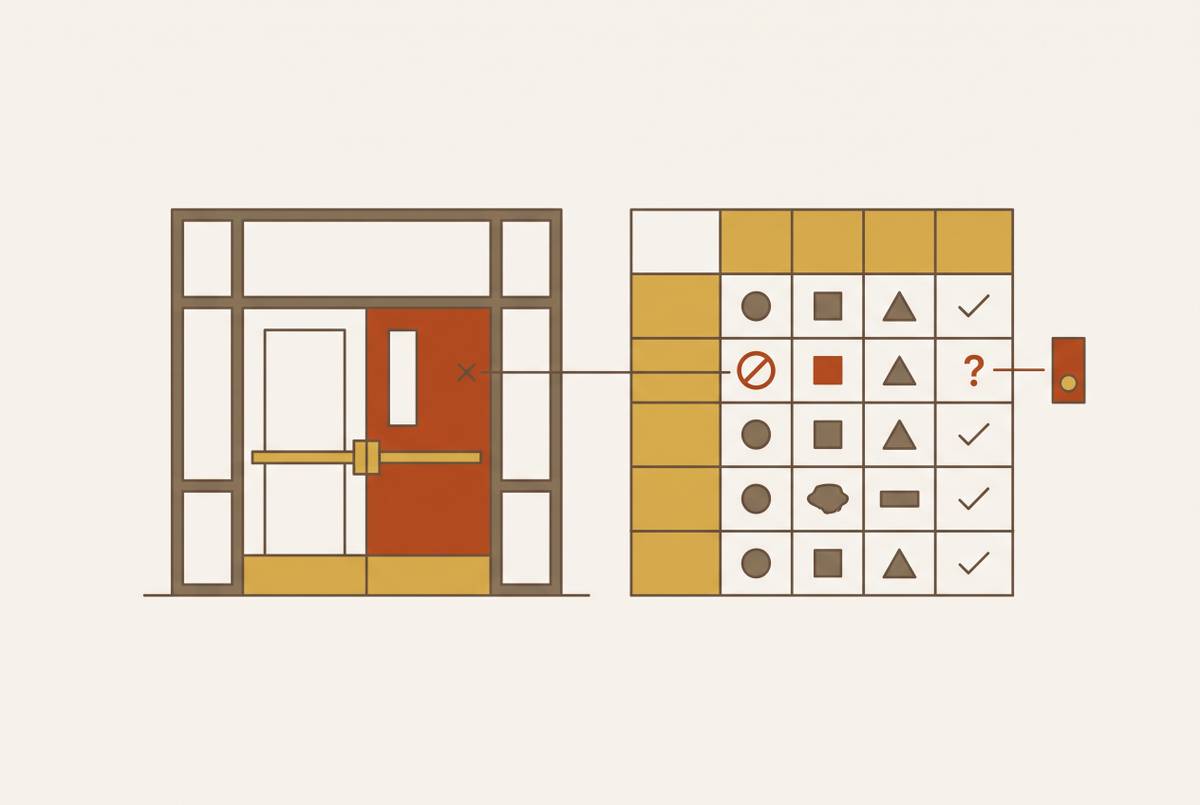
How 08 71 00 Specs and Door Schedules Conflict in Real Projects
Reading door schedules and specs together catches conflicts that sequential review misses.
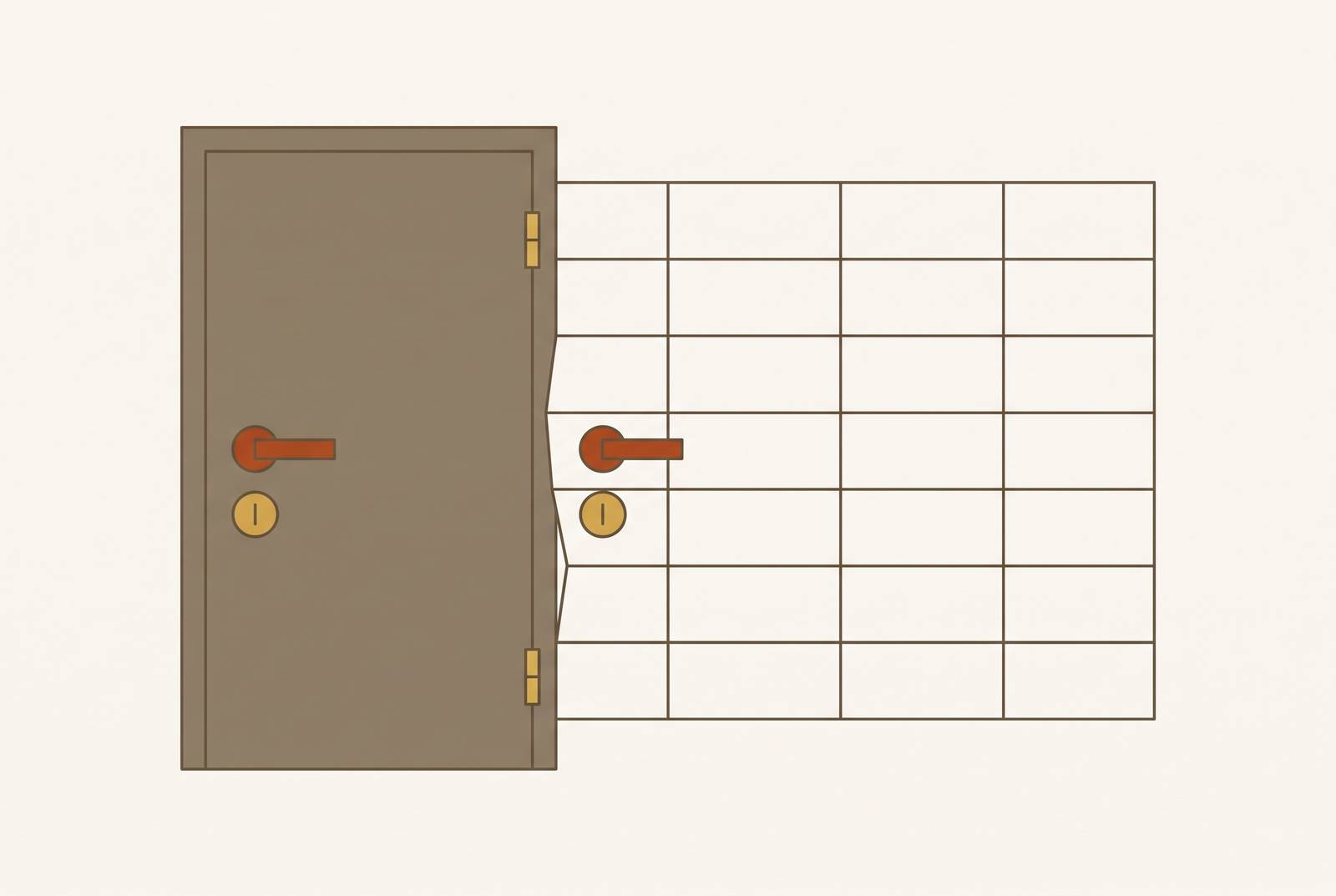
Door schedule omissions get caught before bid by cross-referencing four documents simultaneously, not sequentially: the door schedule, the hardware groups in the 08 71 00 spec, the floor plans, and any owner-specific hardware standard. Most estimators review these one at a time and reconcile afterward, which is exactly the gap where missing hardware sets, fire-rating mismatches, and mis-handed openings survive into a bid price. The fix is reading all four documents together, opening by opening, a standard that manual review rarely meets at any real project scale.
Causes of door schedule and 08 71 00 spec divergence
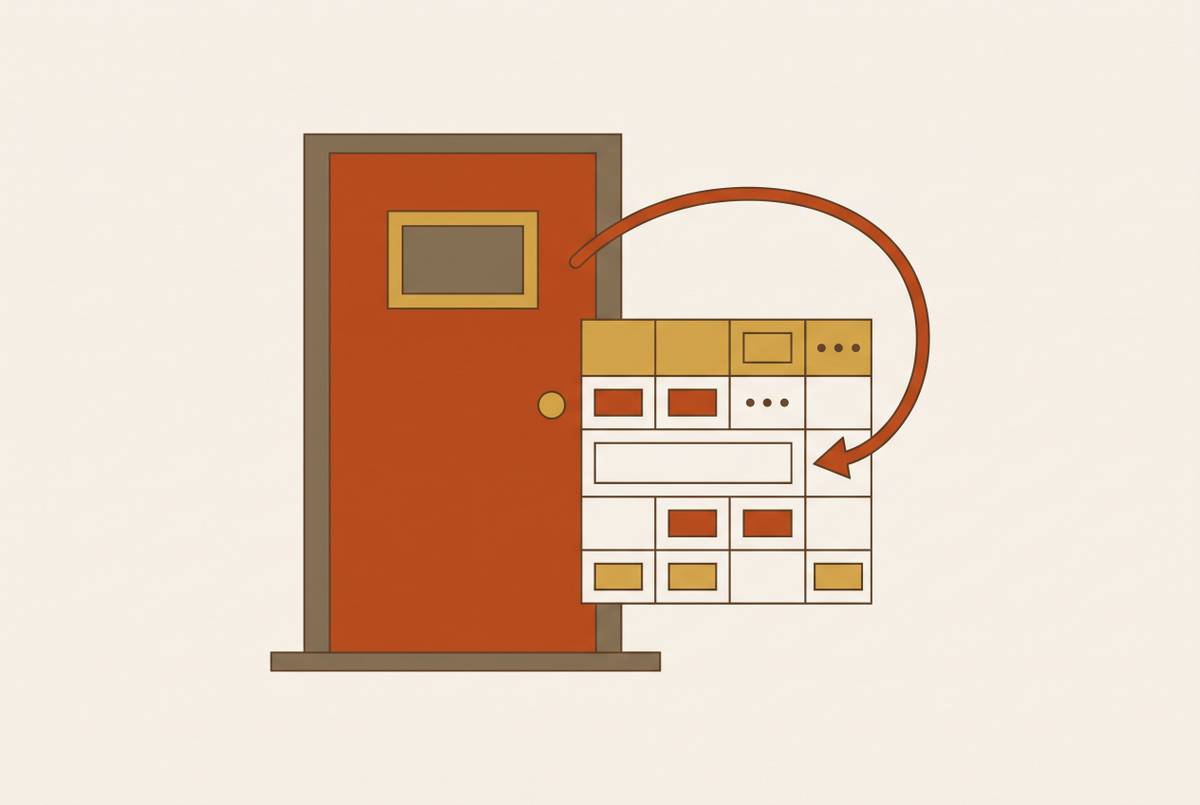
These conflicts don't come from careless drafting. They come from a process that separates two interdependent documents by author, by timing, and by physical location in the project manual. The door schedule is a tabular document that sits on the architectural drawings, usually on the A-series sheets, prepared by the architect. That group number is the only link between the drawings and the hardware spec, and it's a thin one: a single cell in a table, pointing to a document the architect may not have authored.
An AHC (a hardware consultant) or a manufacturer's representative often builds the 08 71 00 spec, and that work doesn't run on the architect's schedule. The hardware consultant assigns these groups based on function, location, fire rating, accessibility, security level, and traffic volume, a judgment process that runs on its own logic and its own schedule, separate from whatever the architect was thinking when the door schedule entries were drawn up.
Neither document lives anywhere near the other inside the project manual. A reviewer checking one against the other has to physically move between two separate documents, produced by two separate parties, at two separate points in the design process. It's a predictable output of how the documents get made, and it's why errors and inconsistencies between the door schedule and the hardware specification remain one of the most common sources of project delays and change orders in commercial construction.
How the door schedule and the spec interlock
The system is designed to work, but only under a specific condition: the door schedule and the hardware spec have to be read together, opening by opening, not reviewed as two separate documents checked off in sequence. That's a simple instruction to state and a hard one to carry out across a building with hundreds of openings.
In practice, the workflow runs like this. It tells the estimator or distributor how many doors carry the HW-3 designation. The estimator has to hold both in view at once. Every door number in the schedule has to resolve to a valid, defined hardware group in the spec, and every hardware group in the spec needs at least one door assigned to it on the schedule. An orphaned hardware group and an unassigned door are both errors that a side-by-side reading of the two documents catches, while a sequential review of each one alone tends to miss them.
For that cross-reference to hold up, the schedule has to carry a specific set of data for every opening: door number, door type, opening width and height, whether it's a single or a pair, door thickness, door material, frame material, fire rating, glazing requirements, and the hardware group assignment. The same WCU spec requires the supplier to check specified hardware for suitability against actual field conditions and to flag unsuitable or incompatible items with proposed substitutions directly in the hardware schedule. In other words, the spec itself assumes conflicts will exist by the time submittals arrive. Schedule and spec have to be reconciled together, opening by opening, and when that review is done by hand it becomes error-prone once a project reaches any real scale. AI-powered Division 8 takeoff platforms like Fresco automate that cross-check by reading the schedule and the spec together and flagging misalignments before they reach the field.
Fire-rating mismatches between schedule and spec
Fire ratings are where a gap in the paperwork can turn into a life-safety and code compliance failure. Commercial fire doors carry one of five standard ratings, 20, 45, 60, 90, and 180 minutes, and each rating imposes its own requirements on door construction, frame preparation, hinge type, closing device, latching hardware, and seal package. The hardware group assigned to a rated opening has to be specified for that rating specifically. It isn't enough that the door itself carries the right label.
That's the mechanism behind the most expensive version of this conflict: a schedule entry marked "90-minute fire-rated," paired with a hardware group whose components, hinges, closers, or latching hardware, are listed only to 45 minutes. The mismatch doesn't just flag one under-rated part. It voids the entire assembly listing, because a fire-rated opening is only as good as its weakest listed component.
WCU's spec handles this with an explicit precedence rule: where UL requirements conflict with drawings or specifications, hardware conforming to UL requirements has to be provided, and any conflicts or proposed substitutions must be clearly indicated in the hardware schedule. Reconciling the schedule and the spec together, rather than reading each in isolation, closes the gap where this kind of error hides.
Hardware set misassignment and the notes-column drift problem
Some of the hardest conflicts to see are the ones where both documents are internally correct and the pointer between them is wrong. If a door gets assigned to the wrong hardware group, it gets the wrong hardware package, even when the spec and the schedule are each internally consistent. The failure sits in the single number linking one to the other.
The more unique hardware sets a project has beyond what it actually needs, the worse this gets. Keeping the number of unique hardware sets to the minimum a project requires isn't just good practice for clarity. It directly reduces the number of places this kind of silent misassignment can happen.
A related and less obvious version of the problem lives in the notes column. Splitting duplicate hardware information between a note and a spec entry is dangerous, because duplication tends to produce conflict rather than reinforcement: the two versions drift apart over revisions, and no one updates both.
Handing errors belong in this same category of misassignment. Locksets, closers, and exit devices are function-specific by direction, so if an item is mis-handed, you can't install it as specified. A door pair installed backward, with a coordinator or astragal left out, forces rework that a cross-check against the floor plan would have caught before the hardware ever shipped.
Boilerplate spec reuse on complex or institutional projects
Some conflicts originate outside the gap between schedule and spec. Someone carried the spec over from somewhere else and never checked it against this project's actual conditions, so the conflicts are built in before the project even starts. Owners and architects have long leaned on boilerplate manufacturer specifications for doors, frames, and hardware, and that holds up fine on a simple commercial job. But on a complex or institutional one, it produces costly change orders tied to life-safety code compliance issues and mismatched hardware sets.
Institutional owners often solve this by publishing their own 08 71 00 standards, and these override the project spec at the product level. UBC Vancouver's institutional 08 71 00 spec, dated November 2025, requires all hardware to be Grade 1, restricts lock cylinders to Abloy of Canada with no substitutions allowed, and limits power operators and electrified closers to the LCN 4630/4640 Series, the Record-8100 Series, and Record-Simple Swing units, again with no substitutions allowed. If a project spec specifies a different cylinder family, it fails submittal on that basis alone, no matter how strong the equivalence argument.
The most common mistake tied to boilerplate reuse is assuming that "or equal" language permits substitution across the board, and it doesn't. Because the door schedule and the 08 71 00 spec are authored separately, at different project stages, and stored in different parts of the project manual, conflicts like these are a predictable structural outcome rather than a one-off estimator mistake, and reconciling both documents together, rather than one after the other, is the only reliable way to catch them before they turn into change orders.
Electrified hardware as a cross-trade conflict zone
Electrified openings bring in a conflict that lives outside the schedule-spec relationship. An electrified door can be specified correctly in the 08 71 00 section and still be non-functional in the field, when the electrical and security documents weren't coordinated with it.
Power supplies, transfer hardware, fail-safe or fail-secure states, and door position switches all have to match across the hardware spec and the electrical drawings for an electrified opening to actually commission. When they don't, the mismatch appears not as a contradiction between the door schedule and the hardware group, but in wiring, power requirements, and sequence-of-operation details that fail to match between the 08 71 00 section and the corresponding electrical and security specification sections, leaving the trades installing and testing those systems working from mismatched information.
You have to reconcile more than the door schedule and the hardware spec to solve this. You have to read Division 8 together with Division 26 (electrical) and Division 28 (electronic safety and security). WCU's spec addresses the risk procedurally rather than purely on paper: it requires a pre-installation conference where manufacturer's representatives for locksets, closers, and exit devices hold a jobsite meeting to instruct the installing contractor's personnel on proper installation. That kind of meeting exists because the documents alone, even when each one is correct, don't reliably stop this category of coordination failure.
Submittal process limits for spec-schedule conflicts
The submittal process exists to catch exactly these conflicts, but it runs after award, often after hardware has already been ordered, making it a costly last line of defense. That cycle takes time, and every day it runs is a day a conflict that could have been caught at bid is instead consuming schedule.
The spec is the contractual basis for the hardware package, so any deviation from it requires formal approval through this submittal process. If a conflict surfaces after materials have already been ordered, the question of who pays for the rework becomes a contract dispute. Spec language typically requires the contractor to flag discrepancies to the architect and hold off proceeding until they're resolved in writing, a clause that protects the owner but puts the burden on the hardware sub that didn't catch the issue earlier in the process.
Cornell University's hardware specifications describe their own hardware sets as "design intent and direction of the owner and architect, a guideline only and not a detailed hardware schedule," and go on to state that "discrepancies, conflicting hardware and missing items should be brought to the attention of the architect with corrections made prior to the bidding process. So the owner is acknowledging, in its own spec language, that gaps are expected and that catching them before bid is the standard, even though it's a standard rarely met in practice. By the time a conflict reaches the estimator's desk, the job is just multiplying each hardware set by its door count and turning it into a purchasable line item. If a conflict survives to that stage, it has already burned through review cycles, and it may already be baked into a bid price that doesn't reflect the eventual correction.
Catching conflicts before bid: find missing hardware and frames before you quote
Catching these conflicts before bid means reading four things at once: the door schedule, the hardware groups, the floor plans, and the 08 71 00 spec itself, opening by opening, rather than reviewing each document on its own and reconciling afterward. Once a project passes a few dozen openings, you can't meet that standard by reviewing documents one by one, by hand.
For handing errors, you have to read the floor plan against both the door schedule entry and the hardware group's directional requirements, so by definition three documents have to be open at the same time.
AI takeoff tools and cross-check timing
An AI takeoff platform built specifically for Division 8 can run this simultaneous cross-check, door schedule, hardware groups, floor plans, and 08 71 00 spec, at bid time. So conflict detection shifts from a post-award cost dispute back into a pre-bid question the estimator can still act on.
The manual process reads one document, sets it down, picks up the next, and only reconciles discrepancies once they turn up afterward. A platform that ingests the full document set at once can surface fire-rating mismatches, hardware group misassignments, and substitution conflicts as part of the takeoff itself, catching them well before they would otherwise turn up as corrections weeks later. Fresco is built exclusively for Division 8 work, pulling data from door schedules, elevations, floor plans, and 08 71 00 specs together, so the reconciliation that the manual process typically defers until submittal happens during takeoff instead.
General-purpose takeoff software wasn't built around the document types, terminology, or cross-reference structure specific to door and hardware work. It can count doors on a plan, but it can't trace a hardware group assignment through a spec to find a component listed to the wrong fire rating, and it won't know to check a project spec against a separate, unbundled owner standard on an institutional job. That distinction, between what a general tool can count and what a Division 8-specific tool can reconcile, is the one that determines whether a conflict gets caught before the bid goes out or gets discovered after the hardware has already shipped.