Simultaneous Spec and Drawing Reconciliation as an Underwriting Risk Signal in Division 8 Bids
Comparing specs and plans simultaneously reveals scope gaps that opening counts alone cannot catch.

Door schedule reconciliation with floor plans and specs simultaneously exposes scope gaps that a correct opening count cannot reveal. Holding the schedule, elevations, partition schedule, floor plans, and 087100 spec against one another makes conflicting requirements visible before pricing is final. For Division 8 bids, reconciliation completeness is therefore a practical underwriting risk signal, showing whether the number reflects the full scope or only the documents read in isolation.
Why a Division 8 bid can carry a clean door count and still be badly wrong
A door assigned to hardware set 107.8 in the schedule can appear in the opening total even though no set 107.8 exists in the hardware spec. A different opening can reference set 107.3 in the schedule while the specification assigns it to 107.4. The first leaves the hardware package undefined, while the second leaves competing instructions about what to supply. Even a checked total cannot show which of these openings has requirements that agree across all sources.
The schedule, elevations, partition schedule, floor plans, and hardware spec were authored independently and may not have been fully reconciled before issue. Each can look usable on its own while contradicting another source at the same opening. Holding them together produces something different from a longer takeoff. It produces the opening total plus the disagreements that must be resolved before the scope behind that total can be priced.
Documents distribute the information needed to define an opening. Handing, leaf count, wall type, fire rating, and STC may have to come from different sheets because the schedule does not include those columns. Those omissions mean that a complete schedule extraction can still be an incomplete scope assessment, with important frame and hardware decisions resting on information the estimator has not yet joined to the opening.
What document-by-document reading misses and why it misses it structurally
Sequential reading separates facts that must be evaluated together. An estimator can read the schedule accurately, read the specification accurately, and still fail to expose the relationship between an opening assignment and an undefined hardware set. Finishing each document on its own does not show that its requirements agree with those in the other documents. Skill improves interpretation, but it does not replace the comparison.
Blank schedule fields make this limitation more consequential. Handing comes from the floor plan, leaf count comes from the door elevation, and wall type comes from the partition tag at the opening, checked against the partition schedule. Other fields that may be missing are interior or exterior, STC, lead-lining, and existing frame. These details affect frame throat size, hardware set eligibility, and fire-rating compliance, so leaving them unconnected to the opening leaves part of the pricing basis unresolved.
The same problem applies to the relationship between plans and schedules. Doors can appear on plans without schedule entries, appear in the schedule without corresponding plan locations, or appear more often on plans than the schedule records. These failures can coexist on one job. They do not cancel one another merely because a total looks reasonable. Large spec books on mid-size ICI projects, late bid-day addenda, and more pursuits with the same headcount compound the problem by encouraging familiar-looking portions to be skimmed.
The specific document conflicts that translate directly into financial exposure
When fire-rating conflicts go unchecked, the assembly may fail to meet the requirements. Where the opening requirements do not agree, a correct quantity cannot establish that the proposed assembly will satisfy them. Inspection failures and disputed costs are among the consequences. The estimator therefore needs more than evidence that a rated opening was counted. The estimator needs evidence that its requirements were reconciled across the documents that define the opening and its hardware.
Submittal rejection exposes the same weakness on the supply side. A distributor quoting from the specification without checking it against the schedule can price hardware sets that do not correspond to the actual openings. The quotation may follow the spec closely. Yet it can still fail to represent the package that must be supplied, with the discrepancy becoming visible when the submittal is rejected. The commercial exposure comes from the mismatch.
An opening priced against a set the spec never defines has no real hardware cost basis behind that assignment, and the delta can surface as a change order after award. A document error that causes the delta does not guarantee that the cost can be recovered. Most unreconciled conflict costs are unrecoverable after the bid goes out, while the margin available to absorb them is thin. A single material change order on a mid-size commercial job can erase the profit on the entire contract. Reconciliation completeness is consequently a proxy for margin at risk.
How institutional owner standards create a reconciliation layer the project spec alone cannot satisfy
Owner standards sit above the project spec and can introduce requirements that a contractor reading only that spec will not find. Both can appear to support a price while the owner standard imposes additional hardware or supplier requirements. The scope review must account for that separate authority before the number can be treated as complete.
Cooper University Hospital's Construction Project Design Standards refer to added emergency release hardware and a door stop specification under Division 08/Door Hardware (087100). The additional source concerns actual hardware scope. A contractor who limits the review to the project spec can miss it even after completing a careful reading of that document.
The Michigan DTMB Door Hardware Specification places a different burden on the hardware supplier. It requires the supplier to have factory-authorized dealer status, be within a set distance of the project, keep enough inventory, and have qualified personnel on staff. These conditions affect who can quote the job. They are not answered by matching door quantities or hardware set assignments. Institutional reconciliation must therefore hold the project spec, owner standard, and drawings together, because completeness includes both what must be furnished and whether the proposed supplier meets the applicable requirements.
What reconciliation completeness actually signals about the risk in a number
Reconciliation method is a leading indicator of hidden bid risk because it determines which errors the review can expose before submission. A sequentially produced bid can contain a correct opening total while leaving hardware assignments, fire-rating conflicts, owner requirements, and frame specifications unresolved. None necessarily appears on the summary sheet. A process that compares the sources at each opening makes those classes of uncertainty available for review instead of allowing them to remain embedded in the price.
The signal is strongest when the comparison has a record. An estimator should be able to produce a short record of conflicts that were flagged and reviewed, with their resolution or written qualification. An undocumented review provides little basis for distinguishing a genuinely reconciled opening from one whose conflicting instructions were never compared. This record is evidence that the process addressed the relationships most likely to conceal unpriced scope, and that unresolved questions were not silently treated as settled requirements.
Sureties and underwriters already judge how reliable a bid is by looking at how steady margins are and how closely costs are controlled. Reconciliation method provides a document-level analogue to that assessment. It connects the discipline of the review to the basis of the number, rather than asking the reviewer to infer completeness from a polished recap. The distinction is consequential before award. A known conflict that has been resolved or qualified presents a different risk from the same conflict left undiscovered inside an apparently finished estimate.
How to cross-reference door hardware specs with floor plans and schedules simultaneously
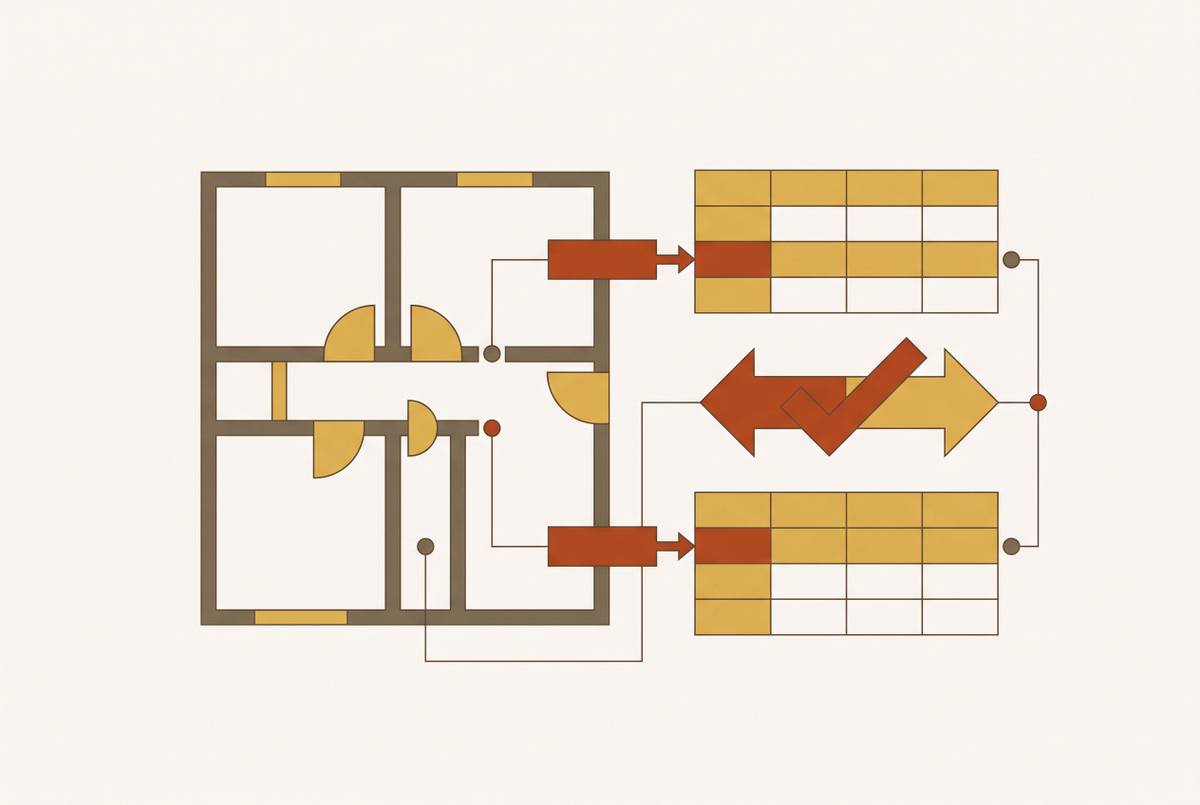
Simultaneous reconciliation changes the estimator's task from document assembly to conflict resolution. The schedule, floor plans, elevations, partition schedule, and 087100 spec are read as sources for the same openings. Handing from the plan and leaf count from the elevation become part of that shared opening scope. Wall type is tied to the plan's partition tag and checked against the partition schedule. Hardware assignments can then be evaluated against the sets the specification actually defines.
A tool that finds door symbols on a floor plan gives quantities, while reading the sources at the same time gives quantities along with the places where the documents disagree. In the simultaneous workflow described here, the straightforward ninety percent of a bid package assembles without manual intervention. The estimator receives the exceptions that require expertise.
Those exceptions still require accountable decisions from the estimator. Determining which document governs a schedule-spec disagreement, or what to qualify in writing back to the architect, remains with the person whose name goes on the bid. Automation changes what is ready for that person to review, making the disagreement explicit during scope assembly from separate documents.
An opening recap also changes when pursuit decisions become possible. Count, hardware set count, project type, key system, access control, STC, lead-lining, and approved manufacturers can be available before the estimator opens a plan sheet. On a bid board constrained by estimating hours, identifying a job that is not worth pursuing before detailed review preserves time for the packages that warrant it.
Using reconciliation completeness as a pre-submission bid review standard
The practical standard is to review the reconciliation record before releasing the bid, rather than accepting the opening total as proof of completeness. That record should show the cross-document conflicts, how each was resolved, and which document was treated as governing. Unresolved requirements need written qualifications. Together, those records separate the scope included in the number from the questions that could not be settled before bid day.
For institutional work, the record should also confirm that both owner standards and the project spec were consulted. For the opening scope itself, wall-type and handing data should be traceable to the relevant plan and partition information. This source test asks whether the attributes controlling frame and hardware requirements came from the documents that actually provide them.
The Spearin doctrine offers contractors broad implied-warranty protection against document errors, subject to recognized limitations. But under design-build and certain GMP structures, the bidder must check whether the documents are accurate, so a documented reconciliation record has legal weight as well as making estimating easier. The pre-submission test remains practical. If the only record of review is a final door count, the unresolved risk remains in the documents for the field to address.