Estimator Blind Spots in Door Schedule Review and the Software Logic That Closes Them
Software flags missing door hardware connections that manual document review alone cannot catch.

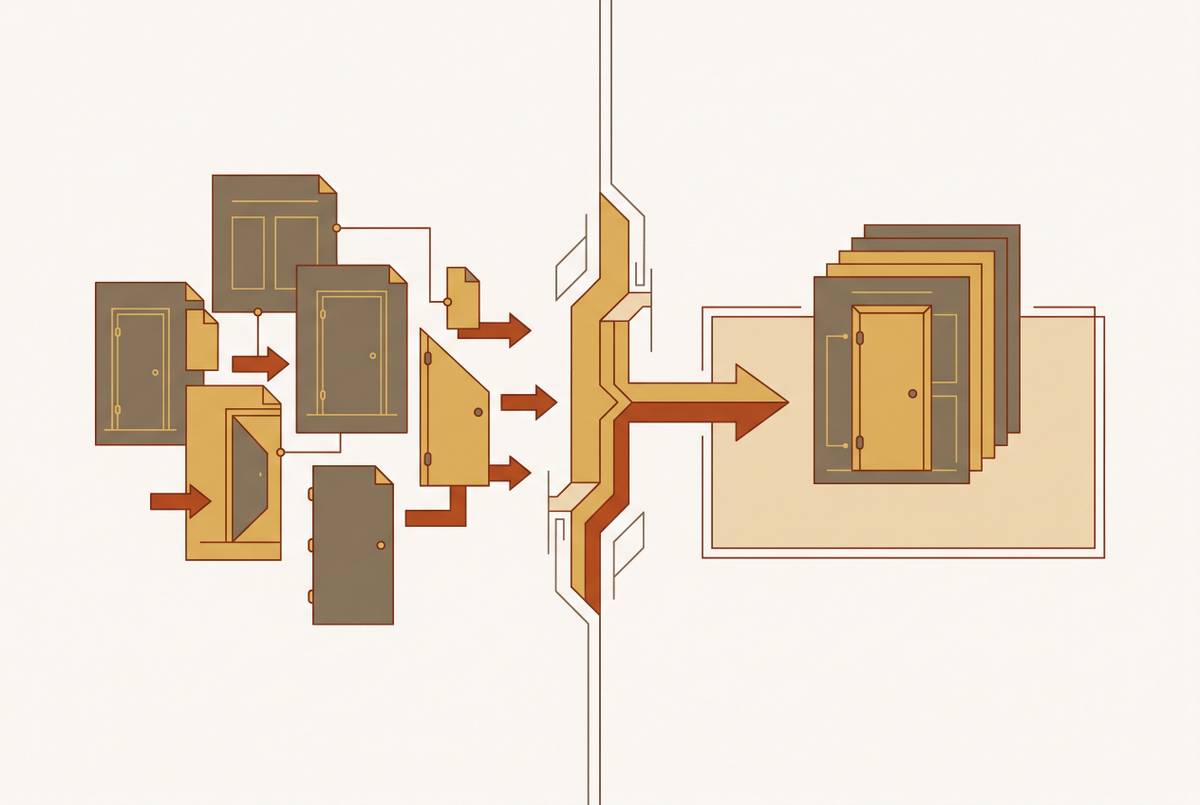
Catching door schedule omissions before bid submission requires reconciling the schedule with hardware sets, floor plans, elevations, partition schedules, specifications, and applicable owner standards. Software closes these blind spots when it reads the documents together and flags missing or conflicting relationships, rather than extracting each document accurately in isolation.
Why Division 8 bids fail at the boundaries between documents, not inside them
An estimator reconciles every scheduled opening with the hardware set count, yet the bid still prices a pair as a single leaf and leaves out electrified scope. The count is correct, but the price is not. The elevation shows the leaf count, while other specification sections state the access control requirements.
This is a boundary failure. An opening connects information distributed across drawings and specifications, and each connection can remain unresolved even when the individual documents have been read carefully. Wrong hardware, incomplete fire-rated assemblies, and unsuitable frame dimensions can all emerge from those unresolved connections. A totals check shows whether the quantities match, but it does not show whether the priced assembly fits the opening.
What each document in a Division 8 set actually contains, and what it deliberately leaves out
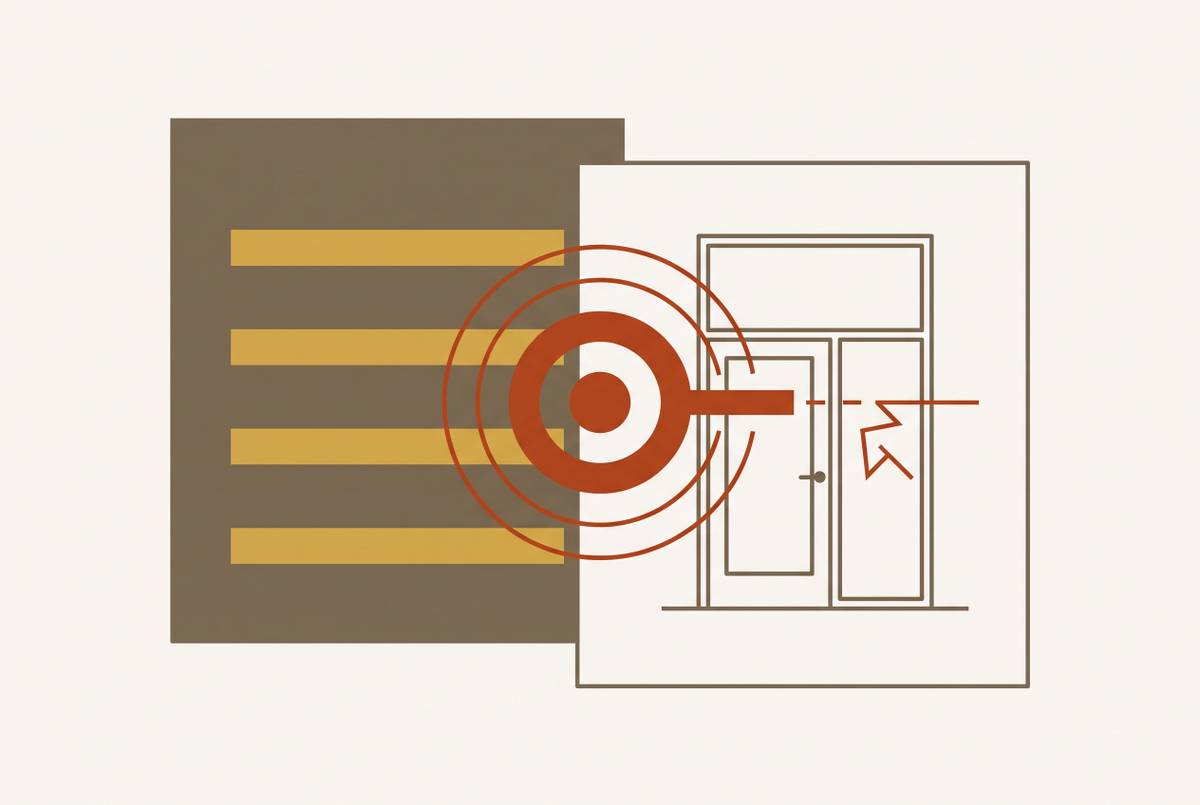
The door schedule is a table on the architectural drawings. It identifies openings by door number and records size, type, material, frame type, fire rating, glazing requirements, and assigned hardware group. Its remarks column may also list silencers, hinge quantities, vision lite locations, or threshold types. Those notes are part of the scope as well as instructions for installation. The table is an index to the opening, rather than a complete description of every condition affecting it.
The hardware specification in Section 08 71 00 lists what is in each hardware group. That includes hinges, locksets, closers, stops, seals, thresholds, silencers, and specialty items, with brand, model, function code, and finish. The group describes a package of components. It does not replace the opening count or explain the wall conditions a frame must fit. The schedule establishes how many openings receive HW-1, while the specification establishes what HW-1 supplies.
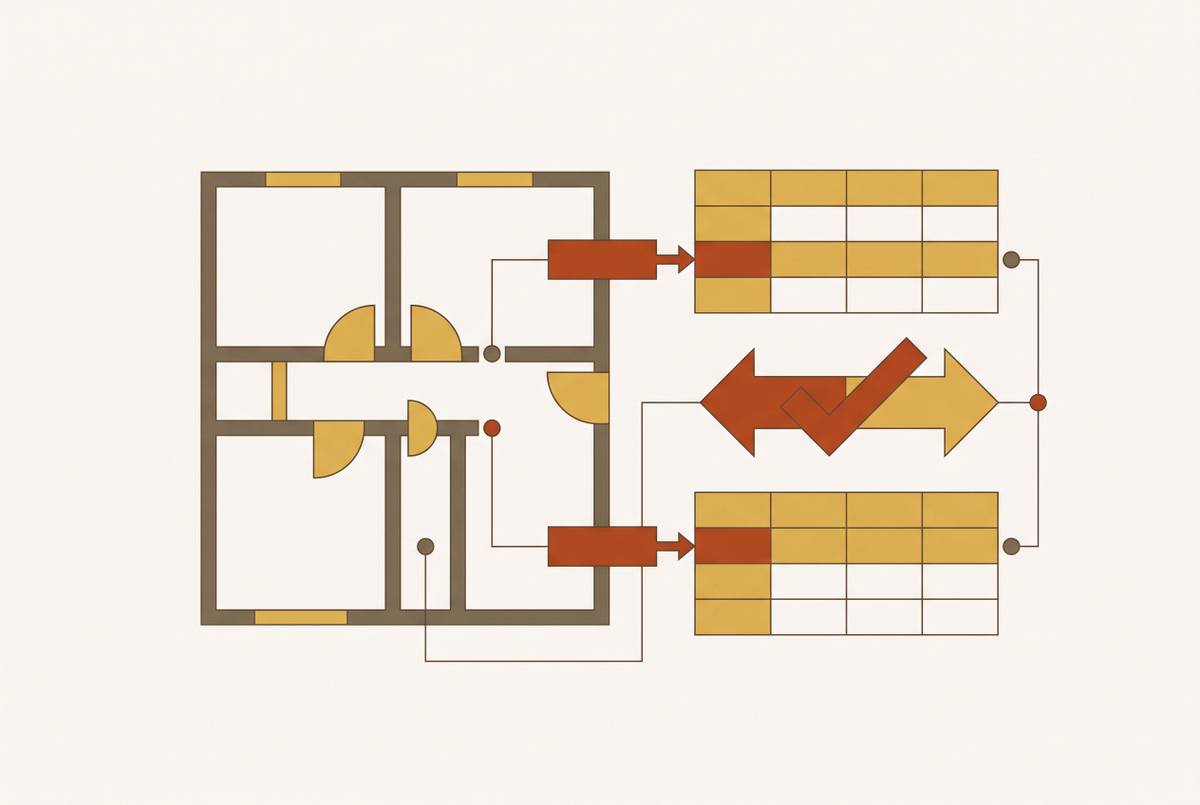
The floor plan locates an opening and shows handing, while the elevation establishes leaf count. The partition tag leads to the wall assembly, including its fire rating and STC. Frame throat depends on the total wall thickness, which includes more than the stud width. Because this information is not collected under one door-number entry, the estimator must connect it before the opening can become a purchasable assembly.
The six error types that live in those gaps, and why a careful single-document review still misses them
Wrong hardware set assignments arise when a valid group number points to a package unsuitable for the opening’s room function, fire rating, or accessibility requirement. The reference can look perfectly complete within the schedule. Its suitability becomes clear only when the group contents are compared with the opening’s conditions. Electrified scope can be missed in the same way when power supplies, wiring coordination, or access control integration are specified outside the material being counted.
A hardware package must meet the opening’s fire-rating and accessibility requirements, and a wall’s hourly rating is not the door’s label rating. Substitution language also has limits for fire-rated openings, life-safety devices, and specified-by-name items. Unreconciled revisions create a different failure mechanism. An updated schedule and an unchanged hardware count can each look correct on their own even though they describe different versions of the project.
Missed pairs and incorrect frame throat sizing complete the six error types. A schedule-only count can record one opening without recognizing the two leaves shown in its elevation. Likewise, a frame can be priced from stud width without including the board layers defined by the partition assembly. Both arise because a quantity or dimension was treated as complete before its controlling drawing was consulted.
These errors become more expensive when a mistaken relationship repeats. All doors assigned to the same hardware group receive identical hardware, so one wrong assignment repeated across dozens of openings multiplies the pricing error. With little time to bid, the estimator must also read drawings, apply life-safety and accessibility requirements, and price hardware that works together. The sequential review process can lead to errors even when the person performing it takes care.
How institutional owner standards add a layer of required knowledge that the bid documents don't repeat
Institutional owners, particularly universities and health systems, maintain standing requirements for hardware grades, approved manufacturers, keying systems, and finishes. These requirements do not always reappear verbatim in the project specification. The bid set can therefore be incomplete for pricing purposes even when every issued page is present. Project requirements define performance, while owner standards further restrict acceptable selections. A package can satisfy the stated fire rating, STC, positive-pressure, electrified hardware, and ADA requirements without satisfying the owner’s purchasing requirements.
The Rutgers Design Standards Manual, December 2018, has rules of its own. It requires wood doors to rooms where high-value items are stored to be solid doors without vision panels or sidelights. It also requires the A/E to review the door manufacturer list early and receive approval from the Owner’s Project Manager. Those requirements affect more than the hardware count. They constrain door configuration and manufacturer selection before the bid is submitted.
The owner-standard gap is therefore distinct from a contradiction between two bid documents. The missing requirement may sit outside both of them. An estimator working without the applicable standards is working from an incomplete information set, rather than merely overlooking a line in the specification. Simultaneous review can reconcile only the requirements available to it, so document completeness remains a condition of a complete bid.
Why the remarks column, pair detection, and wall-type cross-referencing are where manual review breaks down fastest
The remarks column concentrates scope that a fast quantity pass can easily bypass. Silencers, specific hinge quantities, vision lite locations, and threshold types may be recorded there, outside the main schedule fields. The Rutgers standard states that every door schedule must have a remarks/notes column. Reading it is only the first step. Its conditions must also be reconciled with the corresponding hardware package or door configuration, because an instruction can be present without being included in the price.
One opening can contain two leaves, and the elevation may be the document that establishes that fact. The opening count still balances against the schedule. If the takeoff treats the opening as a single leaf, the omission can remain hidden until hardware is ordered. The check must distinguish the number of openings from the number of leaves.
Wall-type cross-referencing adds a dimension problem to the same workflow. The partition tag identifies the assembly, and the partition schedule supplies the layers that determine total wall thickness. When the set does not state the total explicitly, the estimator must perform that arithmetic before sizing the frame throat. Stud width alone is not the ordering dimension. Each of these tasks requires leaving one document to resolve information in another, which is the repeated manual handoff that multi-document software can replace.
What software catches door schedule omissions that single-document tools miss?
Software can expose these omissions when its reading model includes the relationships among openings, hardware groups, elevations, and partition assemblies. A single-document tool can read a hardware group reference correctly without checking that the group is in the specification. It can also extract a frame type without resolving the wall assembly that determines throat depth. Accurate extraction is necessary, but it is not reconciliation.
A simultaneous read can compare plan openings with scheduled openings and flag doors that appear in only one source. It can also identify an opening that appears more times in the plans than in the schedule. Those are different discrepancies from an incorrect grand total. The same relationship model can flag a hardware set reference that has no definition or an opening assigned to two conflicting sets. Handing, leaf count, and wall type can then come from their controlling documents.
Instead of leaving the estimator to search the set for whatever might explain an incomplete entry, the comparison identifies the opening and the conflicting or missing relationship. It makes the unresolved connection visible for review, so the estimator can distinguish an absent hardware set from an unsuitable assignment or a missing leaf count.
General-purpose tools can still help with the information they extract. They fall short when they have no model that links hardware groups to openings or partition tags to frame dimensions. Software therefore needs to be evaluated on whether it performs those comparisons. Division 8 has its own terminology and reconciliation logic, so reading documents alone cannot take the place of an opening-based model.
What a fast first read of the document set is worth before a single count is taken
The first read is also a bid-or-no-bid decision. Key system requirements, access control scope, STC, lead-lining, pair doors, approved manufacturers, and hollow metal versus wood construction reveal whether a project fits the shop’s capabilities and supplier relationships. These are screening variables before they become takeoff details. A fast read helps with this decision only if it brings those requirements together, since the reason to turn down a project may be outside the door schedule.
An estimator who can rule out a job in minutes preserves hours for work the shop can pursue. Access control outside the contractor’s scope or an approved manufacturer list that conflicts with supplier relationships can justify that decision before a detailed count. Distributors and smaller operators with few estimating staff can get the same first read that a larger estimating department can provide by assigning more staff. The benefit is more jobs receiving complete, accurate prices within the bid window, rather than more effort spent on unsuitable opportunities.
Closing the loop: what a defensible Division 8 bid looks like when the gaps have been reconciled
A defensible takeoff records more than an opening total. It has an opening count reconciled against the schedule and plans, with leaf counts recorded separately and handing drawn from the floor plan. Wall type and throat depth come from the partition assembly. Hardware assignments correspond to defined sets, with conflicts resolved and owner requirements reflected in selections. Each opening has a basis for its price.
Substitution decisions belong in that same record. “Or equal,” “or prior approved,” and “no substitution” cannot be interpreted apart from the opening’s fire-rating and life-safety requirements. Fire-rated openings and life-safety devices have hard limits that general substitution language does not override. The decision therefore depends on reading specification language against the assigned opening conditions. Leaving that comparison until submittal leaves part of the bid’s product basis unsettled.
The practical handoff is a reconciled takeoff with a record of what conflicted and how it was resolved. Otherwise, hardware distributors and consultants find those conflicts when they compare the door schedule with the specification during submittal. By that stage, inconsistencies can become delays and change orders. A gap caught before bid submission can be reflected in the price and selection record, while the same gap caught at submittal costs time and credibility. The estimator hands over both the number and the decisions that support it.