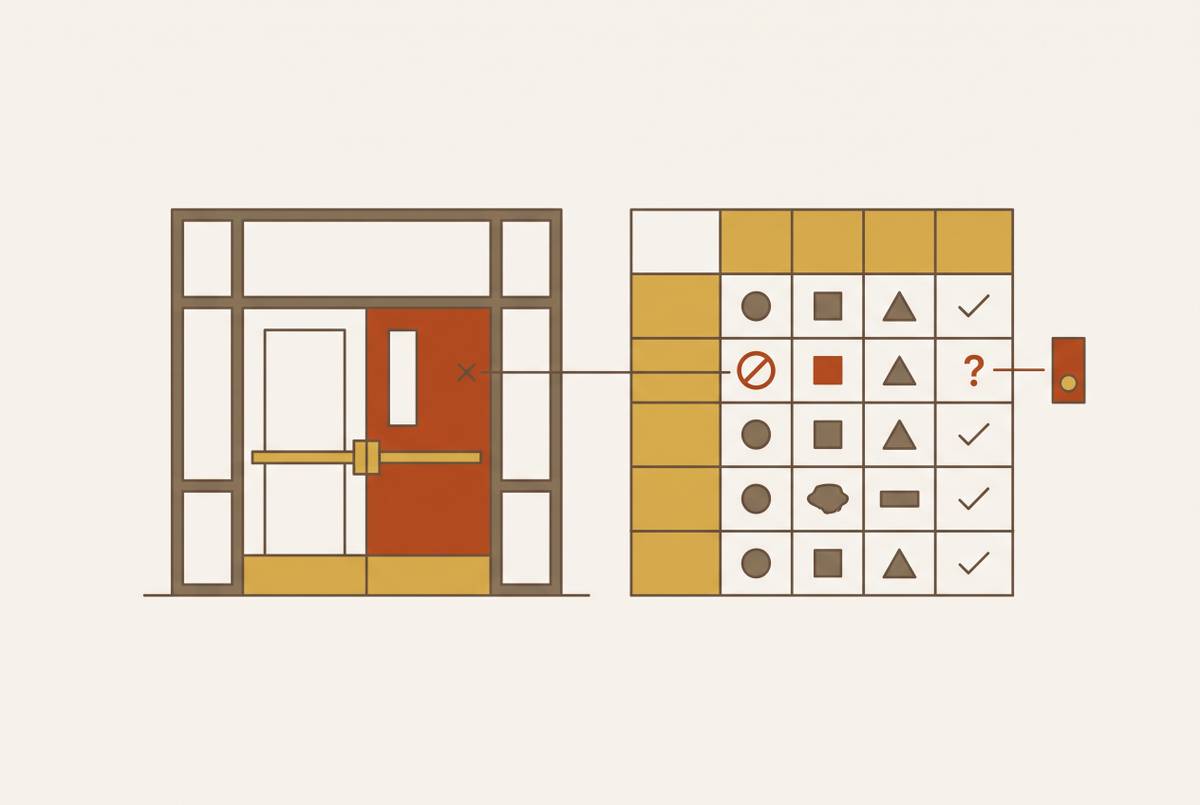
Field-Stage Door Schedule Failures as an Underwriting Signal Traced to Sequential Document Review at Bid Time
Sequential document review at bid time creates field failures in door and hardware coordination.

To reconcile the door schedule with floor plans and specs at the same time, each opening must be checked against its hardware group, location, rating, and owner requirements before it is priced. Purpose-built Division 8 AI-assisted takeoff can make that cross-reference practical within a bid window. Field-stage failures such as wrong hardware, mismatched frames, and missed fire-rated openings can originate in sequential document review, making the bid workflow a leading indicator of field risk.
Why Division 8 estimating is structurally different from every other CSI division
Division 8 pricing depends on how three sets of documents fit together: the architectural door schedule, the hardware specification in Section 08 71 00, and the floor plans where door tags appear. CDF Distributors explains that the door schedule is a table on the architectural drawings. Each row represents an opening and assigns it to a numbered hardware group. That group is the bridge between drawing and specification. The schedule identifies the group, while the specification defines its hinges, lockset function, closer, seals, threshold, electrified components, and specialty items.
An opening therefore cannot be priced reliably as an isolated schedule entry. Its hardware must fit the room function, door dimensions, frame profile, and the rating that applies. On large projects, hundreds or thousands of openings and repeated drawing revisions mean there is more to reconcile as room functions change. A lockset with the wrong function, an exit device that does not fit the door width, or a closer that cannot mount on the frame produces rework, and an error in a shared hardware set propagates to every opening assigned to it.
How sequential document review turns a process choice into a hidden scope gap
Under a tight bid window, an estimator may review floor plans first, the door schedule second, and the hardware specification last, if time permits. Each pass can appear complete on its own. Yet the estimate remains incomplete if no step reconciles the documents against one another before the price is submitted.
The resulting omissions follow recognizable patterns across the document set. Doors can be missed on enlarged plans or counted twice where sheets overlap, and hardware groups can be assigned without a check of the room function or fire rating. Electrified scope introduces another set of dependencies. Power supplies, wiring coordination, and access control integration may be absent from the price even when the scheduled hardware appears accounted for. Required manufacturers, grades, and keying systems can also disappear when owner standards are not reconciled with the project specification.
A revised door schedule may not produce a corresponding change in hardware quantities, while a listed hardware set may fail the fire-rating or accessibility requirements of its assigned opening. The tender can still look complete because the gap lies between documents. More effort does not repair that architecture. An estimator may understand drawings, codes, hardware compatibility, and electrified access control, but applying that knowledge in disconnected passes leaves the decisive relationships untested.
Fire-rated openings as the highest-stakes version of the sequential-review failure
Fire-rated openings turn an incomplete cross-reference into a life-safety and compliance risk. A hardware set may appear acceptable in the specification yet be incompatible with the rated assembly to which the schedule assigns it. A schedule can also assign non-labeled products to an opening that needs labeled products to meet its rating. Reading the hardware group without its scheduled opening and plan context does not establish that the installed assembly will comply.
NFPA 80 inspection criteria make that relationship concrete. Clearances at the head, jambs, meeting stiles, and bottom of the door vary by door type and rating, so physical installation alone does not establish compliance. The dimensions called for in the specification must agree with the assembly in the schedule. Inspection tests the opening. Where the bid process failed to reconcile those requirements, inspection can reveal a conflict that remained concealed through pricing and procurement.
The consequence is not merely an adjustment to paperwork. Incompatible hardware or non-labeled products can require replacement hardware, rework labor, and schedule disruption late in the project. A change order does not make the assembly compliant. The opening still has to satisfy the applicable requirements, regardless of how the parties allocate the cost.
How institutional owner standards multiply the reconciliation surface at bid time
Institutional work adds owner standards on top of the project specification, so more documents must agree before the work is priced. The hardware schedule must be prepared by or under the supplier’s supervision and coordinated with doors, frames, and related work for size, thickness, hand, function, and finish. An estimate based only on the project specification can therefore omit a mandatory condition even when its quantities and hardware groups are otherwise correct.
University of Alabama’s Division 08 71 00 owner standards require DHI sequence and format and coordination of submittals with door and frame fabrication. The standards also require contact with the university’s Public Safety Data Administration for electronic security hardware requirements. That is a separate coordination obligation at bid time. Pricing general electrified hardware without accounting for the university’s requirements can leave a package exposed to rejection at submittal.
University of Southern California’s Health Sciences Campus specification, Section 087102, also mandates DHI sequence and format, double-spaced entries, and numbered and dated pages. The specification requires the final hardware schedule at the earliest possible date, particularly where approval must precede fabrication of other work critical to the construction schedule. Timing is part of the coordination requirement.
Case Western Reserve University’s Facilities Standards require design around owner preferred manufacturers unless the owner authorizes otherwise in writing. A substitute priced without that authorization creates a bid that cannot be executed as priced. The manufacturer choice is not freely interchangeable. A sequential process may reach the project hardware specification without ever bringing the separate owner requirements into the pricing decision.
Where the bid-time gap surfaces in the field and who absorbs it
The contractor bears the primary bid risk when required scope is absent from the estimate. A GC pricing hardware from the door schedule alone can miss BHMA grade callouts, fire-rating specifics, finish premiums, and no-substitution requirements in the full Division 08 specification. The bid is low, but procurement exceeds it. Keying setup and hardware schedule revisions introduce further costs when they were not included in the original price.
Distributors encounter the gap at a different stage. CDF explains that inconsistencies between door schedules and hardware specifications are common sources of delays and change orders, and that distributors and consultants review those documents against each other during submittal. Their review may reveal the conflict before installation, but by then the contractor is already bound to the bid price. Repricing and restocking friction can follow, although that does not establish that the distributor bears the contractor’s underlying bid loss.
Missed electrified scope can also cause delays because electrified hardware has long lead times. If the omission delays ordering, the GC faces expediting fees or lost schedule, and an original-bid omission is not a recoverable scope change simply because it is discovered later. Quantity presentation can also obstruct reconciliation before installation. Door hardware professional Emilio Bendever reported a related coordination problem in 2025 when an estimating platform gave total quantities across all openings. Customers and architects then had to calculate the per-door quantities themselves, showing how an apparently complete quantity output can still leave essential coordination unresolved.
Reading a bid process as a leading indicator of field risk
For underwriters and risk-aware owners, this causal chain makes the bid workflow an observable risk characteristic. Repeated post-award scope additions, submittal rejections, and rework on rated openings need a closer look because they are the kinds of problems that incomplete reconciliation can cause. A single event offers limited insight into a contractor’s process, but recurring hardware-schedule-driven cost growth points toward a repeatable failure. The relevant distinction is whether the contractor consistently discovers required scope before or after committing to a price.
That distinction changes how project history can be interpreted. A contractor with repeated rated-opening rework presents a different risk profile from one with clean submittals and no post-award scope growth. Both may submit a detailed estimate. The detail alone does not reveal whether the schedule, plans, hardware specification, and owner requirements were reconciled before pricing. Process transparency connects the estimate to the outcomes that follow it, making the contractor’s controls more legible to those assessing risk.
The lesson for an underwriter or owner is to examine the review method as well as the price. The review can ask how document sets are checked, whether schedules are reconciled against specifications before pricing, and how owner standards are found. Contractors who make their process clear and work to manage risk are in a better position to seek favorable coverage and terms, while those with weaker controls may face higher premiums, limited capacity, or exclusions. This is a claim that a specific, recurring source of field loss deserves a specific place in risk assessment.
How to cross-reference door hardware specs with floor plans and schedules simultaneously
Parallel review treats each opening as the unit of reconciliation rather than treating each document as a separate task. The door tag on the plan is read against the schedule entry, which is read against the assigned hardware group and the applicable owner requirements. Frame types must agree with the drawings. Door dimensions, frame profiles, room functions, ratings, and hardware components are evaluated as parts of the same assembly before pricing.
The technical demands remain substantial even when the workflow is correct. DHI’s Architectural Hardware Consultant credential includes a five-hour in-person session in which candidates develop complete hardware sets and door schedules. That task is part of a three-part examination. The examination shows the specialized skill needed to make codes, ratings, functions, and hardware requirements agree, beyond the work of extracting quantities. BHMA certification grades, including Grade 1, Grade 2, and Grade 3, are set by accredited standards covering cycle, operational, strength, security, and finish requirements, so grade callouts belong in the opening-level review.
AI-assisted takeoff makes it easier to meet this standard within short bid windows. Purpose-built Division 8 platforms can process door schedules, hardware specifications, floor plans, and owner standards simultaneously, surfacing conflicts before pricing becomes a procurement commitment. Quantity extraction alone does not answer whether a frame type agrees with the drawings or whether a hardware group suits the rated opening assigned to it. Software evaluation should therefore turn on that distinction.
For distributors, earlier reconciliation changes submittal from discovery toward confirmation. For contractors, it moves the resolution of missing or incompatible scope ahead of the bid rather than leaving it to procurement or installation. Underwriters gain a more specific process signal. Documented reconciliation, clean submittals, and no post-award scope additions on rated openings connect the contractor’s stated method to its project outcomes, providing a firmer basis for assessing risk than the submitted price alone.